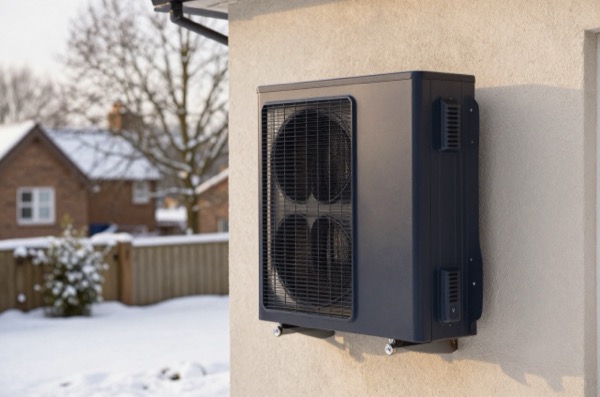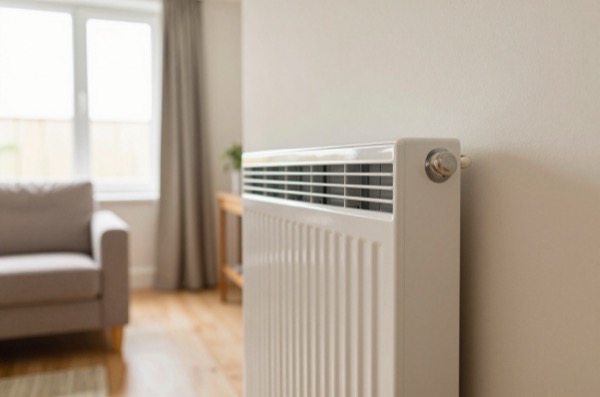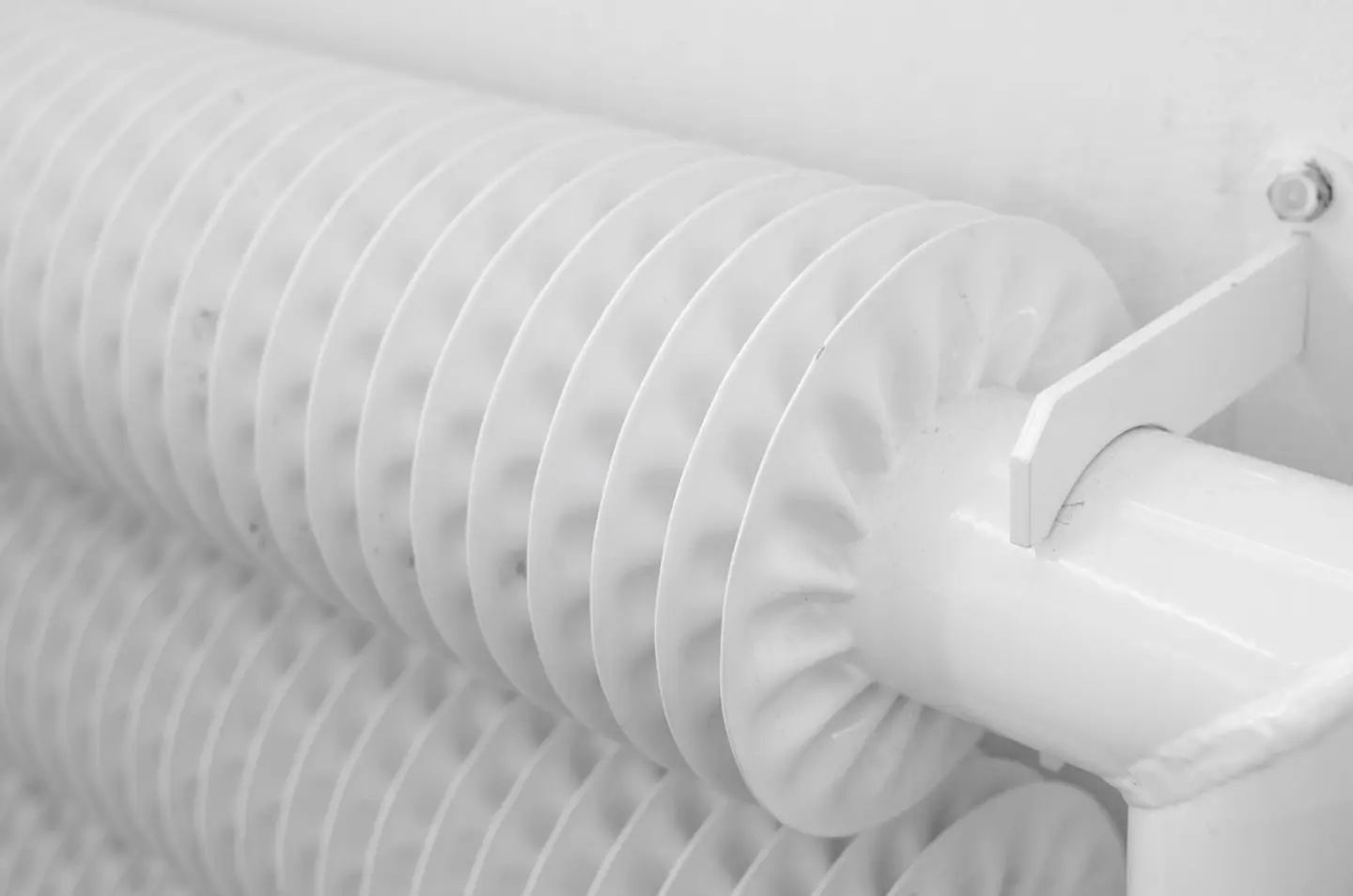
Fan assisted radiators (also called fan convectors or active radiators) use a small built-in fan to force air across the heat exchanger, significantly increasing heat output compared to a passive radiator of the same dimensions. In the UK in 2026, a single unit costs £150–£600 to supply and £350–£900 fully installed. They are most commonly installed in homes switching to heat pump heating, where flow temperatures are lower than a conventional gas boiler and standard radiators may be undersized.1
For homes with air source or ground source heat pumps, fan assisted radiators can be the difference between a comfortable home and an underheated one, without the disruption and cost of replacing every radiator.
How Fan Assisted Radiators Work
A standard (passive) radiator heats a room primarily by convection, air warms naturally at the radiator surface and rises, creating a slow circulation. A fan assisted radiator adds a low-wattage fan (typically 3–20 W) that draws cool air across the fins continuously, dramatically increasing the rate of heat transfer.
The practical effect is more heat from the same size of radiator at a low flow temperature. Myson, for example, states that its Ulow-E2 uses in-built fans to produce heat outputs up to 60% more than traditional radiators.2 This matters because:
- Heat pumps run more efficiently the lower the flow temperature, so a system that can heat the house at around 45°C or below will usually achieve a better Coefficient of Performance (COP) than one forced up to 55°C or more
- Old homes with undersized radiators cannot always be upgraded with larger panels due to space constraints; fan assisted units solve this in the existing footprint
The fans operate quietly at low speed during normal heating, and a well-designed unit is typically quoted at around 25–35 dB(A), comparable to a library or quiet office. At full speed, noise typically rises to 40–50 dB(A).
Unit and Installation Costs
Supply-only prices (2026)
| Radiator type | Output range | Supply cost per unit |
|---|---|---|
| Standard fan convector (horizontal, wall-hung) | 1,000–2,500 W | £150–£350 |
| Premium fan assisted panel radiator | 1,500–4,000 W | £280–£6003 |
| Fan convector (vertical, space-saving) | 1,500–3,000 W | £200–£450 |
| Plinth heater (fan convector under kitchen units) | 500–1,500 W | £120–£280 |
| Fancoil unit (ceiling or floor cassette) | 2,000–6,000 W | £350–£800 |
Installed costs (inc. VAT, labour, and materials)
| Scenario | Cost per radiator |
|---|---|
| Swap-out existing radiator (same position, existing pipework) | £350–£550 |
| New installation (new pipework run from manifold or flow/return) | £550–£900 |
| Plinth heater installation (kitchen, under units) | £300–£500 |
| Whole-house installation (5–8 radiators, project rate) | £280–£480 per radiator |
Installation requires a plumber or heating engineer. The fan element needs a mains electrical connection (the fan runs on 230V or low-voltage 12/24V depending on model), a qualified electrician must connect this if it involves new wiring. Most units are designed for a simple spur from a nearby socket circuit.
Labour rates for heating engineers in the UK run £45–£75/hour in 2026 (£70–£110/hour in London), with a swap-out taking 2–3 hours and a new installation taking 3–5 hours.
Energy Savings and Payback
The energy saving from fan assisted radiators is indirect, it comes from allowing your heat pump (or condensing boiler) to operate at lower flow temperatures, which improves system efficiency.
For heat pump users: reducing flow temperature from 55°C to 45°C typically improves SCOP by 0.3–0.7. For a home using 15,000 kWh of heat per year with electricity at 26.32p/kWh, the capped unit rate for 1 October to 31 December 2026:4
- At SCOP 2.8 (55°C flow): ~5,360 kWh electricity = £1,410/year
- At SCOP 3.4 (45°C flow): ~4,410 kWh electricity = £1,161/year
- Annual saving: ~£249
At this saving rate, a whole-house installation of 6 fan assisted radiators at £450 each installed (total £2,700) pays back in roughly 11 years. The payback is faster if electricity prices rise, if the home is poorly insulated and previously required high flow temperatures, or if the heat pump system is oversized (running at low load, where lower flow temperatures benefit efficiency most).
For gas boiler users: the energy saving is more modest, a condensing boiler already achieves high efficiency at 55°C flow; reducing to 45°C offers a marginal improvement. Fan assisted radiators are rarely cost-justified for gas heating alone.
Comparison: Fan Assisted vs Standard Radiators
| Factor | Standard panel radiator | Fan assisted radiator |
|---|---|---|
| Heat output at low flow temperature | 100% baseline | Up to about 160% of equivalent sized panel |
| Noise | Silent | 25–50 dB(A) depending on fan speed |
| Electricity consumption (fan) | None | 3–20 W per unit |
| Response time | Slow (10–20 min) | Fast (2–5 min), fan boosts warm-up |
| Installation complexity | Simple | Requires electrical connection |
| Unit cost (mid-range, 2,000 W) | £80–£200 | £220–£450 |
| Maintenance | None | Fan requires occasional cleaning; motor life 20,000+ hours |
| Compatibility with heat pumps | Often undersized at low flow temps | Optimised for 35–55°C flow |
For a home installing a new heat pump, the upfront cost comparison is relevant: fitting fan assisted radiators is typically cheaper than upsizing every standard radiator (which may also require new pipe runs if the old radiators were sized for 70°C+). Get a heat loss calculation done first, it will show which rooms need additional output and which existing radiators are adequate.
Grants and Financial Support
Boiler Upgrade Scheme (BUS): the £7,500 grant for an air source or ground source heat pump covers the heat pump unit and core installation but does not specifically ring-fence funding for radiator upgrades.5 However, a MCS-certified installer who includes fan assisted radiators as part of a heat pump installation package may include them in the overall quoted cost covered by the grant. Confirm this with the installer before signing a contract.
Great British Insulation Scheme (GBIS) and ECO4: GBIS closed on 31 March 2026 and is no longer taking applications,6 and ECO4 runs only to 31 December 2026.7 ECO4 funds measures such as insulation or heating upgrades for low-income, fuel-poor and vulnerable households, rather than radiator upgrades on their own.7
Local authority schemes: some councils in England operate discretionary warm homes funds that can support heating upgrades for low-income households. Eligibility varies, check your council’s website or call the government’s Find Ways to Save Energy in Your Home helpline on 0800 098 7950.8
Heat pump tariffs: switching to a time-of-use electricity tariff designed for heat pump users (such as those offering off-peak overnight rates) can meaningfully reduce running costs and improve the financial case for the whole system upgrade, including fan assisted radiators.
Pros and Cons
Advantages:
- Significantly higher heat output per radiator compared to equivalent passive panel at low flow temperatures
- Enables heat pump systems to run efficiently without oversizing every radiator
- Fast warm-up response time, as the fan moves warm air into the room faster than passive convection
- Smaller footprint than an equivalent output standard radiator (useful in small rooms or hallways)
- Compatible with existing wet central heating pipework in most cases
Disadvantages:
- Higher purchase cost than equivalent passive radiator
- Requires electrical connection, adds to installation cost and means the radiator draws a small amount of electricity even at low fan speeds
- Fan noise, though low, is audible in quiet rooms, a consideration for bedrooms
- More components to potentially fail (fan motor, electronic controls)
- No financial benefit in gas-heated homes without heat pumps
Do You Need All Radiators Upgraded?
A whole-house swap-out is rarely necessary. A competent heating engineer or MCS installer will carry out a room-by-room heat loss calculation and identify which rooms are undersupplied at your target flow temperature. Typically, 2–4 radiators in the largest or poorly-orientated rooms need upgrading; the rest can remain as standard panels. Prioritise:
- Living rooms and open-plan kitchen/diners (high heat demand, often existing radiators are borderline)
- Bathrooms (towel rails are notoriously poor at low flow temperatures, a fan convector under a bath panel or a fan-assisted towel rail is a common solution)
- Rooms with single-glazed windows or poor insulation (higher heat loss means higher demand)
A professional heat loss survey costs £150–£400 for a full property assessment and is essential before any heating system upgrade. Many MCS-certified heat pump installers include this in their survey cost.
References (8)
Figures in this note were checked against the sources below on 30 September 2026. Superscript numbers in the text point to them. Every source the site cites, by topic.
- 1technicalfairEnergy Saving Trust.RN-X9NXFYEnergy Saving Trust advice page on air source heat pumps, giving the typical installed cost for a UK home.
- 2technicalsupplier figureMyson, guidance.RN-0IX617Myson's product article on its Ulow-E2 heat pump radiator. The maker states that in-built fans give forced convection and heat outputs up to 60% more than traditional radiators.
- 3costsupplier figureToolstation.RN-QVHDQ0A price, true at 2026-09. the retail price Toolstation publishes for Kudox Premium Type 22 Steel Panel Radiator 600 x 1200mm 7208Btu, which is the supply figure the cost book records for this item
- 4technicalvery strongOfgem.RN-YYE8U2The live source for any running-cost sum in a heating note. For 1 October to 31 December 2026 the direct debit cap is 26.32p per kWh for electricity with a 54.83p daily standing charge, and 7.97p per kWh for gas with a 29.68p daily standing charge, giving a typical annual dual fuel bill of £1,723, a 4% rise on the previous period. Ofgem states these are the average unit rate and standing charge for direct debit customers in England, Scotland and Wales; gas prices include 5% VAT while electricity carried no VAT in this period. The cap is reset every three months, so any note quoting a pence-per-kWh figure should be dated against this page.
- 5technicalvery strongGOV.UK.RN-9EFNVZThe grant values: £7,500 towards an air source heat pump, £7,500 towards a ground source heat pump including water source heat pumps and those on shared ground loops, and £5,000 towards a biomass boiler. A further £1,500 is available until March 2027 where the property is heated by oil or LPG and has no mains gas connection. Only one grant is available per property. Capacity limits are 45kWth for an individual system, 70kWth for multiple heat pumps and 300kWth for shared ground loops. Hybrid systems pairing a gas boiler with a heat pump are not eligible, and an existing low carbon heating system cannot be replaced under the scheme.
- 6technicalvery strongOfgem.RN-RDOIJRThe scheme, formerly known as ECO+, ran from April 2023 to 31 March 2026 and is now closed. It obliged medium and large energy suppliers to deliver measures reducing energy use in the least energy-efficient homes in Great Britain. Eligibility was homes with an EPC rating of D to G in Council Tax bands A to D in England, or A to E in Scotland and Wales, plus low-income and vulnerable households. Unlike ECO4, which funds whole-house packages, GBIS mostly delivered a single insulation measure per home. This is the page to cite when a note has to say a grant route has closed rather than leave a reader chasing it.
- 7technicalvery strongOfgem.RN-FPPUSLECO4 is the fourth phase of the Energy Company Obligation across Great Britain. It applies to measures installed from 1 April 2022 and runs until 31 December 2026 following a nine-month extension; ECO3 closed on 31 March 2022 and ECO4 came into force in July 2022. The scheme places a Home Heating Cost Reduction Obligation on medium and large energy suppliers to promote measures that improve the ability of low-income, fuel-poor and vulnerable households to heat their homes, funding insulation and heating upgrades for both homeowners and tenants. Ofgem also lists the Great British Insulation Scheme as a separate obligation on this page.
- 8technicalvery strongGOV.UK, guidance.RN-5338K3The government's own recommendation tool, and the neutral link a DIY insulation note should offer instead of a comparison site. It gives personalised home improvement recommendations for property owners in England and Wales, and for each suggestion shows an estimated cost of making the improvement and how much could be saved on bills. It cross-refers to the Boiler Upgrade Scheme, the Warm Home Discount Scheme and the Winter Fuel Payment. A telephone helpline is available Monday to Friday 8am to 6pm except bank holidays, and Saturday 9am to 12pm. The page itself carries no eligibility criteria or scheme figures, so a note quoting grant values must cite the individual scheme pages rather than this one.
-
Air source heat pumps: costs, savings and benefits, Energy Saving Trust, accessed 30 September 2026. energysavingtrust.org.uk
-
Ulow-E2 heat pump radiator, Myson, accessed 30 September 2026. myson.co.uk
-
Kudox Premium Type 22 Steel Panel Radiator 600 x 1200mm 7208Btu, Toolstation, accessed 30 September 2026. Priced at 2026-09, so no calibration is needed. toolstation.com
-
Energy price cap unit rates and standing charges, Ofgem, accessed 10 September 2026. ofgem.gov.uk
-
Apply for the Boiler Upgrade Scheme: what you can get, GOV.UK, accessed 10 September 2026. gov.uk
-
Great British Insulation Scheme, Ofgem, accessed 10 September 2026. ofgem.gov.uk
-
Energy Company Obligation (ECO), Ofgem, accessed 10 September 2026. ofgem.gov.uk
-
Find ways to save energy in your home, GOV.UK, accessed 10 September 2026. gov.uk