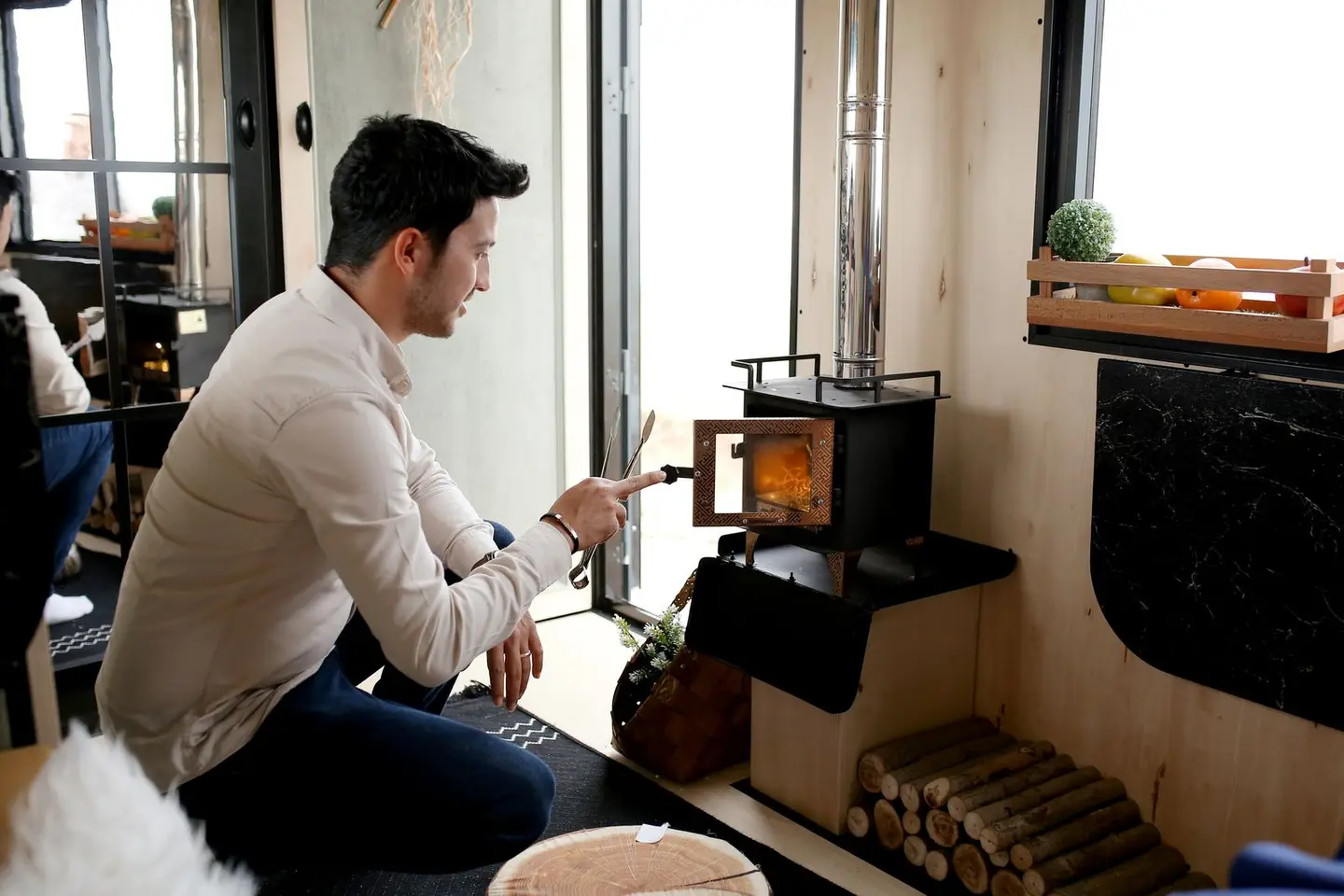
A wood burning stove can cut heating bills, add character to a living room, and provide a reliable heat source during power cuts, but it is one of the more regulated home improvements you can undertake. Get it wrong and you risk a chimney fire, a failed building control inspection, or a £1,000 fixed penalty in a smoke control zone. Get it right and you have an efficient, compliant appliance that can last 25 years.
This guide covers realistic 2026 UK costs, the HETAS registration system, Defra exemptions, smoke control zone rules, and the Building Regulations that apply.
How Much Does a Wood Burning Stove Cost?
Costs vary significantly depending on the appliance output, whether your chimney needs lining, and your location.
| Item | Typical Cost Range |
|---|---|
| Small stove (3–5 kW), appliance only | £800–£1,800 |
| Mid-range stove (5–8 kW), appliance only | £1,200–£2,500 |
| Premium stove (8–12 kW), appliance only | £2,500–£3,500+ |
| Flexible stainless steel flue liner (6 m length) | £200–£500 |
| Twin-wall insulated flue system (no chimney) | £600–£2,000 |
| Hearth construction (if required) | £200–£600 |
| Register plate and gathering | £150–£350 |
| HETAS-registered installation (labour) | £500–£1,200 |
| Total installed cost (typical) | £1,800–£6,000 |
London and South-East rates sit at the top of these ranges. Rural areas in Wales and the North are lower. Do not confuse stove kW output with room size carelessly, an oversized stove run at low burn is inefficient and produces more particulates.
Sizing Your Stove
A rough rule of thumb for a well-insulated modern room:
- kW needed ≈ Room volume (m³) ÷ 14
So a 30 m³ lounge needs approximately a 2.1–3 kW nominal output. Most installers recommend 4–5 kW as a practical minimum because very small stoves can be hard to regulate. Avoid specifying above 8 kW in a standard living room unless you have an exceptionally high ceiling or open-plan space, you will be constantly throttling it, which causes condensation in the flue.
HETAS: What It Is and Why It Matters
HETAS (Heating Equipment Testing and Approval Scheme) is the UK government-authorised body for solid fuel heating systems. A HETAS-registered engineer can self-certify installations under the Competent Persons Scheme, meaning they notify building control on your behalf, you do not need a separate building control application.
If you use a non-HETAS installer, you must apply to your local authority building control (LABC) separately (fee: typically £200–£400) and arrange an inspection. An unnotified installation is a legal issue when selling the house.
Always ask for the HETAS notification certificate. Keep it with your property documents.
Building Regulations That Apply
Wood burning stove installations in England and Wales are notifiable under Building Regulations Approved Document J (Combustion Appliances and Fuel Storage Systems).1
Key requirements:
- Flue liner: existing masonry chimneys must be lined with a flexible stainless steel liner (316 grade minimum; 904 grade for high-sulphur fuels). This is mandatory, not optional, for new appliance installations.
- Hearth: a non-combustible hearth must extend at least 300 mm in front of the stove door and 150 mm to each side, minimum 125 mm thick (or 250 mm if the underfloor is combustible).
- Clearances: minimum 150 mm from the stove body to any combustible material (check manufacturer spec, some require more).1
- Ventilation: rooms with a total floor area under 40 m² and sealed double glazing may need a dedicated air vent. Approved Document J sets the calculation method; as a rule of thumb, any room under 8 m² requires a purpose-built air brick.1
- Carbon monoxide alarm: CO alarm is mandatory in any room with a solid fuel appliance (Approved Document J amendment, 2010, still in force). Combination smoke/CO alarms are acceptable.1
Smoke Control Zones
Roughly 20% of UK properties fall within a declared Smoke Control Area, these cover most city centres and many suburban areas designated by local councils under the Clean Air Act 1993.
In a smoke control zone:
- You may not burn ordinary wood or house coal.
- You must use either a Defra-exempt appliance (an approved stove tested to produce less than 5 g/hour of smoke) or an Authorised Fuel (Smokeless coal, briquettes, or kiln-dried wood used in an exempt appliance).
Ask your local council whether your address sits in a smoke control area, which is how GOV.UK now says to check it, and read the rules and penalties before purchasing. Most reputable stoves sold in the UK from 2022 onwards are already Ecodesign 2022-compliant and Defra-exempt, but confirm before buying.
Ecodesign 2022: since 1 January 2022, all new solid fuel appliances sold in the UK must meet the Ecodesign standard, maximum 3 g/hour dust emissions and minimum 75% efficiency. If you see a stove marketed as “Ecodesign Ready,” confirm it is the full 2022 compliant version.
Fuel: Only Burn Ready to Burn
Since May 2021, UK law prohibits the sale of freshly cut (wet) logs with moisture content above 20%. Use:
- Ready to Burn certified logs (green leaf logo), moisture content under 20%
- Kiln-dried logs, typically 12–18% moisture content
- Smokeless coal/anthracite (if burning coal, check manufacturer compatibility)
Burning wet wood is the single biggest cause of chimney tar and creosote build-up, which can lead to a chimney fire.
Maintenance
| Task | Frequency | Typical Cost |
|---|---|---|
| Chimney sweep | At least once per year (twice if burning frequently) | £60–£120 |
- Check door rope seal | Annual | £15–£30 DIY | | Firebricks inspection | Annual | Replace if cracked, £30–£80 per set | | CO alarm battery/test | 6-monthly | - |
Use a HETAS or NACS (National Association of Chimney Sweeps) registered sweep. They issue a cleaning certificate which some insurers require.
Pros and Cons at a Glance
| Pros | Cons |
|---|---|
| Visible, radiant heat, very comfortable | High upfront cost (£1,800–£6,000 installed) |
| Works during power cuts | Requires regular fuel storage |
| Can reduce gas heating bills | Not suitable for all locations (smoke zones) |
| 25+ year appliance lifespan | Annual sweep required |
| Adds value and appeal | Air quality impact if poorly operated |
References (1)
Figures in this note were checked against the sources below on 14 September 2026. Superscript numbers in the text point to them. Every source the site cites, by topic.
- 1technicalvery strongMinistry of Housing, Communities and Local Government.RN-IU0X2MThe 2022 amendments took effect 1 October 2022 and extended the carbon monoxide alarm provisions. Table 2 sets the minimum flue sizes: 200mm diameter for a fireplace with an opening up to 500mm by 550mm, 125mm diameter for a closed appliance up to 20kW burning smokeless or Clean Air Act compliant fuel, 150mm for other closed appliances up to 30kW and 175mm for those above 30kW and up to 50kW. Diagram 17 gives the flue outlet clearances: at or within 600mm of the ridge the outlet must be at least 600mm above the ridge, elsewhere on a roof it must be at least 2300mm horizontally from the nearest weather surface and either 1000mm above the intersection or as high as the ridge, and it must be 1000mm above the top of any openable rooflight or dormer within 2300mm. Bends must be no more than 45 degrees to the vertical and paragraph 1.49 limits a sweepable flue to four changes of direction.
-
Approved Document J, Combustion appliances and fuel storage systems, 2010 edition incorporating 2010 and 2013 amendments, Ministry of Housing, Communities and Local Government, accessed 14 September 2026. assets.publishing.service.gov.uk