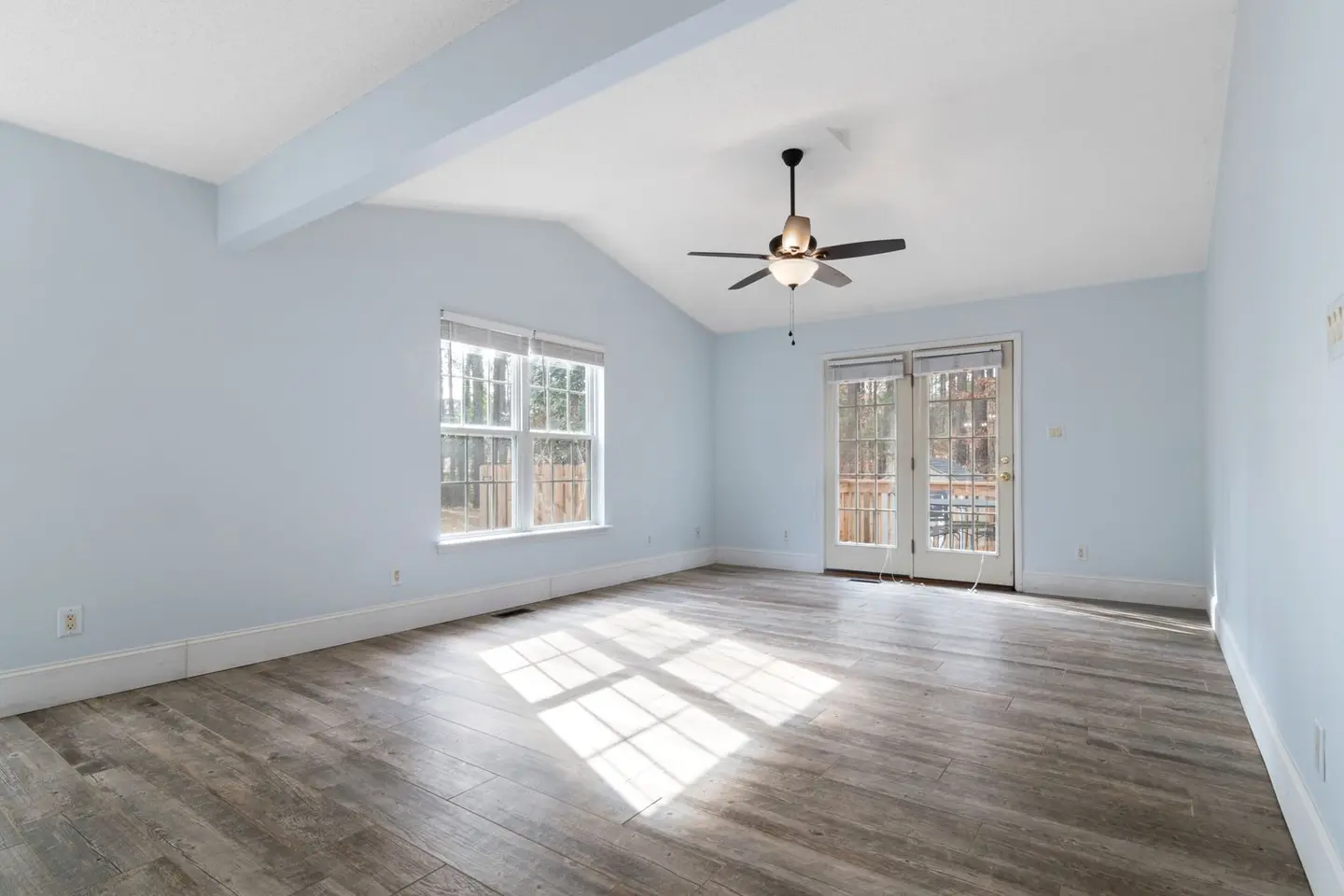
Installing a ceiling fan is one of the most effective ways to improve air circulation in UK summers and recirculate warm air in winter. Costs vary significantly based on whether existing wiring is in place, the ceiling height, and the type of fan chosen.
For a straightforward like-for-like installation at an existing ceiling rose, budget £150–£350 all-in. For rooms without an existing suitable circuit, expect £300–£600+.
Cost Breakdown
| Cost Element | Typical Range |
|---|---|
| Ceiling fan (standard, no light) | £50–£150 |
| Ceiling fan with integrated light | £80–£250 |
| Designer or large-diameter fan | £150–£600+ |
| Electrician labour (simple swap) | £80–£150 |
| Electrician labour (new wiring run) | £150–£350 |
| Downrod extension (high ceilings) | £20–£80 |
| Separate wall switch or remote kit | £15–£60 |
| Canopy brace kit (no existing joist) | £15–£35 |
What Affects the Cost
Existing Wiring
If the room already has a ceiling light point with a standard UK ceiling rose, swapping it for a ceiling fan is a relatively quick job, typically 1–2 hours for an electrician. If there’s no ceiling rose, or if you want the fan on a separate circuit from the light (necessary for independent speed and light control without a remote), new wiring is needed. Running cable from the consumer unit adds time and cost.
Ceiling Height
Fans must be installed at least 2.1 m above floor level. That figure comes from manufacturer instructions rather than from a regulation; the electrical connection itself has to comply with Part P of the Building Regulations and the BS 7671 wiring regulations.1 The blades ideally hang 2.3–2.5 m above the floor for optimal airflow. In rooms with standard 2.4 m ceilings, a flush-mount or “hugger” fan is used. Rooms with ceilings of 3 m or more need a downrod to bring the fan to the correct height, these are typically supplied with the fan but may be available in extended lengths (£20–£80).
Fan Size and Blade Span
Blade span is measured in inches in most product specs (UK market follows US convention for ceiling fans):
| Room Size | Recommended Blade Span |
|---|---|
| Up to 10 m² | 36–42 inches (90–107 cm) |
| 10–20 m² | 44–52 inches (112–132 cm) |
| 20–35 m² | 52–60 inches (132–152 cm) |
| Over 35 m² | 60+ inches or multiple fans |
Larger fans move more air at lower RPM, which is quieter and more energy-efficient.
Control Type
- Pull cord: cheapest, but requires pulling a cord every time, inconvenient on high ceilings
- Wall switch with speed selector: needs a dedicated wall control (£20–£40) and can require re-wiring if the existing switch isn’t suitable
- Remote control: most popular; typically included with mid-range fans or available as an add-on kit (£15–£40). Operates both fan speed and light independently
- Smart/WiFi-enabled: integrates with Alexa, Google Home, Apple HomeKit; fans with this built in cost £150–£400+. A smart switch retrofit (e.g. Zigbee controller) can add smart control to any fan for £30–£60.
Does Ceiling Fan Installation Require an Electrician?
Under Part P of the Building Regulations (England and Wales), electrical work in a dwelling must be carried out by a competent person or notified to the local authority. Installing a ceiling fan involves:
- Connecting to the existing electrical supply
- Potentially modifying a lighting circuit
Where that work is notifiable, it must either be carried out by a registered competent person who self-certifies it, or be notified to the council before it starts. Using a registered competent person means the work is certified without a separate notification to the council; the schemes authorised for domestic electrical work are BESCA, Blue Flame Certification, Certsure (which trades as NICEIC), NAPIT and OFTEC.2
Do not install a ceiling fan yourself unless you are a competent person under Part P, the structural load and electrical connection are both safety-critical.
Day Rates: Electricians in 2026
| Location | Day Rate |
|---|---|
| London | £280–£400/day3 |
| South East | £240–£340/day4 |
| Midlands, North | £200–£280/day |
| Scotland, Wales | £180–£260/day |
Most ceiling fan installations take 2–4 hours, you’ll typically be charged a half-day or a fixed job rate (£100–£200) rather than a full day rate.
Energy Costs and Efficiency
A typical ceiling fan uses 15–75 W depending on speed setting, compared to a portable stand fan (30–50 W) or split air conditioning unit (700–2,000 W). At 26.11p/kWh, the Ofgem price cap direct debit unit rate for 1 July to 30 September 2026, running a 50 W ceiling fan for 8 hours costs about 10p.5 Running in reverse (winter mode, low speed, clockwise rotation) circulates warm air from ceiling to floor and can reduce heating costs by 5–10% in rooms with high ceilings.
Worked Example: Bedroom With Existing Rose
- Fan with integrated LED light and remote: £120
- Electrician (1.5 hours at £60/hr): £90
- Canopy brace kit (ceiling rose not joist-mounted): £20
- Total: approximately £230
This is the most common domestic scenario. Costs rise quickly if new cable is needed or the ceiling is vaulted.
Choosing a Fan: What to Look For
- Motor quality: DC motors are quieter and more energy efficient than older AC motors but cost more (£150+ typically)
- Noise rating: look for less than 40 dB at full speed for a bedroom
- IP rating: IP44 or better for bathrooms; standard fans are IP20 only and cannot be installed in Zone 1 or Zone 2 of a bathroom
- Warranty: budget fans offer 1–2 years; quality brands offer 5–15 years on the motor
- Reversible motor: allows summer (anticlockwise, pushing cool air down) and winter (clockwise, slow speed) modes, worth paying for in UK climates
References (5)
Figures in this note were checked against the sources below on 10 September 2026. Superscript numbers in the text point to them. Every source the site cites, by topic.
- 1technicalvery strongMinistry of Housing, Communities and Local Government.RN-JZ8ZFMApproved Document P, electrical safety in dwellings, 2013 edition (ISBN 978 1 85946 485 4). Paragraph 1.1 requires electrical installations to be designed and installed in accordance with BS 7671. Paragraph 2.5 sets out the notifiable work in regulation 12(6A): installation of a new circuit, replacement of a consumer unit, and any addition or alteration to existing circuits in a special location, where regulation 12(9) defines special location by reference to the space around a bath tub or shower tray. Paragraph 1.4 notes that one way of complying with Part M in new dwellings is to mount consumer units so the switches sit between 1350mm and 1450mm above floor level. Everything else, including adding a socket to an existing circuit outside a special location, is non-notifiable but must still comply with BS 7671.
- 2technicalvery strongMinistry of Housing, Communities and Local Government, guidance.RN-2OL81UThe authoritative list of authorised competent person scheme operators and the work each may self-certify. For 'In dwellings - installation of fixed low or extra-low voltage electrical installations' the authorised operators are BESCA, Blue Flame Certification, Certsure, NAPIT and OFTEC. Certsure LLP trades as NICEIC. ELECSA does not appear: it is no longer an authorised scheme operator, so any note naming ELECSA as a current Part P scheme is stale. Members of an electrical scheme are listed on the electrical competent person register.
- 3costgoodJoint Industry Board for the Electrical Contracting Industry.RN-7N6Z4IA price, true at 2026-01. JIB Handbook 2026, Section 2: National Working Rules for the Electrical Contracting Industry, the negotiated national working rules and pay rates for electrical contracting, which is what a JIB-graded operative is paid rather than what a customer is charged
- 4costvery strongOffice for National Statistics.RN-MMT1DOA price, true at 2026-01. The ASHE Table 14 dataset gives annual estimates of paid hours worked and earnings for UK employees by sex and by full-time or part-time status, broken down to four-digit Standard Occupational Classification, which is the level that isolates individual construction trades such as bricklayers, carpenters, plasterers and electricians. Released 23 October 2025 as the 2025 provisional edition (zip, about 10.7 MB), with revised and provisional editions back to 2017. A correction dated 19 December 2025 suppressed annual pay estimates for SOC 3312 police officers in some areas; construction occupations are unaffected.
- 5technicalvery strongOfgem.RN-YYE8U2The live source for any running-cost sum in a heating note. For 1 October to 31 December 2026 the direct debit cap is 26.32p per kWh for electricity with a 54.83p daily standing charge, and 7.97p per kWh for gas with a 29.68p daily standing charge, giving a typical annual dual fuel bill of £1,723, a 4% rise on the previous period. Ofgem states these are the average unit rate and standing charge for direct debit customers in England, Scotland and Wales; gas prices include 5% VAT while electricity carried no VAT in this period. The cap is reset every three months, so any note quoting a pence-per-kWh figure should be dated against this page.
-
Electrical safety, dwellings: Approved Document P, Ministry of Housing, Communities and Local Government, accessed 7 September 2026. gov.uk
-
Competent person scheme: current schemes and how schemes are authorised, Ministry of Housing, Communities and Local Government, accessed 10 September 2026. gov.uk
-
JIB Handbook 2026, Section 2: National Working Rules for the Electrical Contracting Industry, Joint Industry Board for the Electrical Contracting Industry, accessed 18 September 2026. Priced at 2026-01, so no calibration is needed. jib.org.uk
-
ASHE Table 14.6a, hourly pay excluding overtime by occupation, 2025 provisional, Office for National Statistics, accessed 18 September 2026. Priced at 2026-01, so no calibration is needed. ons.gov.uk
-
Energy price cap unit rates and standing charges, Ofgem, accessed 10 September 2026. ofgem.gov.uk