A cooker hood is one of the hardest-working appliances in any kitchen. It controls steam, grease-laden air, and cooking odours before they migrate to the rest of the house, and it is a legal requirement in new and substantially refurbished kitchens under Building Regulations Part F. Choosing the wrong type, or under-specifying the extraction rate, leads to persistent condensation, greasy cabinets, and a kitchen that never smells quite right.1
This guide covers every common hood type, what the regulations actually require, how to interpret the performance figures on the box, and what you should budget for supply and installation in 2026.
What Building Regulations Require
Approved Document F (Ventilation) specifies that kitchens in new dwellings and material changes of use must have extract ventilation adjacent to the hob at a minimum rate of 30 litres per second for a cooker hood extracting to the outside (60 l/s where there is no hood venting outside and a fan elsewhere in the kitchen does the job) when operating intermittently, or 13 l/s if the system runs continuously.1 These figures apply to the extract rate at the hood itself, not the rated motor speed, so a hood with a stated flow rate of 300 m³/hr (approximately 83 l/s) comfortably meets the 30 l/s minimum even accounting for duct resistance.
If the kitchen is internal (no openable window), mechanical extract is mandatory regardless of build date. In extensions and refurbishments the same standard is expected where reasonably practicable. Ducted extract to outside is preferred; a recirculating hood on its own does not satisfy Part F, so where ducting is genuinely impractical a separate extract fan (60 litres per second intermittent) is needed alongside it.1
Types of Cooker Hood
Chimney Hoods
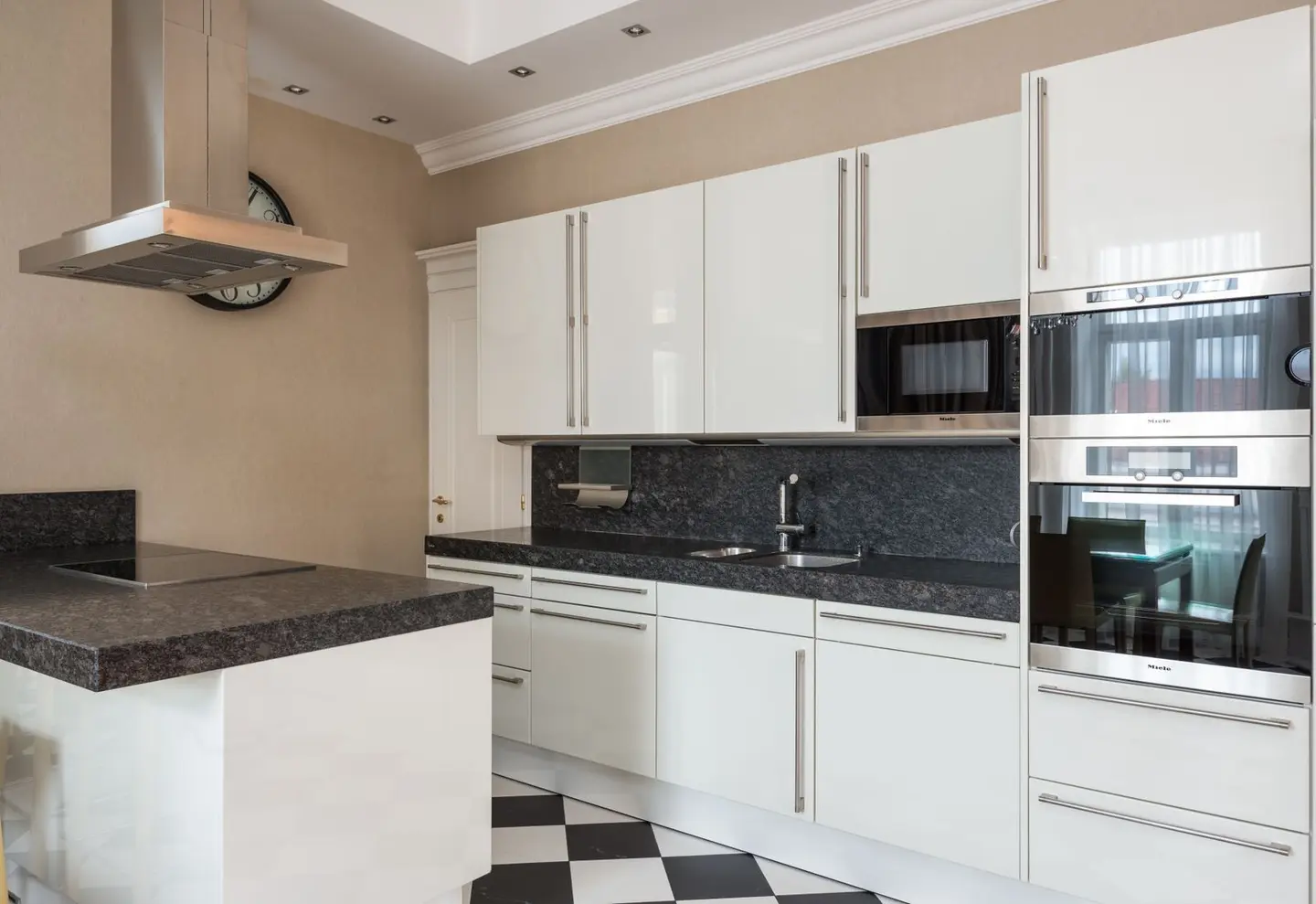
The most popular choice for standalone kitchens. A chimney hood mounts to the wall above the hob, with a telescoping stainless-steel chimney that conceals the duct rising to the ceiling. They are available in widths of 60 cm, 90 cm, and 100 cm, and suit most domestic layouts. Performance ranges from around 300 m³/hr at the budget end to over 900 m³/hr on premium models.
Integrated / Canopy Hoods
Built into an overhead cabinet or custom-made housing so only the extractor panel and controls are visible. Ideal for fitted kitchens where a visible chimney stack would look out of place. The motor unit is often mounted remotely (inside a cabinet or in the loft void), which can significantly reduce kitchen noise.
Island Hoods
Suspended from the ceiling above a kitchen island or peninsula hob. These are larger, typically starting at 90 cm wide and often 120 cm or more, and must be installed so the underside sits 65–75 cm above the cooking surface. The ceiling duct run must be concealed in a structural or decorative soffit. Prices start at around £300 and quickly climb to £1,000+ for well-engineered models.
Downdraft Extractors
Rise up from behind or beside the hob when in use and retract flush when not needed, useful for open-plan kitchens where an overhead hood would obstruct sightlines. Downdraft units work against physics (smoke rises) and generally need higher motor power to compensate; they perform acceptably for everyday cooking but struggle with high-output cooking such as wok work. Expect to pay £400–£1,500 for a quality model. Installation often requires a floor-level duct route, adding complexity.
Recirculating Hoods
Use activated carbon filters instead of ducting to outside. Air is drawn through grease filters, passed through carbon filter cartridges to neutralise odours, and returned to the kitchen. They can be fitted anywhere without ductwork, useful in flats where external ducting is prohibited under a lease. However, they do not remove moisture (so condensation management relies on other ventilation), and running costs are higher because carbon filters must be replaced every three to six months. They should not be the first choice where ducting is feasible.
Hood Type Comparison
| Type | Requires Duct? | Typical Width | Motor Power | Approx. Supply Cost |
|---|---|---|---|---|
| Chimney (wall-mounted) | Yes (preferred) | 60–100 cm | 300–700 m³/hr | £60–£600 |
| Integrated / canopy | Yes | 60–90 cm | 300–600 m³/hr | £100–£500 |
| Island | Yes | 90–120 cm+ | 400–900 m³/hr | £300–£1,500 |
| Downdraft | Yes (floor-level route) | 70–90 cm | 500–900 m³/hr | £400–£1,500 |
| Recirculating | No | 60–90 cm | 200–500 m³/hr (recirculated) | £60–£400 |
Understanding Performance Figures
Extraction Rate (m³/hr)
Manufacturers quote extraction rates at free-air conditions, before any duct resistance. In practice, every metre of duct, every bend, and every grille reduces effective airflow. A 400 m³/hr rated motor may deliver 280–320 m³/hr at the end of a typical duct run with two bends. As a rule of thumb, choose a hood rated for at least 10 times the kitchen volume per hour on its highest setting, so a 25 m³ kitchen benefits from a 250 m³/hr minimum, before factoring in duct losses.
Noise (sones / dB)
Kitchen noise is measured in sones (perceptual loudness) or decibels (acoustic pressure). A quiet conversation is around 30 dB; a standard chimney hood on medium speed is typically 45–55 dB (2–5 sones). Remote-motor integrated hoods are the quietest option, often reaching below 40 dB at working speeds. If a quiet kitchen matters, open-plan spaces, home workers, prioritise noise ratings over raw extraction figures and look for models that achieve 30 l/s at a low sone rating.
Filter Maintenance
Neglecting filters is the single biggest cause of hood performance decline and fire risk.
Grease filters (metal mesh or baffle type) capture cooking grease before it reaches the motor and ductwork. Baffle filters are more effective, easier to clean, and last the lifetime of the hood. Mesh filters should be washed in a dishwasher or hot soapy water every four to eight weeks depending on cooking frequency. A blocked grease filter can drop airflow by 30–40 % and creates a fire hazard if saturated grease ignites.
Carbon filters (recirculating hoods only) absorb volatile organic compounds and odours. They cannot be cleaned and must be replaced every three to six months. Replacement cartridges typically cost £15–£40 each depending on the model.
Duct Run Considerations
For ducted hoods, the routing and diameter of the duct directly affect performance:
- Diameter: 125 mm round duct is the minimum for most domestic hoods; 150 mm is preferred for higher-output models and longer runs. Rectangular flat duct (for tight ceiling voids) should have an equivalent cross-sectional area.
- Run length: Keep total duct length to a maximum of around 3–4 m for a 125 mm duct, allowing for duct-resistance equivalence of bends (each 90° bend equals roughly 1–1.5 m of straight duct). Longer runs need a larger duct diameter or a more powerful motor to maintain the required extract rate.
- Rigid vs flexible: Rigid duct (aluminium or PVC) produces far less turbulence and pressure drop than corrugated flexible duct. Use rigid throughout where possible; if a short length of flexible is needed for final connection, keep it taut and straight.
- Anti-backdraught flap: All exterior wall or roof terminals must incorporate a damper that closes when the hood is off to prevent cold air ingress and bird nesting. Most quality hoods include an inline damper; check before specifying.
- Termination: Wall terminals are simpler; roof terminations are used when external walls are unavailable but add complexity and cost.
Installation Costs (2026)
| Item | Typical Cost |
|---|---|
| Hood supply (budget chimney) | £60–£150 |
| Hood supply (mid-range chimney) | £150–£400 |
| Hood supply (island or downdraft) | £300–£1,500 |
| Installation, straightforward wall chimney | £80–£150 |
| Installation, island hood with ceiling duct | £150–£250 |
| Duct run through external wall (new penetration) | £100–£200 extra |
| Electrical connection (if new circuit or socket needed) | £80–£200 extra |
Most competent kitchen fitters or plumber-electricians can hang a chimney hood in two to three hours. An island hood requiring a ceiling void duct and decorative soffit is a larger job, often half a day or more.
Getting it Right
Measure your hob width and buy a hood at least as wide, ideally 10–15 cm wider on each side, to capture the full cooking envelope. If you have a gas hob with a central wok burner or a high-output induction zone, choose a minimum extraction rate of 600–700 m³/hr and check the duct path before purchase rather than after. A hood that fits beautifully but cannot be connected to outside air will underperform for the lifetime of the kitchen.
Check the duct route first
Before ordering any ducted hood, trace the likely duct path from hood to external wall or roof. Identify any structural elements, cabinets, or services that would obstruct it. An awkward route discovered after delivery is expensive to resolve.
The rules in this note are those that apply in England. Scotland, Wales and Northern Ireland have their own building standards and permitted development rights.
References (1)
Figures in this note were checked against the sources below on 14 September 2026. Superscript numbers in the text point to them. Every source the site cites, by topic.
- 1technicalvery strongMinistry of Housing, Communities and Local Government.RN-QD1SFFTable 1.1 sets minimum intermittent extract rates: kitchen with a cooker hood extracting outside 30 l/s, kitchen without one 60 l/s, utility room 30 l/s, bathroom 15 l/s, sanitary accommodation 6 l/s. Extract terminals and fans other than cooker hoods should be as high as practicable and no more than 400mm below the ceiling; a cooker hood should sit between 650mm and 750mm above the hob if the manufacturer gives no figure. Table 1.7 requires background ventilators of at least 8000mm2 equivalent area in habitable rooms and kitchens for a dwelling, 10,000mm2 for a single-storey dwelling. Background ventilators should be at least 1700mm above floor level and at least 500mm from a fan in the same room. On replacement windows, paragraph 3.14 says new windows must carry background ventilators no smaller than the originals, and paragraph 3.15 gives the fallback minimums where the old size is unknown: 8000mm2 habitable rooms, 8000mm2 kitchen, 4000mm2 bathroom. Paragraph 3.32 confirms that replacing an extractor fan or cooker hood on existing cabling is not notifiable.
-
Approved Document F: Ventilation, Volume 1: Dwellings, 2021 edition, HM Government (GOV.UK), accessed 7 September 2026. assets.publishing.service.gov.uk