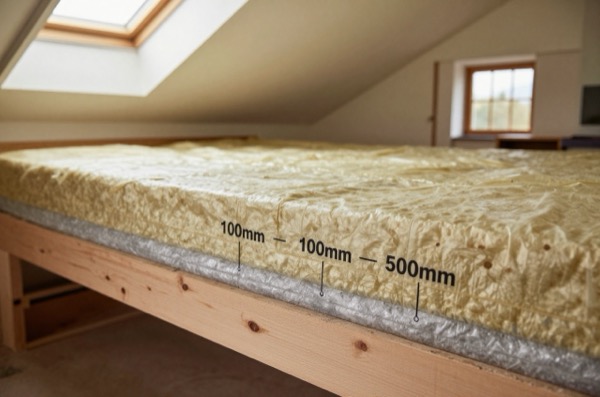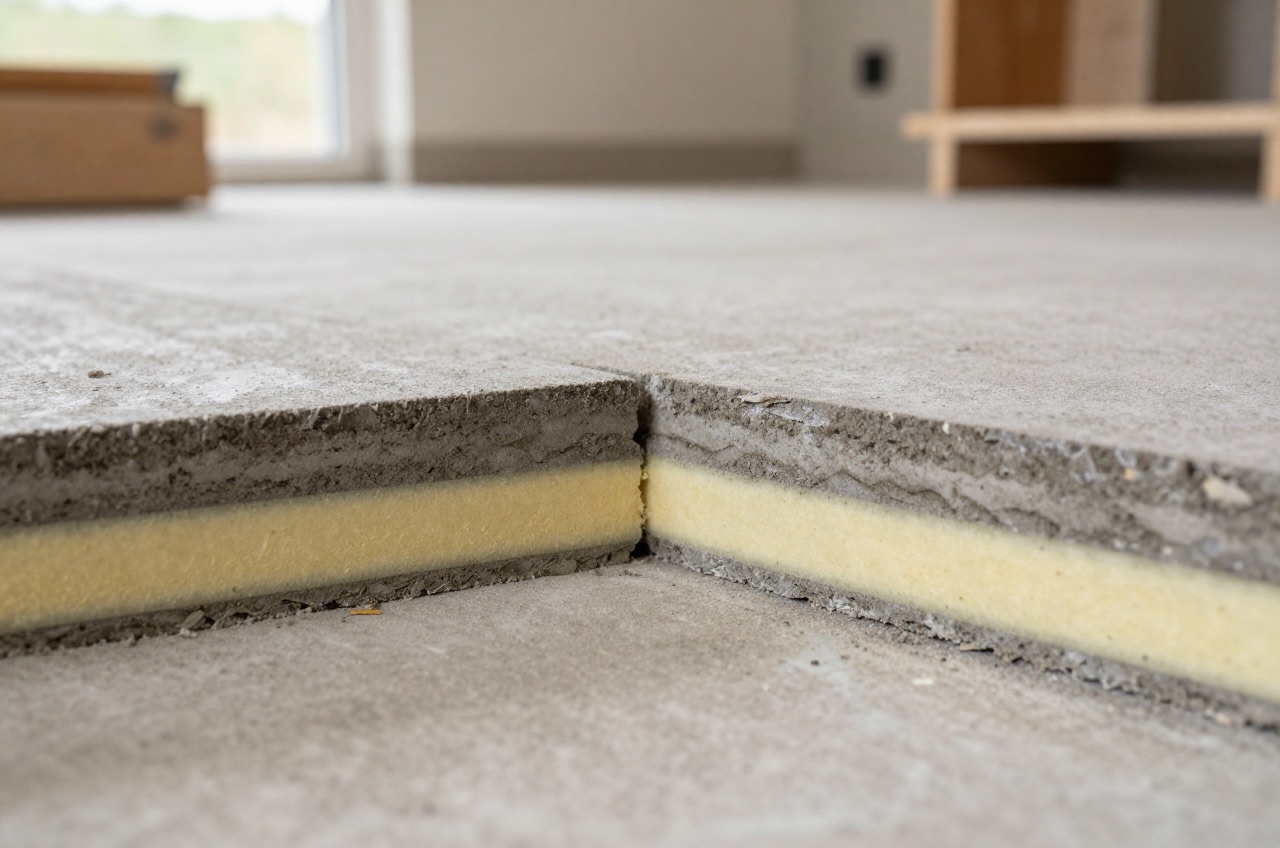
EPS (expanded polystyrene) and XPS (extruded polystyrene) look similar from a distance and share a common base chemistry, but their manufacturing processes produce meaningfully different physical properties. Specifying one where the other is required leads to either over-spend or underperformance, usually the latter in wet or load-bearing conditions.
How They Are Made
EPS is produced by expanding polystyrene beads with steam inside a mould.1 The result is a white board of fused beads, typically 15–30 kg/m³. Each bead is made of closed cells, but water can work its way into the small voids between beads over long periods.
XPS is produced by extruding molten polystyrene through a die, producing a uniform closed-cell structure with a characteristic skin on both faces. Typical density is 28–45 kg/m³. The closed-cell structure dramatically reduces water absorption and gives higher compressive strength for a given thickness.
Both are thermoplastic and combustible. Boards made with a flame retardant are typically Euroclass E, but some EPS floor grades are supplied without one as standard, so check the declared class and the Approved Document B requirements before specifying.2
Lambda Values and Thermal Performance
The thermal advantage of XPS over EPS is modest and, in some cases, non-existent. At the same density class, the two materials perform similarly when dry:
| Product | λ declared (W/mK) | Notes |
|---|---|---|
| EPS 70 | 0.038 | Entry-level floor grade |
| EPS 100 | 0.036 | General insulation boards |
| EPS 150 | 0.035 | Heavier-duty floors |
| EPS 200 | 0.034 | High-load applications |
| XPS 300 (Kingspan GreenGuard GG300) | 0.033 | Moisture-resistant; inverted roofs and basements |
| XPS 300 (Ravatherm XPS X 300 SL, 80 mm and over) | 0.031 | Moisture-resistant; inverted roofs |
The EPS values are Jablite’s declared figures for its Jabfloor grades.2 Kingspan declares 0.033 W/mK for GreenGuard GG300.3 Ravatherm declares 0.031 W/mK for XPS X 300 SL boards 80 mm and thicker.4
The key difference is moisture: XPS has minimal water absorption and resists ground moisture, so it keeps its performance in wet ground, while EPS can take up more water over long periods.3 For dry, interior applications this distinction is academic; for ground-bearing or inverted roof applications it is critical to long-term thermal performance.
Compressive Strength
This is where XPS holds its clearest advantage. Compressive strength (resistance at 10% compression, CS) determines which materials can take structural loads without unacceptable deflection under the slab, screed or loading above.
| Product | CS (kPa) | Typical use under a screed |
|---|---|---|
| EPS 70 | 70 | Domestic floors |
| EPS 100 | 100 | Offices, care homes |
| EPS 150 | 150 | Public and educational buildings |
| EPS 200 | 200 | Industrial and commercial |
| EPS 300 | 300 | Heavy commercial, cold stores |
| XPS 200 | 200–250 | Entry-level XPS for domestic use |
| XPS 300 | 300 | Standard XPS for domestic and commercial screed |
| XPS 500 | 500–700 | Heavy-duty XPS for industrial floors and roads |
Under a sand-cement screed in a house, EPS 70 is the grade manufacturers give for domestic floors, with EPS 100 for offices and care homes and EPS 150 to 250 for public, commercial and industrial floors.2 XPS 300 gives a large margin and moisture resistance, which a floor insulated above its DPM seldom needs.
Moisture Performance
Water absorption (by volume after 28 days immersion to BS EN ISO 16535, which replaced the withdrawn BS EN 12087) is the specification value that matters most for ground-contact applications:5
- EPS: higher than XPS, and it varies with grade and maker, so check the long-term water absorption the datasheet declares
- XPS: typically declared below 0.7% by volume (closed-cell)4
For under-slab applications with a proper DPM (damp-proof membrane), EPS performs adequately because the membrane prevents sustained water contact. Where the DPM integrity cannot be guaranteed, or where insulation is placed outside the waterproofing layer (inverted roof, perimeter/foundation insulation), XPS is the usual choice.3
Application Guide
| Application | Recommended product | Notes |
|---|---|---|
| Under ground-bearing slab (domestic, DPM above insulation) | EPS 70 or EPS 100 | Cost-effective; DPM protects |
| Under ground-bearing slab (commercial / high load) | XPS 300–500 | Reliable CS and moisture resistance |
| Inverted flat roof (insulation above waterproofing) | XPS 300 | Wet by design; EPS not suitable |
| Cavity wall partial fill | EPS 70 or EPS 100 | Standard product |
| Floor perimeter / foundation / basement wall | XPS 200–300 | Continuous moisture exposure |
| Under screed over existing concrete (retrofit) | EPS 70 or EPS 100, or XPS 300 | Depends on floor load and damp risk |
| EWI (external wall insulation) base board | EPS 70 or EPS 100, as the system specifies | Standard EWI system substrate |
Cost Per m² (2026 Supply Prices)
| Product (100 mm) | Supply cost (£/m²) |
|---|---|
| EPS 70 (Jabfloor 70) | about £15 |
| XPS 300 (Ravatherm XPS X 300 SL) | about £22 |
Both figures are retail prices including VAT from single product pages in September 2026. Selco sells a 2.88 m² board of 100 mm Jabfloor 70 for £44.40 including VAT, about £15.42 per m².6 Insulation Bee lists a 3 m² pack of four 100 mm Ravatherm XPS X 300 SL boards at £64.75 including VAT, about £21.58 per m².7 Higher-strength EPS grades cost more than EPS 70, so ask for a price on the grade the floor needs.
On these prices, XPS 300 costs about 1.4 times as much per m² as EPS 70 at the same thickness. For applications where EPS is technically adequate, the cost premium for XPS is hard to justify. For ground-contact and inverted roof applications, the performance case for XPS is clear and the premium is warranted.
Environmental Considerations
Both EPS and XPS are manufactured with blowing agents. XPS historically used HFCs or HCFCs with high global warming potential (GWP). Since 1 January 2020 the F-gas Regulation has banned placing on the market XPS foam that contains HFCs with a GWP of 150 or more, and manufacturers now use CO₂ or HFO blowing agents instead.8 EPS uses pentane as its blowing agent, which has a global warming potential of less than five, and EPS is free of HFCs, CFCs and HCFCs.1
Neither material is easily recycled in standard construction waste streams. EPS can be compacted and reprocessed more readily than XPS; check with the manufacturer for take-back schemes.
Relevant Standards
- BS EN 13163, factory-made EPS thermal insulation products9
- BS EN 13164, factory-made XPS thermal insulation products10
- BS EN 826, compressive behaviour (determines CS grades)11
- BS EN ISO 16535:2019, long-term water absorption by immersion (replaced the withdrawn BS EN 12087)5
- Approved Document C, site preparation, resistance to moisture (ground-floor insulation)12
- Approved Document L (2021), U-values (new dwelling ground floor: a limit of 0.18 W/m²K, with 0.13 W/m²K in the notional dwelling)13
- BS 8217:2005, code of practice for reinforced bitumen membranes on flat roofs14
When specifying for a ground floor, ensure the declared lambda (λD) in the product datasheet is used for U-value calculations rather than the nominal value, aged lambda is particularly relevant for EPS in damp conditions.
The rules in this note are those that apply in England. Scotland, Wales and Northern Ireland have their own building standards and permitted development rights.
References (14)
Figures in this note were checked against the sources below on 2 October 2026. Superscript numbers in the text point to them. Every source the site cites, by topic.
- 1technicalgoodBritish Plastics Federation, guidance.RN-Q23GSPThe British Plastics Federation's EPS page explains how polystyrene beads are expanded with steam and then moulded, which is how EPS boards are made.
- 2technicalstrongJablite, guidance.RN-9K9QLSJablite technical data sheet for its Jabfloor EPS floor insulation laid over a slab under a screed. It lists each grade with its thermal conductivity and compressive strength, and the building type each grade is meant for, with Jabfloor 70 for domestic floors.
- 3technicalsupplier figureKingspan Insulation, guidance.RN-KTJGCGA manufacturer product page for a 300 kPa XPS board. It lists inverted roofs and basements as its uses and notes minimal water absorption and resistance to ground moisture.
- 4technicalsupplier figureRavago Building Solutions (hosted by Quantum Insulation), guidance.RN-JPL213A manufacturer data sheet for a standard 300 kPa XPS board. It declares long-term water absorption by immersion below 0.7% by volume, and Euroclass E reaction to fire.
- 5technicalstrongBSI (British Standards Institution), a standard.RN-3B3DX9STATUS: CURRENT, and it is the replacement for a standard the notes still cite. BS EN ISO 16535:2019 was published 31 July 2019 and expressly supersedes BS EN 12087:2013, which is WITHDRAWN. It specifies the equipment and procedure for determining the long term water absorption of thermal insulating products, giving two methods: method 1 partial immersion and method 2 total immersion. This is the test behind the WL(T) declared value used to compare rigid boards for below ground, inverted roof and perimeter use, which is why extruded polystyrene (XPS) is specified below damp proof level rather than expanded polystyrene or unfaced PIR. Any note citing BS EN 12087 for water absorption of insulation should be corrected to BS EN ISO 16535. Catalogue page confirms number, title, date, status, the supersession of BS EN 12087:2013 and the two methods; the procedure detail is paywalled.
- 6costsupplier figureSelco Builders Warehouse.RN-MBVS6TA price, true at 2026-09. the retail price Selco Builders Warehouse publishes for Jabfloor 70 Floor Insulation 2400 x 1200 x 100mm, which is the supply figure the cost book records for this item
- 7costsupplier figureInsulation Bee.RN-PNXMUCA price, true at 2026-09. Insulation Bee's product page for 100 mm Ravatherm XPS X 300 SL gives a price of £64.75 including VAT for a four-board pack covering 3 m2. A specialist insulation retailer is used because no merchant product page with a readable XPS price was found.
- 8technicalvery strongThe National Archives (legislation.gov.uk), guidance.RN-MRNOX8Annex III of the retained F-gas Regulation lists products banned from the market. Item 16 bans XPS foams containing HFCs with a GWP of 150 or more from 1 January 2020.
- 9technicalstrongBSI (British Standards Institution), a standard.RN-21YSR6The product standard for EPS, the white bead board used for most external wall insulation systems and under many floor slabs. Published 28 Feb 2013, current but under review. It specifies requirements for factory made expanded polystyrene products with or without rigid or flexible facings or coatings used for the thermal insulation of buildings, made as boards, rolls or other preformed shapes including tapered, tongue and groove, shiplap and profiled, and notes the same products are used for sound insulation and in prefabricated systems and composite panels. It sets classes of dimensional tolerance for length, width, thickness, squareness and flatness, the EPS designation code, sampling and conditioning for thermal tests, and the Assessment and Verification of Constancy of Performance regime of type testing plus factory production control. Products with a declared thermal resistance below 0.25 m2K/W or a declared thermal conductivity above 0.060 W/mK at 10 degrees C are outside its scope, as are in situ products, building equipment and industrial insulation, civil engineering applications and beam and block floor systems.
- 10technicalstrongBSI (British Standards Institution), a standard.RN-W6XBQJThe product standard for XPS, the coloured closed cell board used below screeds, in inverted roofs and where water resistance matters. Published 28 Feb 2013, current but under review, with Designated status for UKCA marking. It specifies requirements for factory made extruded polystyrene foam products with or without facings or coatings used for thermal insulation of buildings, manufactured as boards including special edge and surface treatments such as tongue and groove and shiplap, and also used in prefabricated thermal insulating systems and composite panels. As with the other 131xx standards it does not set the property level a product must reach for a given application, which is left to regulations. Products with a declared thermal resistance below 0.25 m2K/W or declared thermal conductivity above 0.060 W/mK at 10 degrees C are excluded, as are in situ products, building equipment and industrial insulation covered by EN 14307, and civil engineering applications covered by EN 14934.
- 11technicalstrongBSI (British Standards Institution).RN-5JJC0LBS EN 826:2013, determination of compression behaviour of thermal insulating products. The test behind a compressive strength figure on an insulation board, which is what decides whether a board can go under a screed or a floor slab at all.
- 12technicalvery strongMinistry of Housing, Communities and Local Government.RN-3SXGDUThe GOV.UK page for Approved Document C, published 3 September 2013, ISBN 978 1 85946 509 7, covering site preparation and resistance to contaminants and moisture, with a separate FAQ document (ISBN 978-1-4098-4805-9). Since April 2023 the Building Safety Regulator has a duty under the Building Safety Act 2022 to keep building safety and standards in England under review, including advising on Approved Document updates. The linked PDF gives the figures a damp note needs: paragraph 5.5 says a wall meets the requirement if it has a damp-proof course of bituminous material, polyethylene, engineering bricks or slates in cement mortar, or any other material that prevents the passage of moisture, continuous with any damp-proof membrane in the floors; for an external wall the damp-proof course should be at least 150mm above the level of the adjoining ground; and for an external cavity wall the cavity should be taken down at least 225mm below the lowest damp-proof course, or a damp-proof tray provided, with weep holes every 900mm and stop ends plus at least two weep holes where the tray does not run the full length. Paragraph 5.6 accepts the alternative of BS 8215 clauses 4 and 5 for damp-proof course design and installation, and BS 8102 for protection against water from the ground.
- 13technicalvery strongMinistry of Housing, Communities and Local Government.RN-L0FCJXThe in-force U-value tables a DIY insulation or door note must quote, with the exact numbers. Table 4.2, limiting U-values for new fabric elements in existing dwellings, sets roof 0.15, wall 0.18, floor 0.18, swimming pool basin 0.25, window 1.4 or Window Energy Rating Band B minimum, rooflight 2.2, doors with more than 60 per cent of the internal face glazed 1.4 or Doorset Energy Rating Band C minimum, and other doors 1.4 or Doorset Energy Rating Band B minimum. Table 4.3, for existing elements, gives a roof threshold of 0.35 and an improved value of 0.16, which is the figure a loft insulation note needs: paragraph 4.12 says a retained element whose U-value is higher than the column (a) threshold, for example through a loft or garage conversion, should be upgraded to the column (b) value. Paragraph 4.13 allows a lesser upgrade only where the improved value is not technically or functionally feasible or would not achieve a simple payback of 15 years or less. Paragraph 4.8 requires a replacement element to be no worse than the one it replaces as well as meeting Table 4.2. Paragraph 4.10 gives the heritage exception: where character must be maintained, a centre pane U-value of no more than 1.2 or low-emissivity secondary glazing. Note 9 records that the timber window concession of 1.6 or Band C ended on 14 June 2023. The 2021 edition came into force on 15 June 2022; a 2026 edition exists at https://assets.publishing.service.gov.uk/media/69c122a6cfa346b9d4704a55/ADL1_2026.pdf.
- 14technicalstrongBSI Group (British Standards Institution).RN-D9CXRXBS 8217:2005, reinforced bitumen membranes for roofing, code of practice. The standard behind a built-up felt flat roof: the number of layers, laps, bonding and detailing at upstands. Cited where a note distinguishes a modern reinforced bitumen system from the felt roofs that gave the material its reputation.
-
Expanded Polystyrene (EPS), British Plastics Federation, accessed 2 October 2026. bpf.co.uk
-
Jabfloor 70, 100, 150, 200, 250: Floor insulation, over slab with screed finish (technical data sheet), Jablite, accessed 29 September 2026. roofingmegastore.co.uk
-
Kingspan GreenGuard GG300, Kingspan Insulation, accessed 29 September 2026. insulation.kingspan.com
-
Product Data Sheet: Ravatherm XPS X 300 SL, Ravago Building Solutions (hosted by Quantum Insulation), accessed 29 September 2026. quantuminsulation.com
-
BS EN ISO 16535:2019 Thermal insulating products for building applications. Determination of long-term water absorption by immersion, BSI, accessed 7 September 2026. knowledge.bsigroup.com
-
Jabfloor 70 Floor Insulation 2400 x 1200 x 100mm, Selco Builders Warehouse, accessed 2 October 2026. Priced at 2026-09 and left there. selcobw.com
-
Ravatherm XPS 300 SL 100mm Board, Insulation Bee, accessed 2 October 2026. Priced at 2026-09 and left there. insulationbee.co.uk
-
Regulation (EU) No 517/2014 on fluorinated greenhouse gases, Annex III: Prohibitions on placing on the market, The National Archives (legislation.gov.uk), accessed 29 September 2026. legislation.gov.uk
-
BS EN 13163:2012+A2:2016 | Thermal insulation products for buildings. Factory made expanded polystyrene (EPS) products. Specification, BSI (British Standards Institution), accessed 12 September 2026. knowledge.bsigroup.com
-
BS EN 13164:2012+A1:2015, Thermal insulation products for buildings. Factory made extruded polystyrene foam (XPS) products. Specification, BSI (British Standards Institution), accessed 12 September 2026. knowledge.bsigroup.com
-
BS EN 826:2013, Thermal insulating products for building applications. Determination of compression behaviour, BSI (British Standards Institution), accessed 12 September 2026. knowledge.bsigroup.com
-
Site preparation and resistance to contaminants and moisture: Approved Document C, Ministry of Housing, Communities and Local Government, accessed 12 September 2026. gov.uk
-
Approved Document L, Conservation of fuel and power, Volume 1: Dwellings, 2021 edition incorporating 2023 amendments, HM Government, accessed 29 September 2026. assets.publishing.service.gov.uk
-
BS 8217:2005 – Reinforced bitumen membranes for roofing. Code of practice, BSI Group (British Standards Institution), accessed 12 September 2026. knowledge.bsigroup.com