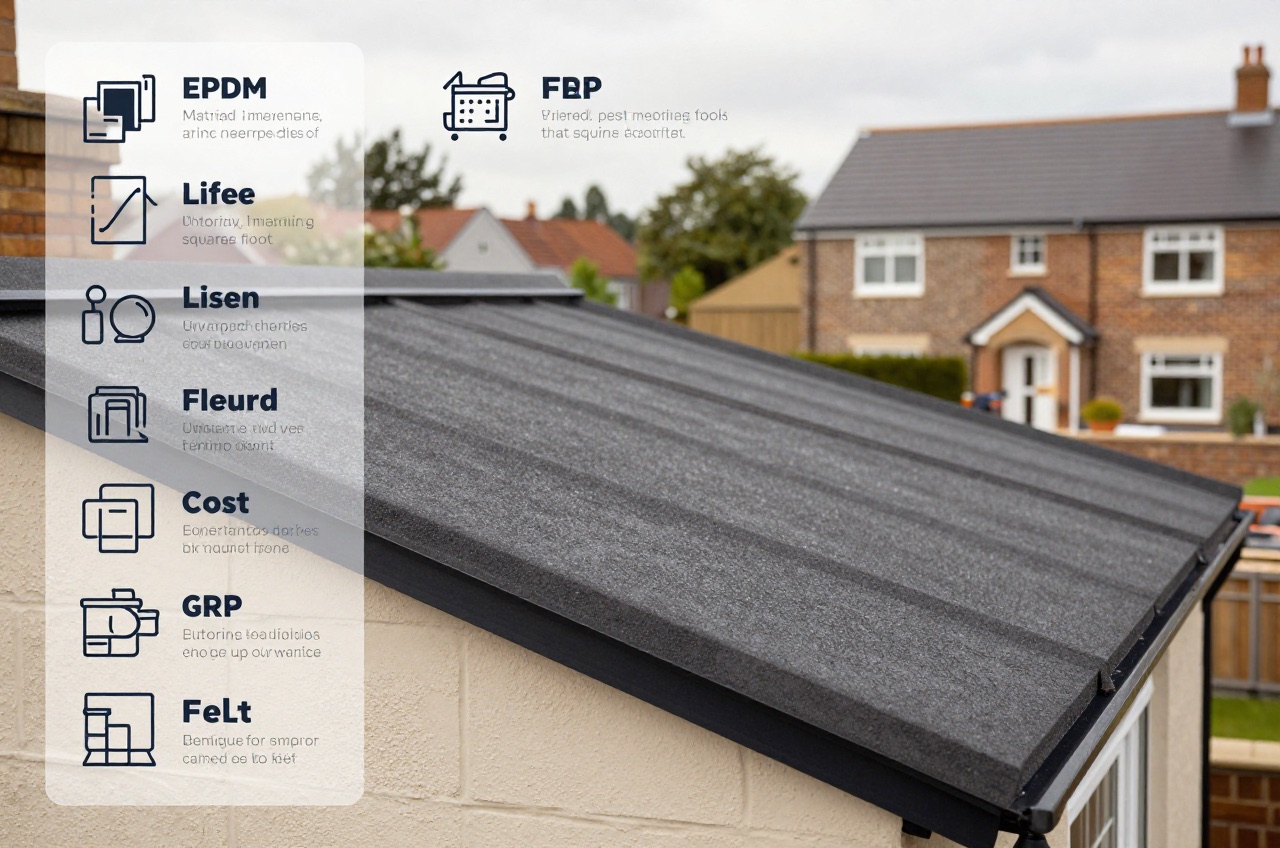
A flat roof, technically anything pitched below 10°, covers more UK homes than most people realise: garage roofs, kitchen extensions, rear additions, bay window tops and porch canopies are all routinely built flat.1 The choice of membrane system affects not just upfront cost but how long it will last, how well it insulates, and whether it can be walked on. This guide compares the three dominant systems, built-up felt, EPDM rubber and GRP fibreglass, with 2026 UK prices and practical guidance on which suits which situation.
Flat Roof Systems Compared
Built-Up Felt (Torch-On Felt)
Traditional felt, laid in two or three layers with bitumen bonded between each sheet, remains the cheapest flat roof option. Modern torch-on felt is a significant improvement over the old sand-and-felt systems found on 1970s–1990s extensions: the top cap sheet is a mineral-surfaced SBS polymer-modified bitumen, far more UV-resistant than the original.
Felt suits straightforward rectangular roofs where budget is the primary constraint. It is the default choice of many builders doing a rear extension on a tight contract. The weak point is detailing around upstands, flashings and outlets, poorly lapped joints and cracked flashings are responsible for the majority of felt roof failures. A competent installation with properly dressed lead flashings and 150 mm upstands can easily last 15 years; a rushed job on a leaky extension may fail in five.
EPDM (Ethylene Propylene Diene Monomer)
EPDM is a synthetic rubber membrane sold in large single-ply sheets, often covering an entire roof in one piece, eliminating seams. It originated in commercial flat roofing and has become popular for domestic use over the past decade. The material is extremely UV-stable, handles thermal expansion well (rubber stretches and returns rather than cracking), and is certified to 50+ years by some manufacturers.
The adhesive bonding process requires skill: a poor bond causes lifting and pooling. Reputable EPDM systems use a fully bonded layout with compatible water-cut outlets and pre-formed corners, so the quality of the installer matters considerably. Look for contractors who are accredited by the system manufacturer (for example, Firestone or Carlisle) rather than those buying generic EPDM off a roll.
GRP Fibreglass (Glass Reinforced Polyester)
GRP is the premium domestic flat roof product. The installer saturates woven glass mat with liquid resin and applies it in situ, then tops with a gelcoat. When cured, it forms a rigid, seamless shell. GRP is the only commonly available system that can be finished to a smooth walking surface without additional decking, and is regularly specified on balconies and roof terraces for this reason.
GRP is hard and brittle compared with rubber, impact from dropped tools or foot traffic without protection boards can crack it, but when undamaged it has outstanding longevity. Many GRP roofs in the UK are approaching 30–35 years with no issues. The main limitation is temperature: GRP cannot be installed below about 5°C or in humid conditions, which constrains the working season in the UK.
Cost Comparison
All figures are installed costs including materials, labour, removal of the existing roof covering and disposal, but excluding structural timber repairs. VAT at 20% is included; repairs and replacements to existing domestic roofs are also standard-rated at 20% (a new-build house is zero-rated), check with your contractor.2
| System | Low (£/m²) | Typical (£/m²) | High (£/m²) | Expected Lifespan |
|---|---|---|---|---|
| Torch-on felt (2-layer) | £40 | £55 | £70 | 10–15 years |
| Torch-on felt (3-layer cap sheet) | £50 | £65 | £80 | 15–20 years |
| EPDM rubber (bonded) | £55 | £75 | £95 | 25–50+ years |
| GRP fibreglass | £65 | £90 | £110 | 25–50+ years |
| Liquid-applied (e.g. Kemperol) | £80 | £105 | £135 | 25+ years |
A typical UK garage roof is around 20–25 m². At those areas:
- Felt replacement: £800–£2,000
- EPDM replacement: £1,100–£2,375
- GRP replacement: £1,300–£2,750
A kitchen extension flat roof at 12–16 m²:
- Felt: £480–£1,280
- EPDM: £660–£1,520
- GRP: £780–£1,760
Day-rate labour (excluding materials) typically runs £250–£400 per operative per day for roofing contractors in London and the South East; £200–£320 elsewhere.
Lifespan and Maintenance
The cost-per-year calculation often makes EPDM and GRP look better value than their upfront premium suggests. A felt roof at £55/m² lasting 15 years costs £3.67/m²/year; an EPDM roof at £75/m² lasting 40 years costs £1.88/m²/year.
All three systems need periodic maintenance:
- Felt: check flashings and outlets annually, clear debris from gutters, look for blistering or splits after severe winters.
- EPDM: inspect bonded seams and upstand details every 2–3 years; re-apply seam tape if lifting is detected early.
- GRP: inspect the gelcoat for cracks or crazing; a surface re-coat (£15–£30/m²) at 15–20 years extends life significantly.
Insulation for Flat Roofs
Building Regulations Part L (England and Wales, 2021 revision) requires a U-value of 0.15 W/m²K for the roof of an extension (Table 4.2) and 0.16 W/m²K for a new-build roof or an existing roof that is renovated (Tables 4.1 and 4.3).3 This demands around 140–180 mm of PIR (polyisocyanurate) board insulation in a warm roof configuration, or deeper rafters packed with mineral wool in a cold roof layout.
Warm roof (insulation above the deck, below the membrane) is strongly preferred: it keeps the structure above the dew point, eliminates condensation risk and avoids the complex ventilation required in cold roof designs. Most reputable flat roof contractors will default to warm deck for any new or replacement installation.
Cold roof (insulation between joists, membrane on top of deck) is cheaper to construct but prone to interstitial condensation unless ventilation is correctly detailed. Building Control will scrutinise cold roof designs; many local authorities now require calculations to BS EN ISO 13788 to demonstrate the condensation risk is managed.4
| Insulation Type | Indicative thickness for 0.15–0.16 W/m²K | Cost (material only, per m²) |
|---|---|---|
| PIR board (e.g. Kingspan K7) | ~140–160 mm | £18–£285 |
| Phenolic board (e.g. Xtratherm) | ~120–140 mm | £22–£35 |
| EPS (expanded polystyrene) | ~220–260 mm | £10–£18 |
| Mineral wool (cold roof) | ~250–300 mm between and below joists | £6–£12 |
Drainage and Falls
A flat roof must achieve a minimum fall of 1:80 (about 12 mm per metre) to drain freely, the NHBC standard and BS 6229 both specify this.6 In practice, most contractors aim for 1:60 to allow for slight deck deflection under load.
Falls are created by:
- Tapered insulation (most common on new installations): the board manufacturer cuts the insulation to create the required slope. Add £4–£8/m² to insulation costs.
- Firring pieces (timber wedges under the deck): cheaper but less thermally efficient as the insulation above remains level.
- Structural falls (rafters or concrete deck already sloped): ideal but rarely the case in retrofit.
Ponding, standing water that never drains, is the primary enemy of flat roofs. It adds weight, promotes algae, stresses seams and accelerates the degradation of all three membrane types. If your existing flat roof ponds, address the falls at replacement; adding a new membrane over a ponding deck repeats the problem.
When to Choose Each System
- Felt, budget garage or outbuilding roof, short-term landlord fix, area under 15 m², or where you expect to replace the whole extension structure within 15 years anyway.
- EPDM, residential extension or balcony roof where longevity matters and budget is moderate; also where complex shapes (round bays, L-shapes) make seamless application valuable.
- GRP, anywhere foot traffic is expected (accessible balcony, terrace, roof of a below-ground extension), anywhere aesthetics matter (smooth painted finish), or where the client wants the longest realistic warranty.
For extensions in England, Building Regulations approval is required for the structural elements of a new flat roof (Part A) and for the insulation specification (Part L). The membrane itself does not need specific approval but must be installed to the drawings submitted. Most flat roof repairs on existing structures are not notifiable under Building Regulations unless more than 50% of the roof (or more than 25% of the building envelope) is being replaced, confirm with your local building control authority.7
References (7)
Figures in this note were checked against the sources below on 7 September 2026. Superscript numbers in the text point to them. Every source the site cites, by topic.
- 1technicalstrongBSI, a standard.RN-XNFNWPBS 6229:2025, the code of practice for flat roofs with continuously supported flexible waterproof coverings. Covers falls and drainage, deck types, vapour control, insulation position and the detailing at upstands and outlets. The standard behind the minimum fall on a flat roof and behind whether a warm or cold deck build-up is the right one.
- 2technicalvery strongGOV.UK, a government page.RN-GKUYQGHMRC's plain-English page on VAT for builders: when building work is standard rated at 20%, zero rated, or reduced to 5%, covering new houses and flats, work for disabled people, energy saving materials, grant-funded heating, conversions and renovations. The readable front door to VAT Notice 708, and the right first check on whether a quote should carry 20% at all.
- 3technicalvery strongHM Government (GOV.UK).RN-IHEXOXThe full Approved Document L Volume 1 for dwellings, 2021 edition with the 2023 amendments, for use in England. This is the statutory guidance on conservation of fuel and power: the U-value tables for new and replacement elements, the rules on when an existing element must be upgraded, controls and commissioning for heating systems, and the notification requirements. If a note quotes a target U-value for a wall, roof, floor, window or door, this is where the number comes from.
- 4technicalstrongBSI Knowledge, a standard.RN-V6N8P0BS EN ISO 13788:2012, the calculation methods for internal surface temperature to avoid critical surface humidity, and for interstitial condensation. This is the maths behind two separate problems: mould growing on a cold internal surface, and moisture condensing inside a wall or roof build-up where it cannot dry out. Cited where a note says internal insulation carries a condensation risk, because this is how that risk is actually assessed.
- 5costsupplier figureJJ Roofing Supplies.RN-C6O733A price, true at 2026-09. a JJ Roofing Supplies category listing for Flat Roof Insulation Board, recorded as the page a price was read from. A listing changes as the range changes, so it evidences the retailer and the range rather than a price a reader can confirm today. Flagged for re-sourcing to the product page
- 6technicalgoodNational Federation of Roofing Contractors (NFRC), guidance.RN-5QB3FPThe National Federation of Roofing Contractors' summary of what changed in BS 6229:2025, the flat roof code of practice, after the 2024 review and public consultation. Free to read, which the standard itself is not, so it is the practical way to find out what moved on falls, drainage, insulation position and inverted roofs before deciding whether the standard needs buying.
- 7technicalvery strongPlanning Portal, guidance.RN-HGKY9FThe Planning Portal on building regulations for work to an existing pitched or flat roof: when repair and re-cover are notifiable, structural alteration, and the thermal upgrade trigger. The general page that sits behind the more specific re-roofing and thermal element pages.
-
BS 6229:2025 Flat roofs with continuously supported flexible waterproof coverings. Code of practice, BSI Knowledge, accessed 7 September 2026. knowledge.bsigroup.com
-
VAT for builders: Houses and flats, GOV.UK, accessed 7 September 2026. gov.uk
-
Approved Document L, Conservation of fuel and power, Volume 1: Dwellings, 2021 edition incorporating 2023 amendments, HM Government (GOV.UK), accessed 7 September 2026. assets.publishing.service.gov.uk
-
BS EN ISO 13788:2012 Hygrothermal performance of building components and building elements. Internal surface temperature to avoid critical surface humidity and interstitial condensation. Calculation methods, BSI Knowledge, accessed 7 September 2026. knowledge.bsigroup.com
-
Flat Roof Insulation Board category listing, JJ Roofing Supplies, accessed 15 September 2026. Priced at 2026-09, so no calibration is needed. jjroofingsupplies.co.uk
-
BS 6229: 2025 Update – Key Points for Members, National Federation of Roofing Contractors (NFRC), accessed 7 September 2026. nfrc.co.uk
-
Building Regulations: Work to an existing roof, Planning Portal, accessed 7 September 2026. planningportal.co.uk