A roof inspection is one of the most cost-effective maintenance investments a homeowner can make. Catching a deteriorating flashing, slipped tile, or failed pointing early costs a fraction of the emergency call-out, or worse, the internal water damage, that follows from leaving it. In 2026, a standard visual inspection by a qualified roofer in the UK costs between £100 and £250 for a typical semi-detached or terraced house.
The price rises with roof size, complexity, and the access method required. Here is what to expect and how to get genuine value from the appointment.
What Affects the Price
Several variables push the cost up or down:
- Roof size and pitch, A compact terrace with a simple gable roof takes less time to inspect than a large detached with multiple hips, valleys, and dormers.
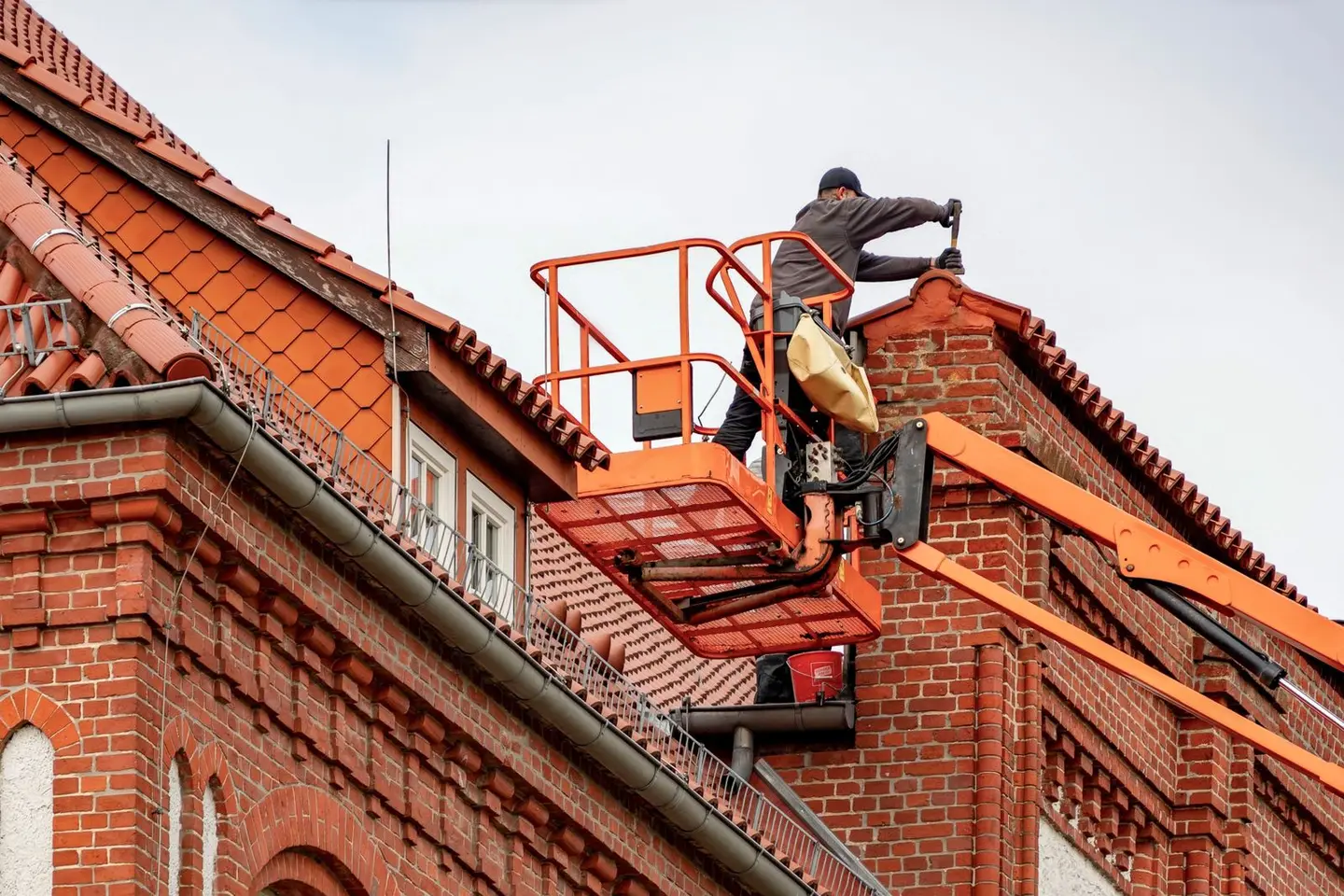
- Access method, Many inspectors can assess a standard roof from a ladder with binoculars or from ridge level. Where closer access is needed, a contractor-erected tower or scaffold typically adds several hundred pounds, and a cherry picker or mobile elevated work platform (MEWP) with an operator is usually hired by the day, at roughly £375–£595 plus VAT, on top of the inspector’s fee. Drone surveys (see below) avoid physical access costs but have limitations.
- Written report, A verbal debrief on site is standard. A typed condition report with photographs, useful for conveyancing, insurance, or planning repairs, adds £50–£150 to most quotes.
- Urgency, Emergency same-day inspections after storm damage carry premium rates, typically well above normal pricing.
- Location, Greater London and the South East typically run higher than the Midlands and North.
2026 Roof Inspection Price Guide
| Inspection type | Typical cost range |
|---|---|
| Visual inspection, small terrace (up to 60 m² roof) | £100–£150 |
| Visual inspection, semi-detached or mid-terrace | £130–£200 |
| Visual inspection, detached house | £175–£300 |
| Drone roof inspection (supply of photos/video) | £150–£350 |
| Structural roof survey with written report | £250–£450 |
| Post-storm condition report for insurance | £200–£400 |
| RICS Home Survey Level 2 (includes roof) | £400–£1,000 |
The HomeOwners Alliance puts an RICS Home Survey Level 2 at £400–£1,000 for a standard property in reasonable condition in 2026.1
Prices exclude VAT where the contractor is VAT-registered. Many sole-trader roofers are not VAT-registered, because registration only becomes compulsory once taxable turnover goes over £90,000 a year, so compare quotes on a like-for-like basis.2
What Does a Roof Inspection Cover?
A competent inspection should assess:
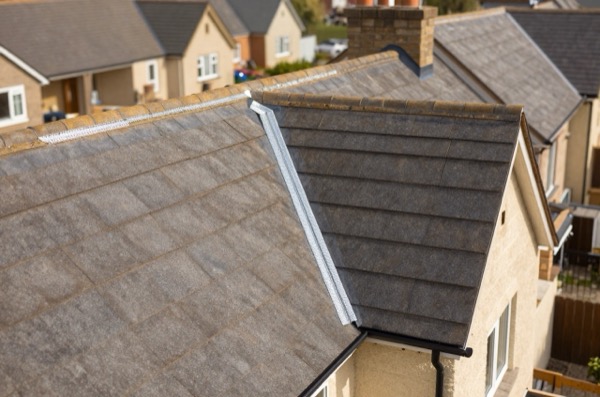
- Tiles or slates, slippage, cracking, missing units, moss or lichen colonisation
- Ridge and hip tiles, mortar condition, loose or missing units
- Flashings, lead step, cover or soaker flashings at abutments and chimney bases; common failure point
- Valley gutters, debris accumulation, lead or GRP condition
- Verges, mortar bed or dry-fix system condition
- Flat roof sections, felt, GRP, or EPDM surface, blistering, ponding, edge detail
- Chimney, stack pointing, cap/pot, flaunching, lead apron
- Fascias, soffits, and bargeboards, rot, paint failure, gaps that allow birds or vermin
- Gutters and downpipes, blocking, joint failure, bracket condition
A thorough inspector will photograph every defect. Ask whether photos are included before booking.
Drone Roof Inspections
Drone surveys have become a mainstream option for roof inspections. A drone pilot with a qualified roofer reviewing the footage can deliver a surprisingly detailed condition report without scaffolding or ladders.
Limitations: close-up mortar condition and cracked underlay beneath tiles are hard to assess from the air. Drone inspections work best as a first-pass screen; if they reveal a problem, a closer physical inspection is still needed. Expect to pay £150–£350 for a drone inspection with a video/photo report.
Who Should Carry Out a Roof Inspection?
- Qualified roofing contractor, most common option. Look for NFRC (National Federation of Roofing Contractors) membership or registration with CompetentRoofer, the NFRC’s government-authorised competent person scheme.3
- RICS surveyor, if you need a formal written report for a property transaction or legal dispute, an RICS-regulated surveyor’s report carries more weight. This is more expensive (see table above) but may be worth it pre-purchase.
- Independent roof surveyor, some companies specialise purely in inspection and reporting, without carrying out repair work themselves. This removes the conflict of interest where the inspector also sells the repairs.
How Often Should You Get a Roof Inspected?
There is no statutory requirement for routine roof inspections on dwellings, but a sensible pattern is:
- Every 5–10 years for a roof under 20 years old with no known issues
- Every 2–5 years for an older roof (30+ years) or one with a history of repairs
- After any significant storm with wind gusts over 50 mph or hail
- Before buying or selling a property
- Before and after major building work adjacent to the roof
Common Issues Found and Repair Costs
| Defect | Typical repair cost (2026) |
|---|---|
| Replace individual broken/slipped tiles | £100–£250 per tile (with access) |
| Re-bed and point ridge tiles | £400–£1,000 for a typical terrace |
| Repoint chimney flaunching | £200–£450 |
| Replace lead flashing at chimney | £350–£700 |
| Patch flat roof felt or EPDM | £200–£500 |
| Full re-roofing (concrete interlocking tiles, semi-detached) | £6,000–£12,000 |
The inspection fee is easily recouped if it prevents even one of the above escalating into a structural or internal water damage claim.
Getting Quotes
Get at least two quotes, three is better for large roofs. Key questions to ask:
- Are you NFRC-registered or on a recognised competency scheme?
- Does the price include a written report with photographs?
- Will you identify work I can defer vs work that is urgent?
- Do you have public liability insurance? (Ask for the level of cover in writing.)
A roofer who refuses to give a written report or quotes purely for repair work without explaining the inspection findings in detail is a warning sign.
Building Regulations and Roofing Work
Inspection itself does not require planning permission or Building Regulations approval. However, if the inspection leads to re-roofing or structural repair work, note:
- Stripping and re-covering more than half of a roof counts as renovating a thermal element under Approved Document L (Conservation of Fuel and Power), so the whole roof then has to be upgraded to a U-value of no more than 0.16 W/m²K, where that is technically, functionally and economically feasible.4
- Works to a listed building that would affect its character, which can include roof repairs in different materials, need listed building consent.5
- In conservation areas covered by an Article 4 direction, changing roof materials may need householder planning permission.
Always confirm with your local planning authority if the property is subject to any designations before committing to repair work following an inspection.
The rules in this note are those that apply in England. Scotland, Wales and Northern Ireland have their own building standards and permitted development rights.
References (5)
Figures in this note were checked against the sources below on 30 September 2026. Superscript numbers in the text point to them. Every source the site cites, by topic.
- 1costfairHomeOwners Alliance.RN-9W5S6NA price, true at 2026-09. A consumer body's 2026 guide to survey costs, giving the typical price of a specialist damp survey as £150 to £300.
- 2technicalvery strongHM Revenue and Customs (GOV.UK), a government page.RN-J2B1F3When a business must register for VAT: the taxable turnover threshold, the backward and forward look tests, and voluntary registration. This is why a small builder's quote may carry no VAT at all while a larger firm's carries 20% on the same work, which is a genuine price difference and not a discount.
- 3technicalvery strongMinistry of Housing, Communities and Local Government.RN-SAMO3MThe official list of competent person schemes whose members can self-certify certain building work instead of getting building regulations approval, published 4 April 2013 and last updated 12 March 2018. Named schemes with contact numbers include ATTMA, APHC, Assure Certification, Blue Flame Certification, the British Board of Agrement, BESCA, Capita Gas Registration and Ancillary Services trading as Gas Safe Register, CIGA, Certass, Certsure LLP trading as NICEIC, the Elmhurst Airtightness Scheme, Fensa Limited, HETAS Limited, NAPIT Registration Limited, the National Federation of Roofing Contractors trading as CompetentRoofer, and OFTEC. Two footnotes matter: the Gas Safe Register is not technically a competent person scheme although in practice its installers carry the same building regulations responsibilities, and Benchmark Certification Limited ceased to operate as a competent person scheme on 10 February 2017, becoming part of NAPIT Registration Limited that day. Installers joining an electrical scheme are added to the single electrical competent person register.
- 4technicalvery strongMinistry of Housing, Communities and Local Government.RN-L0FCJXThe in-force U-value tables a DIY insulation or door note must quote, with the exact numbers. Table 4.2, limiting U-values for new fabric elements in existing dwellings, sets roof 0.15, wall 0.18, floor 0.18, swimming pool basin 0.25, window 1.4 or Window Energy Rating Band B minimum, rooflight 2.2, doors with more than 60 per cent of the internal face glazed 1.4 or Doorset Energy Rating Band C minimum, and other doors 1.4 or Doorset Energy Rating Band B minimum. Table 4.3, for existing elements, gives a roof threshold of 0.35 and an improved value of 0.16, which is the figure a loft insulation note needs: paragraph 4.12 says a retained element whose U-value is higher than the column (a) threshold, for example through a loft or garage conversion, should be upgraded to the column (b) value. Paragraph 4.13 allows a lesser upgrade only where the improved value is not technically or functionally feasible or would not achieve a simple payback of 15 years or less. Paragraph 4.8 requires a replacement element to be no worse than the one it replaces as well as meeting Table 4.2. Paragraph 4.10 gives the heritage exception: where character must be maintained, a centre pane U-value of no more than 1.2 or low-emissivity secondary glazing. Note 9 records that the timber window concession of 1.6 or Band C ended on 14 June 2023. The 2021 edition came into force on 15 June 2022; a 2026 edition exists at https://assets.publishing.service.gov.uk/media/69c122a6cfa346b9d4704a55/ADL1_2026.pdf.
- 5technicalvery strongThe National Archives (legislation.gov.uk), legislation.RN-XN22L9The provision that decides when listed building consent is actually needed, and the answer to the common overstatement that any alteration to a listed building requires consent. Section 7(1): 'no person shall execute or cause to be executed any works for the demolition of a listed building or for its alteration or extension in any manner which would affect its character as a building of special architectural or historic interest, unless the works are authorised under section 8.' The trigger is therefore effect on character as a building of special architectural or historic interest, not alteration as such, so work with no effect on that character falls outside the restriction. Section 7(2) makes subsection (1) subject to section 33(1) of the Planning Act 2008, which excludes the requirement for other consents where development consent is required. Authorisation itself comes from section 8.
-
How much does a house survey cost?, HomeOwners Alliance, accessed 30 September 2026. Priced at 2026-09 and left there. hoa.org.uk
-
Register for VAT: When to register for VAT, GOV.UK, accessed 30 September 2026. gov.uk
-
Competent person scheme: current schemes and how schemes are authorised, Ministry of Housing, Communities and Local Government, accessed 30 September 2026. gov.uk
-
Approved Document L, Conservation of fuel and power, Volume 1: Dwellings, 2021 edition incorporating 2023 amendments, Ministry of Housing, Communities and Local Government, accessed 14 September 2026. assets.publishing.service.gov.uk
-
Planning (Listed Buildings and Conservation Areas) Act 1990, section 7: Restriction on works affecting listed buildings, legislation.gov.uk, accessed 30 September 2026. legislation.gov.uk