Selecting the right screw or fixing for each job is one of the most consequential decisions in any build or renovation. An undersized wood screw in a structural bracket, or a zinc-coated fixing used outdoors, will fail, sometimes dangerously, always expensively. This guide walks through every common fixing type, material finish, and application so you can specify and buy with confidence.
Types of Screws and When to Use Each
Wood Screws
Traditional wood screws have a smooth shank under the head to allow two pieces of timber to be drawn tightly together. Modern alternatives, twin-thread or multi-purpose screws, have coarser threads along most of the shank for faster driving and better holding power in softwood, MDF, and chipboard.
- Twin-thread / multi-purpose screws: The standard workhorse for timber-frame, stud walls, joinery, and general carpentry. Gauge 3.5 mm × 40 mm to 5 mm × 100 mm covers the vast majority of applications.
- Single-thread / traditional wood screws: Better for hardwood joinery where thread stripping is a concern.
- Drywall screws: Fine thread for metal stud, coarse thread for timber stud. Black phosphate coating grips the plasterboard taper; not rated for structural use.
- Decking screws: Countersinking head, stainless or coated for external use, often with a ribbed shank to resist uplift. Use 4.5 mm × 65–75 mm into joists.
- Chipboard screws: Aggressive coarse thread optimised for chipboard and MDF. Countersinking head sits flush with the board surface.
Self-Tapping and Self-Drilling Screws
Self-tapping screws cut their own thread into thin sheet metal or plastic. Self-drilling (Tek) screws go further, they drill the pilot hole and tap the thread in one pass, used widely in steel-frame and roofing work.
Coach Bolts and Coach Screws
Coach bolts (carriage bolts) have a domed head and square neck that bites into timber to prevent rotation. Used for heavy structural connections, pergolas, gate posts, structural joists. Coach screws (lag screws) have a hexagonal head driven by a spanner and are used where the full bolt-through method is impractical. Both are typically M10–M12 in 75–150 mm lengths for typical structural use.
Masonry Fixings
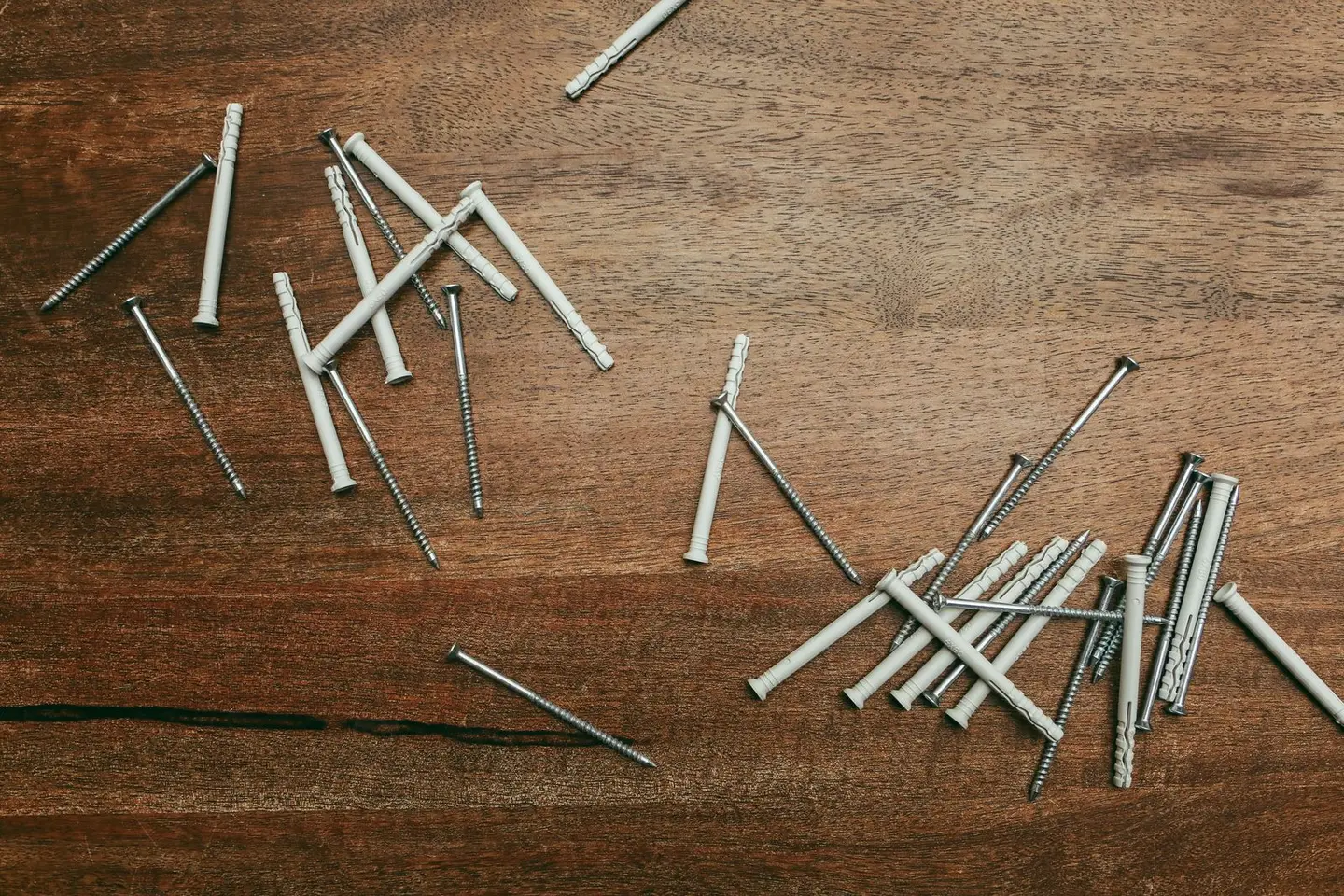
Covered more fully in the wall plugs guide, but frame fixings (long nylon-sleeved screws) and masonry bolts (Rawlbolts) complete the fixing family for direct-to-masonry applications.
Screw Materials and Coatings
The material and surface treatment determine how long a screw will last in a given environment.
| Finish | Typical Use | Outdoor Rated? | Notes |
|---|---|---|---|
| Bright zinc plated (BZP) | Interior timber, general DIY | No | Corrosion within months in damp/outdoor |
| Yellow passivated | Interior joinery | No | Slight improvement over BZP |
| Galvanised (hot-dip) | Structural, treated timber, pressure-treated wood | Yes | Reacts with some CCA timber preservatives |
| A2 stainless steel | Outdoor joinery, decking, marine proximity | Yes | Cost 3–5× BZP; will not rust |
| A4 stainless steel | Marine / coastal environments | Yes (marine) | Higher nickel content; premium price |
| Black phosphate | Drywall, interior hidden fixings | No | Low friction for fast driving |
| Coated / Torx-coated | Decking, cladding, external timber | Yes (check manufacturer) | Proprietary coatings vary in quality |
Important for treated timber: Modern tanalised (pressure-treated) timber uses copper-based preservatives that corrode BZP rapidly. Always use A2 stainless or hot-dip galvanised fixings in treated structural timber.
Drive Types
The drive recess affects how much torque you can apply before camming out (stripping).
- Pozidriv (PZ): The UK standard for general screws, two cross recesses at 45° to each other. PZ2 covers most timber screws.
- Phillips: Visually similar to Pozidriv but designed to cam out at a set torque. Less common in UK trade use.
- Torx (T-drive / star drive): Six-pointed star. Far higher torque transfer without cam-out. Standard on decking and structural screws. Requires matching Torx bits.
- Hex (Allen): Socket-headed bolts and set screws. Used in furniture fittings and engineering.
- Slotted: Legacy application only, flat-bladed driver tends to slip.
Most professional tradespeople now use PZ2 or T20/T25 Torx bits as daily drivers. Investing in a set of high-quality driver bits (£10–£20 from a trade supplier) reduces cam-out and stripped heads significantly.
Screw Dimensions and What They Mean
Screws are specified by diameter × length in millimetres. The diameter is usually the thread diameter. For multi-purpose screws, common sizes:
| Gauge (mm) | Typical Length Range | Common Application |
|---|---|---|
| 3.0 | 12–25 mm | Light joinery, cabinet hinges |
| 3.5 | 20–50 mm | Plasterboard, light timber |
| 4.0 | 25–70 mm | General joinery, stud work |
| 4.5 | 50–100 mm | Structural framing, decking |
| 5.0 | 80–150 mm | Engineered timber, heavy joinery |
| 6.0 | 80–200 mm | Structural connections, landscaping |
Rule of thumb: a screw should penetrate the receiving member by at least twice its diameter, and ideally penetrate two-thirds of the total joint depth for load-bearing connections.
Costs (2026 UK Trade Prices)
Prices vary by retailer and volume; trade card prices at builders’ merchants are typically 20–30% below RRP.
| Fixing Type | Pack Size | Approximate Cost |
|---|---|---|
| Multi-purpose BZP (4.0 × 50 mm) | 200 | £3–£5 |
| Multi-purpose BZP (4.5 × 80 mm) | 100 | £3–£6 |
| A2 stainless multi-purpose | 100 | £10–£18 |
| Decking screws (4.5 × 65 mm, coated) | 100 | £8–£15 |
| Drywall screws (fine thread, 3.5 × 38 mm) | 500 | £5–£9 |
| Coach screws (M10 × 100 mm, hot-dip galv) | 10 | £4–£8 |
| Coach bolts (M10 × 100 mm) | 10 | £4–£7 |
| Self-drilling Tek screws | 100 | £8–£14 |
Choosing the Right Fixing: Quick Checklist
- What are you fixing into? Timber, masonry, steel, or sheet material each require different screws.
- What is the load? Structural connections need larger-gauge screws and a minimum embedment depth; plasterboard fixings cannot carry structural load.
- Is it exposed to moisture? Damp, outdoor, or treated-timber environments require A2/A4 stainless or hot-dip galvanised.
- What drive type does your bit set cover? Buying screws with an incompatible drive wastes time and money.
- Pre-drilling required? In hardwood or near board edges, a pilot hole prevents splitting, drill to 70% of shank diameter.
Building Regulations Relevance
For structural connections in Part A (Structure) work, e.g., floor joists, roof rafters, stud walls, the fixing specification should follow the structural engineer’s design or comply with BS EN 1995 (Eurocode 5 for timber). Joist hanger nails and structural screws must meet minimum dimensions specified by the manufacturer’s ETA (European Technical Assessment). In notifiable structural work, building control will inspect connections.1
Screws and fixings appear simple, but the specification choices ripple through the durability and safety of every joint. Spending an extra £5 on a box of stainless screws for an outdoor deck now prevents a costly callback or, worse, a structural failure later.
References (1)
Figures in this note were checked against the sources below on 14 September 2026. Superscript numbers in the text point to them. Every source the site cites, by topic.
- 1technicalvery strongMinistry of Housing, Communities and Local Government (GOV.UK).RN-Z6AXUWThe full Approved Document A PDF, which carries the deemed-to-satisfy tables a domestic project is checked against. Section 2E covers foundations of plain concrete: paragraph 2E3 gives the recommended minimum widths of strip foundations in Table 10, keyed to ground type and total load of loadbearing walling per linear metre. Table 10 sets, for rock (not inferior to sandstone, limestone or firm chalk, requiring at least a pneumatic or mechanically operated pick to excavate), a width equal to the width of the wall at every load. For medium dense gravel or sand (requires a pick to excavate, a 50mm square wooden peg hard to drive beyond 150mm) and for stiff clay or stiff sandy clay (can be indented slightly by the thumb), the minimum widths are 250mm at 20 kN per linear metre, 300mm at 30, 400mm at 40, 500mm at 50, 600mm at 60 and 650mm at 70. Firm clay and firm sandy clay (thumb makes an impression easily) start at 300mm. The document also covers minimum depth of strip foundations, wall thickness rules for residential buildings up to three storeys (paragraph 2C10 covers internal loadbearing walls in brickwork or blockwork), buttressing, lateral support by floors and at roof level, interruption of lateral support, wall cladding in Section 3, and Section 5 on reducing sensitivity to disproportionate collapse with the building consequence classes.
-
Approved Document A, Structure, 2004 edition incorporating 2004, 2010 and 2013 amendments, Ministry of Housing, Communities and Local Government, accessed 14 September 2026. assets.publishing.service.gov.uk