Your front door is the single most visible element of your home’s exterior and also a primary security point. A good replacement door should do three things well: look right for the property, resist forced entry, and insulate effectively. In 2026, a composite door supply and fitted costs £1,000–£3,000 depending on size and design; timber and aluminium sit higher; standard uPVC lower.1 (2023 price, brought to 2026)
This guide compares every mainstream material and style, explains the security ratings you should know about, and outlines the installation process.
Materials at a Glance
Composite Doors
The most popular choice for UK homes since the 2010s. A composite door has a timber or polyurethane foam core clad with GRP (glass-reinforced plastic) skins, producing a door that looks like timber but is far more stable and requires minimal maintenance.
- Thermal performance: foam-filled cores achieve U-values of 0.8–1.4 W/m²K, well below the Part L limiting value of 1.4 W/m²K for a replacement door in an existing dwelling. The 1.8 W/m²K figure still quoted in places was a transitional allowance for timber doors that expired on 14 June 2023; since 15 June 2023 the full 1.4 standard applies.2 1.8 survives only for an external fire doorset as defined in Approved Document B.
- Security: most composite doors meet PAS 24 as standard and are available to Secured by Design specification.
- Maintenance: wipe down with soapy water; no painting required.
- Cost (supply & fit): £1,000–£3,000 for a standard single door.
Timber Doors
Traditional hardwood (oak, meranti, sapele) or softwood (Scots pine, Scandinavian redwood) doors suit period properties where character and authenticity matter. High-quality hardwood doors are structurally superior and can be repaired indefinitely; softwood doors are cheaper but more prone to swelling and rot if poorly maintained.
- Thermal performance: solid timber has a U-value of around 2.0–3.5 W/m²K; engineered timber with insulated cores can reach 1.0 W/m²K.
- Security: requires multi-point locking to meet PAS 24; older hardwood doors with single locks can be upgraded.
- Maintenance: paint or stain every 3–5 years; check for moisture ingress around frame joints.
- Cost (supply & fit): £1,500–£5,000+ for hardwood; £800–£2,000 for softwood.
uPVC Doors
The budget choice. Modern uPVC reinforced with a steel subframe performs adequately on insulation and security, but many homeowners find the aesthetic limiting, profile shapes are constrained and colour options (though improving) do not match timber or composite.
- Thermal performance: U-values of 1.2–1.8 W/m²K.
- Security: multi-point locking is standard; PAS 24-rated products are available.
- Maintenance: virtually none; will yellow slightly after 15–20 years in direct sunlight.
- Cost (supply & fit): £700–£1,500.
Aluminium Doors
Increasingly popular for contemporary properties. Slim aluminium profiles allow large glazed panels and sharp sightlines. More expensive than uPVC or composite but highly durable and available in any RAL colour via powder coating.
- Thermal performance: thermally broken aluminium frames achieve U-values of 1.0–1.6 W/m²K.
- Security: structural integrity is high; PAS 24 and even RC2 (EN 1627) ratings are available.
- Maintenance: minimal, powder coating does not peel or fade for 20–30 years.
- Cost (supply & fit): £2,000–£5,000+.
Material Comparison Table
| Material | Typical U-value (W/m²K) | PAS 24 available? | Maintenance | Typical installed cost |
|---|---|---|---|---|
| uPVC | 1.2–1.8 | Yes | Very low | £700–£1,500 |
| Composite (GRP) | 0.8–1.4 | Yes (standard) | Very low | £1,000–£3,000 |
| Softwood timber | 2.0–3.0 | With upgrade | Medium-high | £800–£2,000 |
| Hardwood timber | 1.5–2.5 | With upgrade | Medium | £1,500–£5,000+ |
| Aluminium | 1.0–1.6 | Yes | Very low | £2,000–£5,000+ |
Security Ratings Explained
PAS 24:2022 is the UK standard for enhanced security performance of doorsets. Any door sold as “Secured by Design” or compliant with Approved Document Q (Building Regulations for new-build dwellings) must meet PAS 24 as a minimum. It tests the doorset, door leaf, frame, glass, hinges, letter plate, and lock, as a unit.
Secured by Design (SBD) is a UK police initiative. Doors carrying the SBD mark have been tested and certified to PAS 24 or higher. Insurance companies often recognise SBD products.
LPS 1175 and EN 1627 RC2/RC3 are higher attack-resistance standards relevant to commercial or high-security residential applications.
For most homes, a PAS 24-rated composite or aluminium door with a five-point locking system, anti-bump/anti-pick cylinder (e.g. TS007 3-star rated), and door chain or viewer is the right specification.
Styles and Designs
Panel Styles
- Solid panel, traditional; maximum insulation, no glazing.
- Half-glazed, glazed upper half; suits Victorian and Edwardian terraces.
- Full-glazed, frameless or near-frameless glass; contemporary aesthetic; use laminated safety glass.
- Cottage style, stable-door design with upper and lower sections opening independently; suits rural or period homes.
Colour
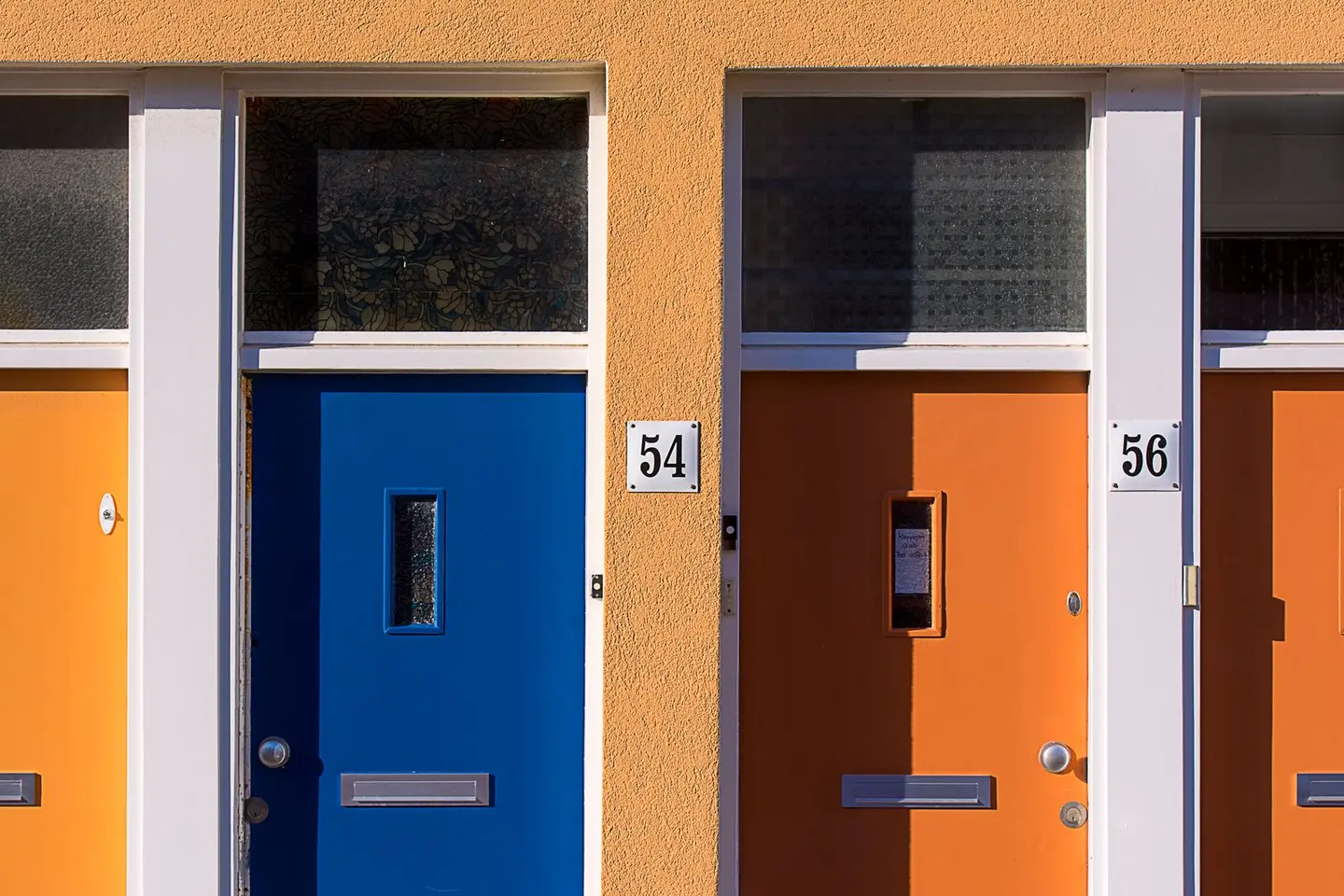
RAL 7016 (anthracite grey) and RAL 9005 (jet black) dominate UK composite and aluminium sales. Traditional Victorian or Georgian homes suit Farrow & Ball-palette colours, estate blue, off-black, red oxide. uPVC offers a narrower but improving range; composite can be sprayed in any colour.
Period Considerations
- Victorian/Edwardian terraces: Four- or six-panel design; stained-glass toplights; cast-iron letterbox.
- 1930s semi: Arched or square-top glazing; oak-effect composite suits the era.
- Post-war estates: Simple panel door or contemporary composite; avoid over-decorating.
- Conservation areas: May require timber doors in a traditional style; check with the local planning authority.
Installation Process
Replacing a front door typically takes 3–6 hours for an experienced installer. The process:
- Survey: installer measures the opening, checks frame condition, and notes any subsidence or damage.
- Frame choice: if the existing frame is sound, a door-only replacement (“rebate fit”) is cheaper. A full frame replacement is needed if timber has rotted or dimensions need changing.
- Removal: old door and frame stripped out; masonry checked for damage.
- Frame installation: new frame bedded in expanding foam, fixed with frame anchors into masonry at 600 mm centres.
- Door hanging: door leaf hung on multi-point hinges, hardware fitted, locks adjusted.
- Finishing: mastic sealant around the perimeter; internal architrave fitted; threshold adjusted.
A full doorset replacement (door + frame) takes longer and costs £150–£300 more in labour than a door-only swap.
Building Regulations
Under Part L of the Building Regulations (England), a replacement external door in an existing dwelling must achieve a maximum U-value of 1.8 W/m²K for the whole doorset. Most modern composite and uPVC doors comfortably beat this. You do not need Building Regulations approval for a like-for-like replacement, but the installer must self-certify compliance or notify the local authority.2
If the work is done by a registered FENSA or Certass member (or a similarly approved scheme), they handle notification automatically.
What to Budget For
- Standard composite door, supply and fit, mid-range design: £1,200–£1,800
- Premium composite with side panels and overhead glazing: £2,500–£4,000
- Hardwood bespoke door with period fittings: £3,000–£6,000+
- Letter plate upgrade alone (if keeping existing door): £50–£150 fitted
- Cylinder upgrade to TS007 3-star: £40–£80 fitted
Always ask for a written quote that itemises the door, frame (if included), hardware, glazing specification, and installation, this makes comparing multiple quotes much easier.
The rules in this note are those that apply in England. Scotland, Wales and Northern Ireland have their own building standards and permitted development rights.
References (2)
Figures in this note were checked against the sources below on 14 September 2026. Superscript numbers in the text point to them. Every source the site cites, by topic.
- 1coststrong locallyWelwyn Hatfield Borough Council, a government page.RN-CVCUIVA price, true at 2023-06, brought forward on the Construction Output Price Index. Appendix B of a council's repairs and maintenance policy, the rechargeable repairs price list, with the useful note that prices were correct at February 2025 and are uplifted by September CPI each year. A dated and openly indexed schedule, which is better documented than most. Still a landlord recharge including administration, so it reads above a bare trade rate.
- 2technicalvery strongMinistry of Housing, Communities and Local Government.RN-L0FCJXThe in-force U-value tables a DIY insulation or door note must quote, with the exact numbers. Table 4.2, limiting U-values for new fabric elements in existing dwellings, sets roof 0.15, wall 0.18, floor 0.18, swimming pool basin 0.25, window 1.4 or Window Energy Rating Band B minimum, rooflight 2.2, doors with more than 60 per cent of the internal face glazed 1.4 or Doorset Energy Rating Band C minimum, and other doors 1.4 or Doorset Energy Rating Band B minimum. Table 4.3, for existing elements, gives a roof threshold of 0.35 and an improved value of 0.16, which is the figure a loft insulation note needs: paragraph 4.12 says a retained element whose U-value is higher than the column (a) threshold, for example through a loft or garage conversion, should be upgraded to the column (b) value. Paragraph 4.13 allows a lesser upgrade only where the improved value is not technically or functionally feasible or would not achieve a simple payback of 15 years or less. Paragraph 4.8 requires a replacement element to be no worse than the one it replaces as well as meeting Table 4.2. Paragraph 4.10 gives the heritage exception: where character must be maintained, a centre pane U-value of no more than 1.2 or low-emissivity secondary glazing. Note 9 records that the timber window concession of 1.6 or Band C ended on 14 June 2023. The 2021 edition came into force on 15 June 2022; a 2026 edition exists at https://assets.publishing.service.gov.uk/media/69c122a6cfa346b9d4704a55/ADL1_2026.pdf.
-
Rechargeable repairs price list 2025, Welwyn Hatfield Borough Council, accessed 18 September 2026. Priced at 2023-06; brought to 2026 on the Construction Output Price Index, housing repair and maintenance (Great Britain), published by Office for National Statistics, a factor of 1.0358. welhat.gov.uk
-
Approved Document L, Conservation of fuel and power, Volume 1: Dwellings, 2021 edition incorporating 2023 amendments, Ministry of Housing, Communities and Local Government, accessed 14 September 2026. assets.publishing.service.gov.uk