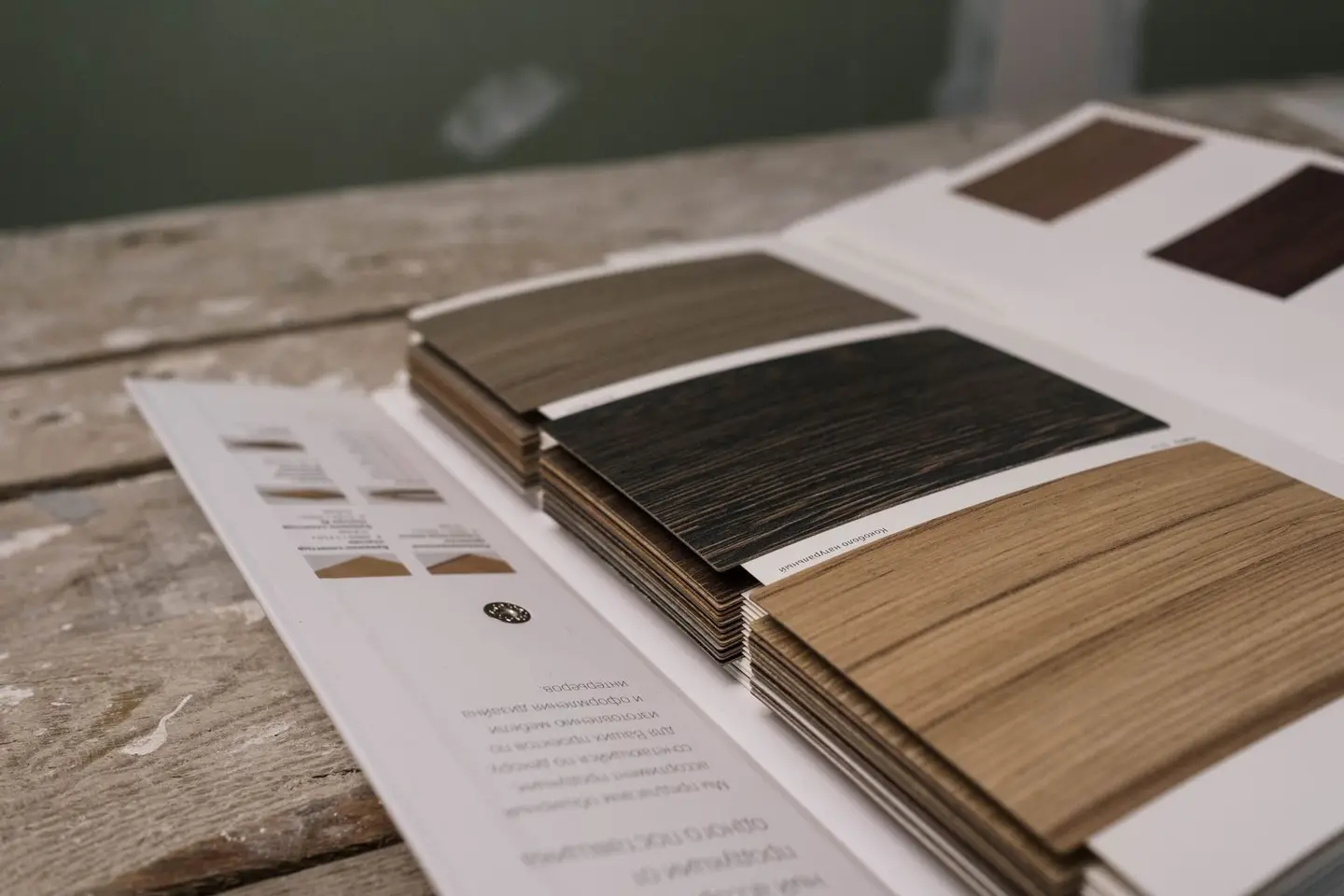
MDF and solid timber both appear throughout UK home joinery, skirting boards, architraves, shelving, fitted wardrobes, stair components, yet they suit very different situations. The wrong choice leads to swollen edges, cracked paint, or unnecessary cost. This guide compares them on the dimensions that matter most.
What They Are
MDF (Medium Density Fibreboard) is engineered from wood fibres bonded with resin under heat and pressure. The result is a dense, smooth, homogeneous panel with no grain, no knots, and consistent thickness. Standard boards are 2,440 × 1,220 mm in thicknesses from 3 mm to 30 mm. Moisture-resistant (MR) grade MDF, often green-tinted, uses a more water-resistant resin binder.
Solid timber covers a wide range. In domestic joinery you will encounter:
- Softwoods (Scots pine, redwood, whitewood), the default for skirting, architraves, and site-made shelving. Sold as PAR (Planed All Round) in standard cross sections.
- Hardwoods (oak, ash, tulipwood), used for stair treads, worktops, and high-end fitted joinery. Significantly more expensive.
- Engineered timber (glulam, LVL), structural; outside the scope of typical interior joinery.
Material Costs (2026 UK)
| Material | Form | Typical cost |
|---|---|---|
| Standard MDF | 18 mm sheet, 2,440 × 1,220 mm | £25–£40 |
| Moisture-resistant MDF | 18 mm sheet, 2,440 × 1,220 mm | £35–£55 |
| Softwood PAR (pine) | 25 × 100 mm, per linear metre | £3–£6 |
| Softwood PAR (pine) | 25 × 150 mm, per linear metre | £5–£8 |
| Oak PAR | 25 × 100 mm, per linear metre | £12–£22 |
| Oak PAR | 50 × 250 mm (shelf-grade), per linear metre | £30–£55 |
| MDF skirting (pre-profiled) | Per linear metre | £2–£51 |
| Solid pine skirting (pre-profiled) | Per linear metre | £3–£8 |
| Solid oak skirting | Per linear metre | £10–£20 |
Labour for fitting skirting and architrave typically runs at £150–£250 per day for a joiner, with a standard room taking two to four hours.
Key Properties Compared
| Property | MDF | Solid softwood | Solid hardwood |
|---|---|---|---|
| Surface smoothness | Excellent, paints perfectly | Good, grain visible through paint | Excellent for clear finishes |
| Stability (humidity) | Poor, swells if wet | Moderate, moves seasonally | Moderate to good |
| Machinability | Excellent, routers cleanly | Good | Good, but dulls blades faster |
| Screw holding (face) | Good with coarse thread | Good | Excellent |
| Screw holding (edge) | Poor, crumbles | Good | Good |
| Weight (18 mm per m²) | ~13 kg | ~8–10 kg | ~11–15 kg |
| VOC off-gassing | Yes, formaldehyde (diminishes with time) | Low | Low |
| Paintability | Excellent after sealing edges | Good | Best left clear or stained |
| Natural appearance | None | Grain visible | Rich grain |
| Cost (relative) | Low | Low–medium | High |
When to Choose MDF
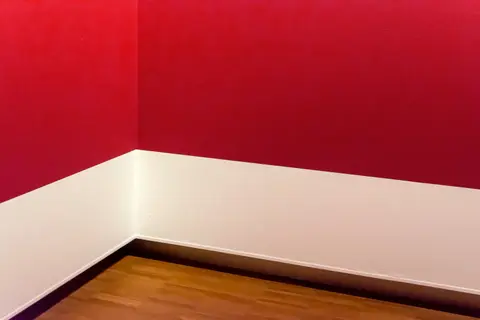
Painted joinery in dry rooms is where MDF excels. Skirting boards, architraves, windowsills (internal, dry), door stops, built-in cabinet carcasses, and alcove shelving painted with a water-based or oil-based paint are all strong candidates. The smooth, knot-free face takes paint cleanly with minimal preparation, seal the edges with diluted PVA or a purpose-made MDF primer, sand back, and the result is indistinguishable from solid timber at a fraction of the cost.
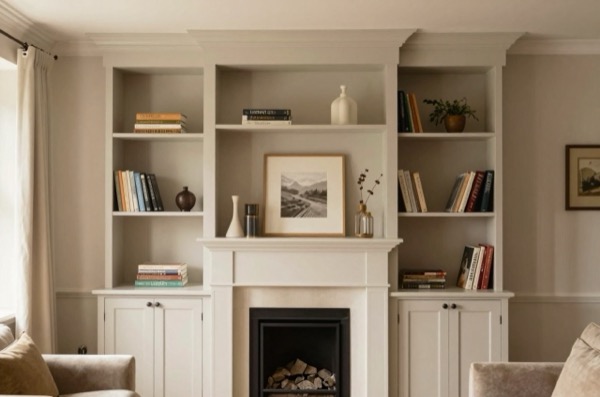
Fitted wardrobes and alcove units, MDF sheet goods are the industry default for carcass construction. CNC-cut panels from 18 mm MDF provide consistent dimensions, excellent flatness, and easy machining for shelf pin holes and cam-lock fixings.
Intricate profiles, MDF can be routed to any ogee, ovolo, or chamfer profile with no tear-out and no grain inconsistency. For complex cornice or dado rail profiles, it is often cheaper to rout MDF than to machine equivalent solid timber.
When to Choose Solid Timber
Areas with moisture, bathrooms, cloakrooms, utility rooms, and around sinks. Even MR MDF is not fully waterproof; solid timber (particularly hardwood) copes far better with intermittent damp, though it still needs sealing. For wet areas, solid timber or PVC-cased MDF mouldings are safer choices.
Structural load-bearing shelves, MDF deflects more than solid timber or plywood under heavy loads. A 900 mm MDF shelf at 18 mm will sag noticeably under a row of hardback books; a 22 mm pine shelf of the same span will not. Either add a support rail or switch to solid timber or 18 mm birch plywood for loaded spans over 600 mm.
Natural-finish joinery, stained, oiled, or clear-lacquered joinery showing visible grain. MDF has no grain. Solid oak, pine, or ash is the only choice where a natural wood appearance is desired.
Outdoor joinery, standard and MR MDF are not rated for external use. Solid hardwood (treated or naturally durable species) or exterior-grade composite is required.
Fixings at edges, MDF edge screw holding is poor. Where a shelf bracket or hinge lands in an MDF edge, the material will eventually crumble. Use solid timber or specify metal inserts (T-nuts or barrel nuts) for edge-loaded fixings.
Painting MDF: the Key Step Most People Skip
MDF edges are highly absorbent. Without sealing, they drink paint and swell slightly with water-based products. Always:
- Sand edges to 120 grit.
- Apply one coat of diluted PVA (3 parts PVA : 1 part water) or a dedicated MDF primer.
- Allow to dry fully (minimum two hours), then sand lightly with 180 grit.
- Apply full coats of primer and topcoat as normal.
Face sides need only a light 180-grit sand before priming.
Health and VOCs
New MDF contains urea-formaldehyde resin, which off-gasses VOCs at measurable levels. The risk diminishes significantly once the board is sealed with paint or lacquer, but during cutting, especially with a router or circular saw, the dust is fine and the release significant. Always cut in a ventilated space, wear an FFP3 dust mask, and use dust extraction at source. Structural MDF and low-VOC MDF variants are available for sensitive environments.
Summary: Quick Decision Guide
- Painted skirting/architrave, dry room → MDF (cheaper, better paint finish)
- Bathroom skirting → solid timber or PVC-wrapped MDF moulding
- Wardrobe carcass → MDF sheet (18 mm)
- Heavy-load shelving > 600 mm span → solid pine or birch plywood
- Natural wood appearance → solid timber
- Stair strings and treads → solid hardwood (oak standard)
- Budget dado/coving in a dry room → MDF
References (1)
Figures in this note were checked against the sources below on 14 September 2026. Superscript numbers in the text point to them. Every source the site cites, by topic.
- 1costsupplier figureLawsons (Whetstone) Ltd.RN-86VVKJA price, true at 2026-09. the retail price Lawsons (Whetstone) Ltd publishes for MDF Skirting, which is the supply figure the cost book records for this item
-
MDF Skirting, Lawsons (Whetstone) Ltd, accessed 15 September 2026. Priced at 2026-09, so no calibration is needed. lawsons.co.uk