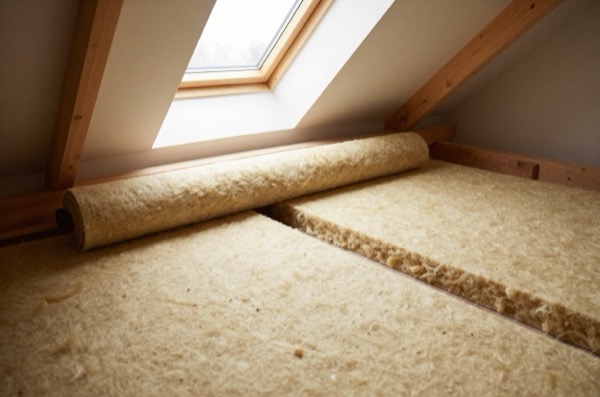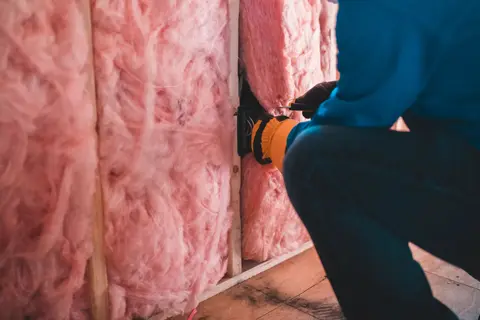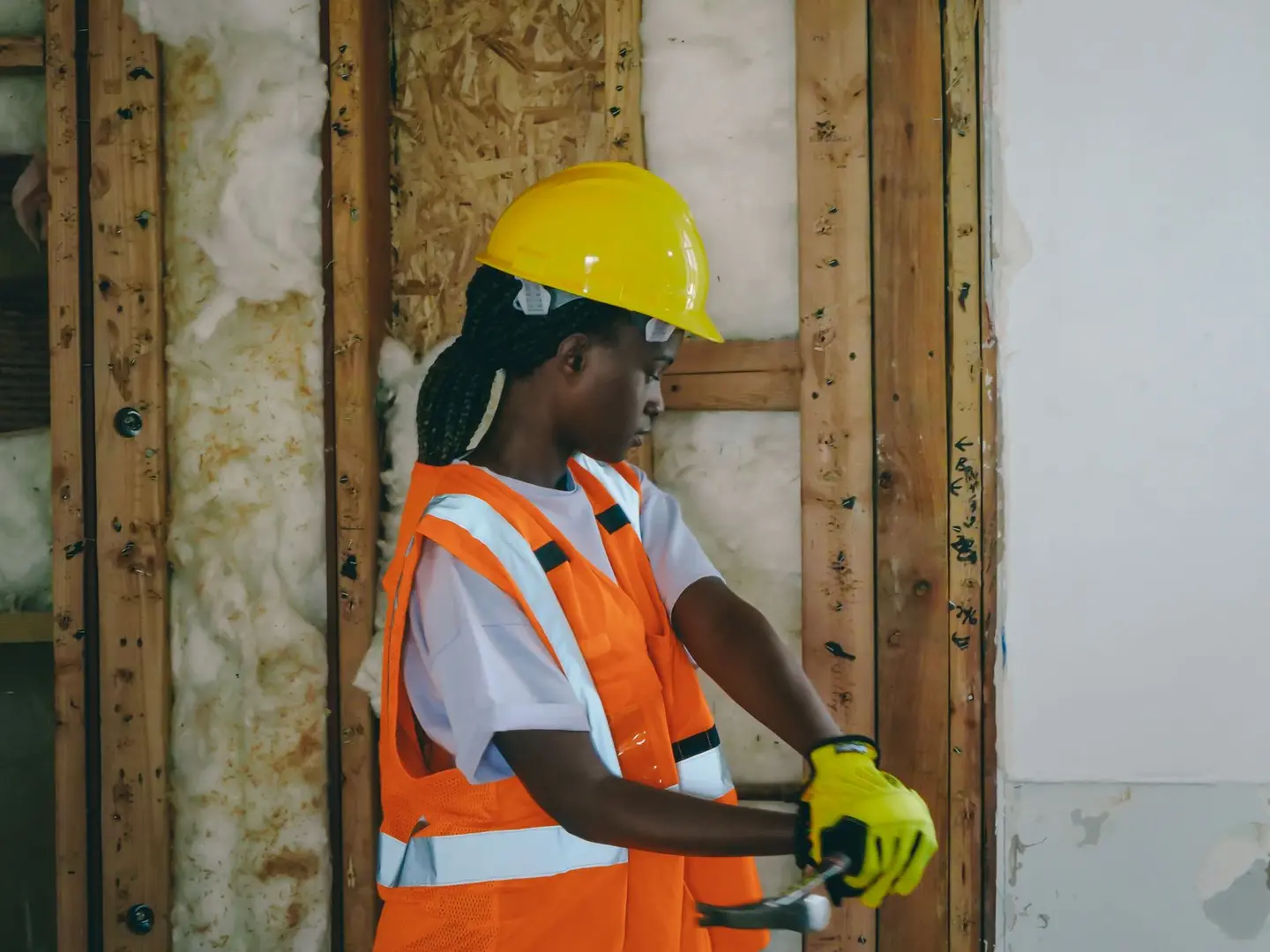
“Mineral wool” covers two quite different products that are often confused: stone wool (sold under brand names like Rockwool and Rocksilk) and glass wool (sold as Knauf Earthwool, Isover, and others). Both are made from inorganic fibres bonded into batts or rolls, and both provide thermal and acoustic insulation, but their performance profiles, fire behaviour, and best applications differ meaningfully.
Understanding the distinction helps you specify the right product rather than defaulting to whatever the merchant has in stock.
What Is Mineral Wool?
All mineral wool insulation is made by melting raw material and spinning it into fine fibres, which are then bonded with a binder (usually a thermosetting resin) and compressed into rolls, batts, or rigid slabs. The fibre is naturally non-combustible, the raw material either melts at very high temperatures (stone wool) or softens and fuses without propagating flame (glass wool).
The key distinctions:
| Property | Stone wool (Rockwool) | Glass wool |
|---|---|---|
| Raw material | Basalt rock / blast furnace slag | Recycled glass (70%+ typically) |
| Melting point | >1,000°C | ~600°C |
| Density range | 30–180 kg/m³ | 10–48 kg/m³ |
| Typical λ (thermal conductivity) | 0.034–0.044 W/mK | 0.032–0.044 W/mK |
| Fire classification | A1 (non-combustible) | A1 (non-combustible) |
| Acoustic performance | Higher (denser, better sound absorption) | Moderate |
| Relative cost | Higher | Lower |
| Water resistance | Good (hydrophobic treatment standard) | Moderate |
Thermal Performance Compared
Both materials achieve similar thermal conductivity values when comparing like-for-like densities. The λ value (W/mK) is the number to compare: lower is better.
| Product type | Typical λ (W/mK) | Density (kg/m³) |
|---|---|---|
| Glass wool loft roll (standard) | 0.044 | 10–14 |
| Glass wool loft roll (higher performance) | 0.040 | 16–20 |
| Stone wool roll (Rockwool Roll, Twin Roll) | 0.044 | 23–30 |
| Stone wool rigid slab (Rockwool RWA45) | 0.035 | 45 |
| Stone wool rigid slab (high-density, Rockwool RW3) | 0.034 | 60 |
Rockwool’s own datasheet puts RWA45 slabs at 0.035 W/mK and its denser RW3 slab at 0.034 W/mK.1 Knauf’s standard glass wool loft rolls, for comparison, are 0.040–0.044 W/mK.2 Rockwool’s own loft rolls (Roll, Twin Roll and Rollbatt) are 0.044 W/mK, so a stone wool roll is no better thermally than a glass wool roll.3
In practice, the difference in λ between comparable products is small enough that thickness matters more than brand. A 200 mm layer of good glass wool roll (λ = 0.038) gives roughly U = 0.18 W/m²K in a standard ventilated loft, short of the 0.16 W/m²K that Building Regulations Part L sets when an existing roof is renovated; a total of around 250–270 mm gets there.4 The same thickness of stone wool roll performs much the same.
Where stone wool’s density advantage shows up is in rigid-slab applications: a 50 mm Rockwool slab at 45 kg/m³ is stiffer and more dimensionally stable than glass wool at the same thickness, which matters in cavity walls and rafter applications where the product must stay put without mechanical restraint.
Fire Resistance: Where Stone Wool Wins Clearly
Both stone wool and glass wool carry an A1 Euroclass fire classification under BS EN 13501-1, meaning neither contributes to fire growth.21 However, there is an important distinction in their behaviour at extreme temperatures:
- Stone wool (basalt): Resists temperatures of over 1,000°C, so it keeps its structure in a fire.1 This makes it suitable as a fire-protection product, not just insulation. It is used in fire-rated duct wraps, structural steel protection, and fire barriers in compartment walls.
- Glass wool: The glass softens and melts at a much lower temperature than stone wool.5 Rockwool, which makes stone wool, puts glass wool’s melting point at around 600°C.6 It will not burn or propagate flame, but it loses structural integrity at temperatures that stone wool withstands. It is not suitable for applications where the insulation must maintain integrity during a fire.
For residential renovation purposes this matters in:
- Party wall fire barriers (Building Regs Part E/B)7
- Roof void fire stops in HMOs and flats
- Penetration seals around pipes and cables in fire-rated compartments
- Fire protection of structural steelwork (in conversions and extensions)
In all of these applications, specify stone wool. Glass wool is not an appropriate substitute even though both are technically “mineral wool” and both carry A1 classification.
Acoustic Performance
Stone wool’s higher density gives it an edge as an acoustic insulator. The key metric for partitions is the weighted sound reduction index (Rw), and for mid-frequency sound (voices, TV), denser insulation in a timber-frame partition can add a few decibels of attenuation compared with lighter glass wool, although in a lightweight stud partition the difference is often small.
For separating floors in flats or conversions subject to Part E of the Building Regulations, stone wool is a common choice. The figures are worth getting right because three things get mixed up. The measure is DnT,w + Ctr, tested in the finished building, not Rw, which is a laboratory value. A purpose built flat needs 45 dB or better on separating walls and floors; one formed by a material change of use, which is what most conversions are, needs 43 dB.8 And a separating floor carries a second figure that walls do not: impact sound, at a maximum of 62 dB L’nT,w purpose built or 64 dB on a conversion.8 Rockwool’s Flexi slab appears in registered Robust Details for separating walls, such as E-WT-1 (twin timber frame).9
For simple draught-proofing or thermal loft insulation where sound is not a concern, glass wool is perfectly adequate.
Cost Comparison (2026 UK Supply Prices)
| Product | Format | Cost (supply only) |
|---|---|---|
| Glass wool loft roll, 100 mm | Roll (~8 m²) | £2.50 – £4.00/m² |
| Glass wool loft roll, 200 mm | Roll (~5 m²) | £5.50 – £8.00/m² |
| Glass wool rafter/wall batt | 100 mm, per m² | £4.00 – £7.00/m² |
| Stone wool roll (general) | 100 mm, per m² | £5.00 – £8.00/m² |
| Rockwool RWA45 slab, 50 mm | Per m² | £6.00 – £9.00/m² |
| Rockwool RWA45 slab, 100 mm | Per m² | £10.00 – £14.00/m² |
| Knauf Rocksilk RS60/RS80 stone wool slab | 50 mm, per m² | £8.00 – £12.00/m² |
| Rockwool acoustic partition slab | 50 mm, per m² | £7.00 – £11.00/m² |
RS60 and RS80 are Knauf’s Rocksilk stone wool slabs, not Rockwool products; a 50 mm pack of RS60 covering 6.48 m² sold for £53.92 including VAT in September 2026, about £8.30/m².10
Prices are for merchant supply; DIY-store prices for rolls are typically 10–20% higher. Installation costs vary enormously by application, loft rolls are a standard DIY task; fitting batts between rafters or in party walls is typically contractor work at £10–£20/m² labour.
Which to Choose for Common Applications
Loft insulation (accessible, between joists): Glass wool roll is the cost-effective choice. It’s lighter, easier to manoeuvre in a low loft, and performs at least as well as a stone wool roll thermally in this application. Install 100 mm between joists and a second 270 mm layer across the joists for a total 370 mm to achieve approximately U = 0.11 W/m²K.
Rafter insulation (warm roof or between-and-below): Stone wool batts cut more cleanly and hold their shape between rafters without sagging. For a warm loft conversion, you’re typically fitting batts between rafters and a second layer below, stone wool’s dimensional stability earns its price premium here.
Timber-frame wall (structural): Either works thermally; use stone wool if Part E acoustic performance is required, which it is for separating walls and floors in new homes and in homes formed by a material change of use, such as a house converted into flats (Approved Document E).8
Party wall or separating floor: Use the insulation the tested construction specifies, which is usually a stone wool product. On a new house or flat, building to a registered Robust Detail can replace pre-completion sound testing; a conversion formed by a material change of use still has to be tested.8
Fire-stopping or fire-rated duct wrap: Stone wool only. Do not substitute glass wool.
Cavity wall (retrofit, professional injection): Neither roll product, cavity wall installers use purpose-made blown mineral wool, either glass wool (such as Knauf Supafil) or stone wool, installed to PAS 2035/2030:2023 under the system’s own BBA certificate or ETA.11 Note that BS 5617, still quoted in places for cavity fill, was specific to urea-formaldehyde foam and was withdrawn on 2 January 2024.12
Handling and Health
Both products can cause temporary skin and throat irritation from loose fibres during cutting. Modern mineral wool fibres are made to be bio-soluble, and Rockwool states that its stone wool is not suspected of being carcinogenic under the CLP Regulation.13 Standard precautions still apply: gloves, eye protection and a disposable dust mask when cutting. Rockwool’s safe use sheet specifies at least an FFP1 mask to EN 149 in confined spaces or dusty work; an FFP2 or FFP3 mask gives a wider margin in a cramped loft.13
The rules in this note are those that apply in England. Scotland, Wales and Northern Ireland have their own building standards and permitted development rights.
References (13)
Figures in this note were checked against the sources below on 2 October 2026. Superscript numbers in the text point to them. Every source the site cites, by topic.
- 1technicalsupplier figureROCKWOOL Ltd, guidance.RN-4A34DNRockwool UK's datasheet for its general-purpose stone wool slabs. It gives nominal densities (RWA45 45 kg/m3, RW3 60 kg/m3), declared thermal conductivities, Euroclass A1 and resistance to temperatures over 1,000°C.
- 2technicalsupplier figureKnauf Insulation, guidance.RN-CIMOVVThe maker's datasheet for its glass mineral wool rolls. It confirms that glass wool rolls have a thermal conductivity of 0.040 to 0.044 W/mK, the upper end of the quoted range.
- 3technicalsupplier figureROCKWOOL Ltd, guidance.RN-NL78OORockwool's loft roll datasheet, whose U-value table gives 0.16 W/m²K for 100 mm between joists plus 170 mm over them, 270 mm in total; it settles the build-up and U-value.
- 4technicalvery strongMinistry of Housing, Communities and Local Government.RN-L0FCJXThe in-force U-value tables a DIY insulation or door note must quote, with the exact numbers. Table 4.2, limiting U-values for new fabric elements in existing dwellings, sets roof 0.15, wall 0.18, floor 0.18, swimming pool basin 0.25, window 1.4 or Window Energy Rating Band B minimum, rooflight 2.2, doors with more than 60 per cent of the internal face glazed 1.4 or Doorset Energy Rating Band C minimum, and other doors 1.4 or Doorset Energy Rating Band B minimum. Table 4.3, for existing elements, gives a roof threshold of 0.35 and an improved value of 0.16, which is the figure a loft insulation note needs: paragraph 4.12 says a retained element whose U-value is higher than the column (a) threshold, for example through a loft or garage conversion, should be upgraded to the column (b) value. Paragraph 4.13 allows a lesser upgrade only where the improved value is not technically or functionally feasible or would not achieve a simple payback of 15 years or less. Paragraph 4.8 requires a replacement element to be no worse than the one it replaces as well as meeting Table 4.2. Paragraph 4.10 gives the heritage exception: where character must be maintained, a centre pane U-value of no more than 1.2 or low-emissivity secondary glazing. Note 9 records that the timber window concession of 1.6 or Band C ended on 14 June 2023. The 2021 edition came into force on 15 June 2022; a 2026 edition exists at https://assets.publishing.service.gov.uk/media/69c122a6cfa346b9d4704a55/ADL1_2026.pdf.
- 5technicalsupplier figureKnauf Insulation, guidance.RN-8A9HMCKnauf Insulation, which makes both glass and rock mineral wool, compares the two and states that rock mineral wool has the higher melting point.
- 6technicalsupplier figureROCKWOOL Ltd, guidance.RN-B4UQMJROCKWOOL UK's guide to mineral wool states that glass wool melts at around 600°C while stone wool withstands fire temperatures above 1,000°C; the note attributes the glass wool figure to Rockwool.
- 7technicalvery strongMinistry of Housing, Communities and Local Government.RN-J0UZDBApproved Document B Volume 1, fire safety in dwellings, 2019 edition with the 2020, 2022 and 2025 amendments and the forthcoming 2026 and 2029 changes collated in. Covers means of warning and escape, internal fire spread through linings and structure, external fire spread and access for the fire service. This is the document behind escape window sizes, protected stairways, the 4.5 metre rule and the fire doors a loft conversion needs.
- 8technicalvery strongMinistry of Housing, Communities and Local Government.RN-35VE7WTable 0.1a sets separating element performance for dwellings: purpose built walls a minimum 45 dB DnT,w + Ctr, floors and stairs 45 dB airborne and a maximum 62 dB L'nT,w impact; where a dwelling is formed by material change of use the figures relax to 43 dB airborne and 64 dB impact. Table 0.2 sets the laboratory value for new internal walls and floors within a dwelling at a minimum 40 dB Rw. Requirement E2 covers internal walls between a bedroom or a room containing a WC and other rooms, and internal floors, but expressly does not apply to an internal wall containing a door, a wall separating an en suite toilet from its own bedroom, or existing walls and floors in a material change of use. Section 5 gives internal wall types A to D and internal floor types A to C, including timber or metal stud with plasterboard and mineral wool; paragraph 5.14 requires all gaps around internal walls to be filled.
- 9technicalsupplier figureROCKWOOL Ltd, guidance.RN-J2R75JRockwool UK's datasheet for its Flexi stone wool slab. It lists the Robust Details separating wall constructions that use it: E-WT-1 and E-WT-2 (twin timber frame) and E-WS-1 (twin steel frame).
- 10costsupplier figureInsulation UK.RN-IU37A5A price, true at 2026-09. A UK insulation merchant's product page for Knauf Rocksilk RS60 stone wool slab, 50 mm, 1200 x 600 mm, sold in packs of nine, with its price including VAT.
- 11technicalsupplier figureKnauf Insulation, guidance.RN-NUJR3GKnauf Insulation's datasheet for Supafil 40, a BBA-certified glass mineral blowing wool for full-fill masonry cavity walls, showing that blown cavity wool is not only stone wool.
- 12technicalstrongBSI, guidance.RN-PY45YZBSI listing for BS 5617:1985, showing it specified urea-formaldehyde foam cavity fill (not polyurethane) and was withdrawn on 2 January 2024.
- 13technicalsupplier figureROCKWOOL Ltd, guidance.RN-0HD8KXRockwool UK's safe use instruction sheet for its stone wool insulation. It covers the fibres' bio-solubility and CLP status and the protective equipment recommended when handling and cutting.
-
RW Slabs (RWA45, RW3, RW4, RW5 & RW6) technical datasheet, version 1.04, March 2026, ROCKWOOL Ltd, accessed 30 September 2026. rockwool.com
-
Loft Roll 40 and 44 datasheet, Knauf Insulation, accessed 30 September 2026. pim.knaufinsulation.com
-
ROCKWOOL Roll, Twin Roll and Rollbatt datasheet, ROCKWOOL Ltd, accessed 2 October 2026. rockwool.com
-
Approved Document L, Conservation of fuel and power, Volume 1: Dwellings, 2021 edition incorporating 2023 amendments, Ministry of Housing, Communities and Local Government, accessed 30 September 2026. assets.publishing.service.gov.uk
-
Glass and Rock Mineral Wool Compared, Knauf Insulation, accessed 30 September 2026. knauf.com
-
What is mineral wool insulation and why you should use it, ROCKWOOL Ltd, accessed 30 September 2026. rockwool.com
-
Approved Document B (fire safety) volume 1: Dwellings, 2019 edition incorporating 2020, 2022, 2025 and 2026 amendments, Ministry of Housing, Communities and Local Government, accessed 14 September 2026. assets.publishing.service.gov.uk
-
Approved Document E, Resistance to the passage of sound, 2003 edition incorporating 2004, 2010, 2013 and 2015 amendments, Ministry of Housing, Communities and Local Government, accessed 14 September 2026. assets.publishing.service.gov.uk
-
Flexi technical datasheet, ROCKWOOL Ltd, accessed 30 September 2026. rockwool.com
-
50mm Knauf Rocksilk RS60 Building Slab 1.2m x 600mm, Insulation UK, accessed 30 September 2026. Priced at 2026-09 and left there. insulationuk.co.uk
-
Supafil 40 datasheet, May 2024, Knauf Insulation, accessed 30 September 2026. pim.knaufinsulation.com
-
BS 5617:1985 Specification for urea-formaldehyde (UF) foam systems suitable for thermal insulation of cavity walls with masonry or concrete inner and outer leaves, BSI Knowledge, accessed 30 September 2026. knowledge.bsigroup.com
-
Safe use instruction sheet: ROCKWOOL stone wool insulation products, December 2022, ROCKWOOL Ltd, accessed 30 September 2026. rockwool.com