Bathroom tiles in the UK range from around £10/m² for standard ceramic wall tiles to £150/m² or more for natural stone such as marble or travertine. Supply costs are only part of the picture, tiling labour runs £35–£60/m² depending on format and surface, adhesive and grout add another £5–£20/m², and wastage (10–20% depending on layout pattern) means you should always order more than your room area suggests.1
Choosing the right tile involves matching material to application (walls vs floors), checking slip resistance for wet zones, confirming suitability for underfloor heating if applicable, and selecting a layout pattern before calculating quantities. This guide covers each factor in turn.
Types of Bathroom Tile
Ceramic Wall Tiles
Ceramic tiles are kiln-fired clay body products covered with a glaze. They are the most widely used wall tile in UK bathrooms and are straightforward to cut and fix. Supply cost is typically £10–£40/m² for standard ranges, with designer collections running higher.2
Key limitations: ceramic tiles are relatively porous compared to porcelain (water absorption typically 3–10%), which makes them unsuitable for most floor applications. The glaze is also softer, so ceramic is not recommended for high-traffic floors. For walls and splashbacks, however, they are perfectly adequate and meet the requirements of BS EN 14411, the European standard covering ceramic tiles, which classifies tiles first by forming method, group A extruded and group B dry-pressed, then by water absorption, so a dry-pressed tile lands somewhere between BIa and BIII.3
Porcelain Floor and Wall Tiles
Porcelain is a denser, lower-absorption variant of ceramic, fired at higher temperatures. Water absorption is below 0.5% (Group BIa under BS EN 14411:2016), which makes it suitable for both walls and floors, wet rooms, and external applications.3 Supply cost runs £20–£80/m² for domestic ranges, with larger format or rectified tiles at the upper end.4
For floor use, porcelain should achieve a PEI (Porcelain Enamel Institute) wear rating of 4 or 5 in bathrooms that see regular traffic. PEI 4 covers residential floors with heavy use; PEI 5 is specified for commercial applications. Through-body porcelain (colour consistent throughout the tile body) is more forgiving of chips and easier to repair invisibly.
Natural Stone
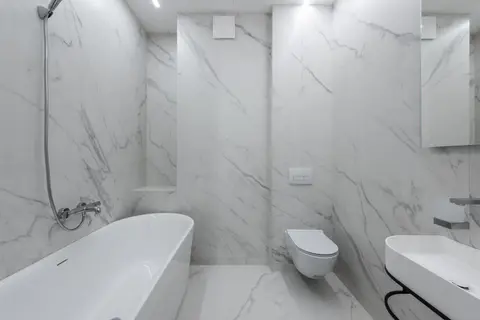
Slate, travertine, limestone, and marble are all used in UK bathrooms but require more preparation and ongoing maintenance than ceramic or porcelain. Supply cost ranges from £40–£150/m² depending on species and origin. Natural stone is heavy, marble typically runs 2.5–2.8 kg per m² per mm of thickness, so structural loadings and substrate rigidity must be considered, particularly on timber upper floors.
All natural stone must be sealed before grouting and periodically thereafter to prevent staining and water ingress. Travertine, which has natural voids in its surface, requires void-filling treatment before polishing. Marble and limestone are acid-sensitive, so avoid standard bathroom cleaners containing citric acid or vinegar.
Tile Type Comparison
| Tile Type | Supply Cost (£/m²) | Suitable For | Slip Rating (typical) | Maintenance |
|---|---|---|---|---|
| Ceramic (glazed) | £10–£40 | Walls, splashbacks | R9 if textured | Low, wipe clean |
| Porcelain (polished) | £20–£60 | Walls, low-slip floors | R9 | Low |
| Porcelain (textured/matt) | £20–£80 | Floors, wet rooms | R10–R11 | Low |
| Natural slate | £40–£100 | Floors, feature walls | R11–R12 | Medium, seal annually |
| Travertine | £50–£130 | Walls, floors | R10 (filled) | Medium, seal, fill voids |
| Marble | £60–£150 | Walls, feature floors | R9–R10 | High, seal, acid-sensitive |
| Mosaic (glass/porcelain) | £30–£100 | Walls, shower trays | R10+ | Medium, more grout to clean |
Slip Resistance Ratings
No UK building regulation sets a slip rating for a domestic bathroom floor, so nothing here is a legal minimum. The R rating on a tile data sheet comes from DIN 51130, a ramp test walked in heavily cleated safety boots with motor oil as the contaminant, which classifies surfaces from R9 to R13 by the angle at which the tester slips: R9 is 6–10°, R10 is 10–19°, R11 is 19–27°, R12 is 27–35° and R13 above 35°.5 HSE is blunt that a surface classified R9, and in some instances R10, will be slippery in wet or greasy conditions, so treat the ratings as a rough sort rather than a safety guarantee.5 On that basis:
- R9 is the floor of the scale, not a safe minimum; reasonable only for bathroom floors that stay largely dry
- R10 is the sensible working choice for a standard bathroom floor and shower enclosures with drainage
- R11 is what to specify for shower trays and wet room floors where water pools, and for step surfaces
Some manufacturers also quote a barefoot rating from DIN 51097, a ramp test walked barefoot with a soap solution, whose classes are A (12–17°), B (18–23°) and C (above 24°). HSE warns that class A, and in many cases class B, will be slippery when wet.5 The two scales are not interchangeable, so read both figures off the manufacturer’s data sheet rather than converting between them. Where a floor genuinely matters, the test HSE itself relies on is the pendulum, and a pendulum test value of 36 or above is classed as low slip potential. That is HSE and UKSRG guidance, not a Building Regulations requirement.5 Approved Document M Volume 1, which is the dwellings volume, does not mention slip resistance at all.6
Planning permission is not required for internal bathroom tiling. However, any electrical work in a room containing a bath or shower is work in a special location under Part P of the Building Regulations, so it is notifiable and must be carried out or certified by a registered competent person. A special location is not the same thing as the wet zones (Zones 0, 1 and 2) defined by BS 7671. Wet zones define minimum IP ratings for any fittings and influence where heated towel rails and extractor fans can be installed.
Adhesive and Grout
Adhesive
Tile adhesive is classified under BS EN 12004-1:2017, which replaced the single-part BS EN 12004:2007+A1:2012.7 The two most relevant classes for bathrooms are:
- C1 (standard cementitious adhesive), adequate for wall tiles in dry or low-moisture areas
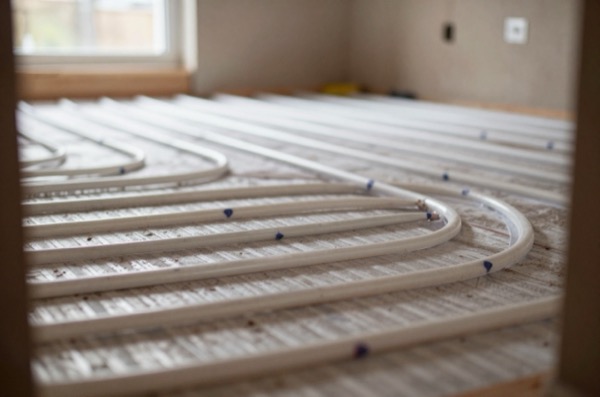
- C2S1 (improved cementitious, flexible), required for floor tiles, large format tiles (typically 600×600mm and above), tiles over underfloor heating, and any wet room application where thermal movement or substrate deflection is likely
The S1 designation indicates limited deformability (up to 2.5mm), which accommodates the movement that occurs with underfloor heating cycles. For timber subfloors, a fully flexible adhesive (S2 class) is advisable. Cost: standard C1 adhesive runs £5–£10/m²; C2S1 flexible adhesive costs £8–£15/m² depending on brand and coverage.
Grout
Standard cement-based grout costs £5–£12/m² depending on joint width and application. It is suitable for most wall and floor applications but is porous and can discolour over time in wet areas unless sealed.
Epoxy grout costs £20–£40/m² and offers far superior stain resistance and durability. It is effectively waterproof, does not require sealing, and is increasingly specified for shower enclosures and wet rooms. The trade-off is a more demanding application, epoxy grout has a shorter working time, is harder to remove from tile faces if left to cure, and is not suited to DIY installation without practice. For joints below 3mm, a proprietary narrow-joint epoxy system is required.
Tile Sizes and Large Format Trends
Standard wall tiles in UK bathrooms have traditionally run 200×300mm and 300×600mm. Floor tiles commonly used 300×300mm and 450×450mm. The current trend is toward much larger formats:
- 600×600mm, now the most common floor tile size in new build and renovation; fewer grout lines create a cleaner appearance
- 1200×600mm, increasingly used on both floors and walls; requires a perfectly flat substrate (typically within 3mm over 2m) and a flexible C2S1/S2 adhesive
- 1200×1200mm and larger, available but demanding to install; levelling systems (tile clips and wedges) are almost always required
Larger tiles are unforgiving of substrate unevenness. Any hollow spots or adhesive voids beneath a large porcelain tile will eventually cause cracking under point loads. A solid-bed fix (full coverage adhesive, no voids) is mandatory.
Layout Patterns and Wastage
The pattern in which tiles are laid affects both the visual result and the quantity you need to order. Wastage must be factored into your order before purchasing.
- Grid (straight stack), simplest to set out and cut; minimum wastage at 10%
- Brick bond (offset 50%), classic running bond; 10% wastage; requires cuts at every row end
- Third bond (offset 33%), increasingly specified with large format tiles to avoid the lippage risk of a 50% offset on long tiles; 10–12% wastage
- Diagonal (45°), square tiles laid at 45 degrees to the walls; 15% wastage due to edge cuts; visually enlarges smaller bathrooms
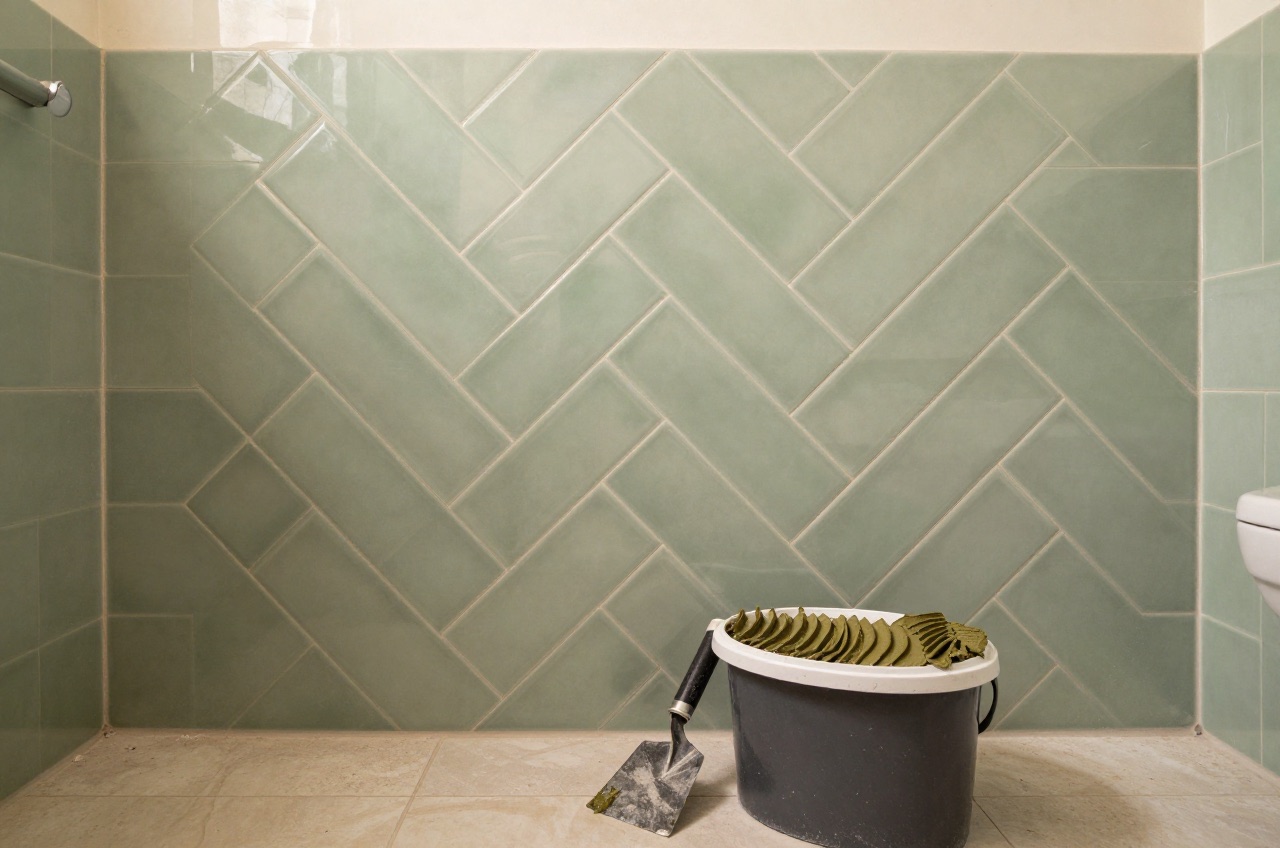
- Herringbone, rectangular tiles arranged in a V pattern; striking but labour-intensive; 15% wastage minimum, often closer to 20% for smaller rooms with many cuts
- Chevron, similar to herringbone but tiles are cut at an angle so the pattern aligns precisely; requires tiles cut specifically for the pattern or pre-cut chevron tiles; 15–20% wastage
As a working rule: order 10% over your measured area for straight patterns, 15% for diagonal or herringbone, and 20% for small mosaic formats or complex rooms with many cuts. Always buy from the same batch number to avoid colour variation between firings.
Labour Costs
Tiling labour in 2026 runs at the following approximate rates for wall and floor work respectively:
- Wall tiling: £35–£55/m² for standard ceramic or porcelain; higher for mosaic or small formats (£50–£80/m²)
- Floor tiling: £40–£60/m² for porcelain up to 600×600mm; £55–£75/m² for large format tiles requiring levelling systems
- Wet room tanking: add £15–£30/m² for application of a liquid waterproofing membrane before tiling
These rates typically exclude materials. In most cases, the tiler will supply adhesive and grout and add a mark-up; confirm this in advance. Day rates for an experienced tiler run £200–£300/day; productivity depends heavily on tile size and complexity, a tiler working with 300×300mm wall tiles in a standard bathroom will typically cover 8–12m² per day, compared to 5–8m² with large format floor tiles requiring careful levelling.
Practical Checklist Before You Order
- Measure carefully, calculate net area, then apply the wastage factor for your chosen pattern
- Check the substrate, cement board or tile backer board is recommended over plasterboard in wet zones; plywood requires priming
- Confirm underfloor heating compatibility, specify the UFH system’s maximum surface temperature and match it to the adhesive data sheet
- Verify slip rating, obtain the manufacturer’s DIN 51130 R-rating for floor tiles, and the DIN 51097 class if the floor will be walked barefoot; do not rely on descriptions such as “anti-slip”
- Plan wet zone electrical work separately, any socket, light fitting, or heated rail within Zone 1 or 2 requires a qualified electrician
Batch Numbers
Always record the batch (or “shade”) number printed on tile boxes. If you need to re-order after the job starts, mismatched batches can be visually obvious even under the same product name.
The rules in this note are those that apply in England. Scotland, Wales and Northern Ireland have their own building standards and permitted development rights.
References (7)
Figures in this note were checked against the sources below on 9 September 2026. Superscript numbers in the text point to them. Every source the site cites, by topic.
- 1costsupplier figureWickes.RN-YEAHYNA price, true at 2026-09. the retail price Wickes publishes for Johnson County Old Stone Grey Matt Ceramic Wall Tile 300 x 200mm, which is the supply figure the cost book records for this item
- 2costsupplier figureWickes.RN-Y2796SA price, true at 2026-09. Wickes's product page for an own brand ceramic wall tile, 300 x 75 mm, in a metro format. Published retail price per square metre for a plain tile, which is the low end of the wall tile range a bathroom note quotes.
- 3technicalstrongBSI Knowledge, a standard.RN-YWX7VMBSI catalogue page for BS EN 14411:2016, published 31 July 2016, status Current, Under Review; supersedes BS EN 14411:2012, which is Withdrawn. The standard defines terms and specifies characteristics for ceramic tiles including mosaics (any piece fitting into a 49 cm2 square) produced by extrusion or dry pressing, for internal and external floors including stairs and for walls. It classifies tiles into groups by two parameters: forming method, group A extruded and group B dry-pressed, and water absorption level, which is where the BIa to BIII designations on a porcelain or ceramic tile data sheet come from. It sets the level of requirements for those characteristics, references the test methods, and covers assessment and verification of constancy of performance, designation and marking. It expressly does not apply to mesh-backed products, ceramic trims and accessories, tiles made by processes other than extrusion or dry pressing, dry-pressed unglazed tiles with water absorption above 10 per cent, external road finishes, or ceiling finishes. 2016 changes include a new Clause 6 on AVCP and the exclusion of decorative pieces and mesh-backed products.
- 4costsupplier figureWalls and Floors.RN-OQQQENA price, true at 2026-09. the retail price Walls and Floors publishes for Porcelain Tiles, which is the supply figure the cost book records for this item
- 5technicalvery strongHealth and Safety Executive, guidance.RN-2IWEP7HSE's guidance note behind every slip-resistance figure a flooring or paving note quotes, and the source that separates the two tests people conflate. Table 1 classifies slip potential from pendulum test values (PTV): 0 to 24 high, 25 to 35 moderate, 36 and above low. Table 2 gives the parallel Rz microroughness classification. It describes the HSL/UKSRG ramp CoF test, then deals with the German ramp tests separately: DIN 51097 uses barefoot operators with a soap solution and DIN 51130 uses heavily cleated EN ISO 20345 safety boots with motor oil, and HSE states it has reservations about both because neither uses contaminants representative of real workplaces and the way results are reported is a cause for concern. Table 3 sets the DIN 51130 R scale by slip angle: R9 6 to 10 degrees, R10 10 to 19, R11 19 to 27, R12 27 to 35, R13 above 35. It warns that R9 and sometimes R10 surfaces will be slippery when wet and that a single class covers a wide CoF range, R10 alone spanning 0.18 to 0.34, so an R number is not a substitute for a PTV. Note that BS 7976-2, the pendulum method, was withdrawn in February 2022, which makes this HSE page the right citation for the thresholds.
- 6technicalvery strongMinistry of Housing, Communities and Local Government.RN-5IVIKFParagraph 1645 of the M4(2) guidance requires a minimum 1,200 mm clear space in front of and between all kitchen units and appliances in living, kitchen and eating areas. Wall switches, socket outlets, stopcocks and controls must have their centre line between 450 mm and 1,200 mm above floor level (Diagram 1.5), consumer units are mounted with switches 1,350 to 1,450 mm above floor level, and boiler timer controls and thermostats between 900 mm and 1,200 mm. Communal approach routes and flights need a minimum clear width of 1,200 mm and every landing a minimum 1,200 mm clear of any door swing. Handrail guidance is measured 450 mm above the pitch line of the treads.
- 7technicalstrongBSI, a standard.RN-TL1I4RBS EN 12004-1:2017, published 28 February 2017, committee B/539, prepared by CEN/TC 67 Ceramic tiles, current; it supersedes BS EN 12004:2007+A1:2012. The scope covers three types of ceramic tile adhesive: cementitious for internal and external installations, and dispersion and reaction resin for internal installations only, on walls and floors. It gives the terminology for the products, working methods and application properties, specifies the performance requirements and the appurtenant test methods, the assessment and verification of constancy of performance, and the classification, designation and marking of tile adhesives, which is where the C, D and R type letters and class numbers on a bag of adhesive come from. It expressly does not provide criteria or recommendations for the design and installation of ceramic tiles, which is BS 5385. It notes tile adhesives may also be used for natural and agglomerated stones if they do not adversely affect the material. BS EN 12004-2:2017 gives the test methods.
-
Johnson County Old Stone Grey Matt Ceramic Wall Tile 300 x 200mm, Wickes, accessed 16 September 2026. Priced at 2026-09, so no calibration is needed. wickes.co.uk
-
Wickes Farmhouse Pannacotta Ceramic Wall Tile 300 x 75mm, Wickes, accessed 18 September 2026. Priced at 2026-09, so no calibration is needed. wickes.co.uk
-
BS EN 14411:2016 Ceramic tiles. Definition, classification, characteristics, assessment and verification of constancy of performance and marking, BSI Knowledge, accessed 9 September 2026. knowledge.bsigroup.com
-
Porcelain Tiles, Walls and Floors, accessed 15 September 2026. Priced at 2026-09, so no calibration is needed. wallsandfloors.co.uk
-
Assessing the slip resistance of flooring (GEIS2), Health and Safety Executive, accessed 9 September 2026. hse.gov.uk
-
Approved Document M, Access to and use of buildings, Volume 1: Dwellings, 2015 edition with 2016 amendments, Ministry of Housing, Communities and Local Government, accessed 9 September 2026. assets.publishing.service.gov.uk
-
BS EN 12004-1:2017 Adhesives for ceramic tiles. Requirements, assessment and verification of constancy of performance, classification and marking, BSI Knowledge, accessed 9 September 2026. knowledge.bsigroup.com