A rain shower, whether a simple large-head overhead fitting or a full thermostatic ceiling-mounted system, can transform a standard bathroom into something that feels genuinely spa-like. In 2026, the rain shower head itself costs £30–£800+ depending on the type and brand, while the total installed price including plumber labour typically falls between £400 and £2,500. If you are converting an existing bathroom into a wet room to accommodate a ceiling-mounted drain-flush system, budget £3,000–£8,000 for the full project.
The wide range reflects real differences in water pressure requirements, installation complexity, and whether your existing plumbing system can support the shower without upgrades. This guide breaks down each component so you can understand exactly where your money goes.
Types of Rain Shower and Their Prices
Not all rain showers are the same. The term covers everything from a large fixed overhead head on an existing shower arm to a bespoke ceiling-mounted system with integrated thermostatic controls and body jets.
| Type | Unit Cost (2026) | Notes |
|---|---|---|
| Budget overhead shower head (arm-mounted) | £30–£801 | Fits existing shower arm; chrome plastic or entry-level stainless |
| Mid-range overhead head (arm-mounted) | £80–£180 | Brushed nickel, brass or premium chrome; anti-limescale nozzles |
| High-end overhead head (arm-mounted) | £180–£400 | Solid brass, larger diameter (300 mm+), multiple spray patterns |
| Ceiling-mounted head (surface-fixed) | £120–£500 | Requires concealed supply pipe in ceiling or wall |
| Ceiling-mounted head (recessed/flush) | £250–£800+ | Flush finish; ceiling must be opened up; suitable for wet rooms |
| Thermostatic shower system (valve + head + handset) | £300–£1,500+ | Exposed or concealed bar valve; Hansgrohe, Grohe, Mira, Crosswater |
| Electric rain shower unit | £150–£4502 | Self-contained; no boiler needed; suits low-pressure gravity systems |
The bracket figures above are for the unit only, supply without labour.
What Drives the Price?
Diameter and flow rate, a 200 mm diameter head at 12 litres per minute (l/min) requires roughly twice the water throughput of a standard 8 l/min handset. At the high end, a 400 mm recessed ceiling head may demand 20–25 l/min. If your system cannot deliver that flow, the experience will be disappointing regardless of what you spend on the head.
Finish, polished chrome costs least. Brushed brass, gunmetal, and matte black command a premium of 20–40% over the equivalent chrome fitting and are harder to source from UK trade merchants.
Valve type, a simple manual mixer valve (one lever or two separate taps) is the cheapest option. A thermostatic bar valve (which maintains temperature if someone runs a tap elsewhere) adds £150–£600 to the valve cost alone but is highly recommended for households with children or the elderly.
Concealed vs exposed, concealed valves need the wall to be opened up to box in the pipework, adding tiling and making-good costs. Exposed bar valves are quicker and cheaper to fit.
Electric vs mixer/thermostatic, electric showers heat water on demand and are independent of your boiler, but most electric units (7–10.5 kW) have limited flow rates and most rain shower heads require more than an electric unit can comfortably deliver. They are a viable option only with a compact low-flow overhead head.
Water Pressure Requirements
This is the single most common reason rain shower installations underperform expectations.
| System Type | Typical Static Pressure | Compatibility |
|---|---|---|
| Combi boiler | 1.0–3.0 bar (mains pressure) | Good, most rain heads work well |
| Gravity-fed system (tank in loft) | 0.1–0.5 bar | Poor, needs pump or power shower valve |
| Gravity-fed with booster pump | 0.8–2.0 bar | Adequate for most arm-mounted heads |
| Unvented cylinder (mains-pressure) | 1.5–3.5 bar | Excellent, supports all rain shower types |
| Electric shower | Self-contained | Limited flow rate; choose compact head |
Minimum 1.0 bar is required for a satisfactory experience from most overhead rain heads. Manufacturers typically quote 1.5–2.0 bar as the recommended operating pressure for larger heads (250 mm+). Below 1.0 bar the flow will be weak and uneven.
If you have a gravity-fed system and want a proper rain shower experience, a twin-pump unit (£200–£500 fitted) can boost pressure to an acceptable level. Factor this into your budget if you have a hot water cylinder and cold water storage tank rather than a combi boiler. A shower pump on a gravity system draws from the tank and cylinder and needs no permission, but any pump or booster taking more than 12 litres a minute off the incoming mains must be notified to your water company and consented before the work begins.3
Installation Cost Breakdown
A plumber’s day rate in 2026 ranges from £200–£350 depending on location, with London and the South East typically at the upper end. Most rain shower installations take half a day to a full day for a competent plumber, more if pipework needs re-routing or a ceiling needs opening.4
| Work Element | Typical Cost (2026) |
|---|---|
| Swap existing shower head for arm-mounted rain head | £80–£150 (1–2 hrs labour + head cost) |
| Install thermostatic bar valve + overhead arm + head | £350–£700 (plumber day + materials) |
| Ceiling-mounted head (surface pipe, new supply run) | £500–£1,000 |
| Ceiling-mounted head (fully concealed, ceiling opened) | £800–£1,800 |
| Addition of booster pump (gravity-fed system) | £300–£600 (pump + fitting) |
| Tiling after concealed valve or ceiling work | £40–£80/m² (tiler supply and fix) |
| Waterproof membrane / tanking to shower enclosure | £200–£500 depending on area |
| Building Regulations compliance certificate (if electric) | Included if competent-person scheme member |
Worked Example: Mid-Range Thermostatic Ceiling Rain Shower
A homeowner in the Midlands wants to replace their existing over-bath shower with a ceiling-mounted thermostatic system. They have a combi boiler with good mains pressure.
| Item | Cost |
|---|---|
| Concealed thermostatic valve (Crosswater Kai, brushed steel) | £320 |
| 300 mm ceiling-mounted rain head (surface-fixed) | £185 |
| Handset + slider rail | £95 |
| Plumber (full day, concealed valve + new ceiling supply run) | £280 |
| Plasterer / tiler (re-tile around valve area, 1.5 m²) | £180 |
| Incidentals (fittings, PTFE, fixings) | £35 |
| Total | £1,095 |
This is a realistic mid-range cost. Choosing a budget valve and head can bring this below £700; a premium Hansgrohe or Vola system with a fully recessed 400 mm head, wet room conversion, and drain-to-floor tiling can exceed £5,000.
Wet Room Conversion with Rain Shower
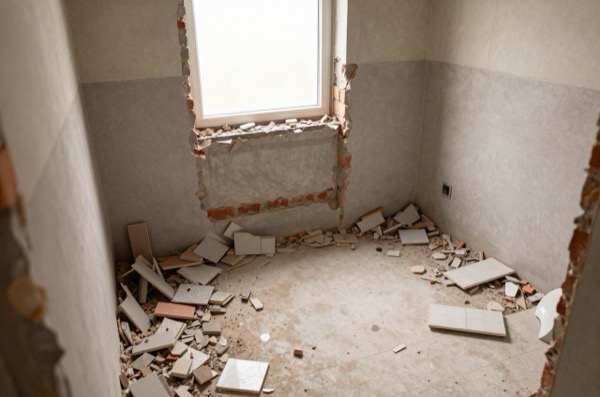
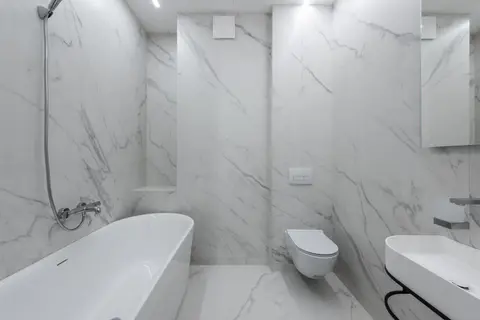
The most aspirational option is a full wet room: a waterproofed, fully tiled, drain-flush floor with a ceiling rain shower and no shower tray or enclosure. In 2026, a wet room conversion costs £3,000–£8,000 for an average 2–4 m² bathroom space.
That budget covers:
- Removing the existing suite (bath, shower tray, screen)
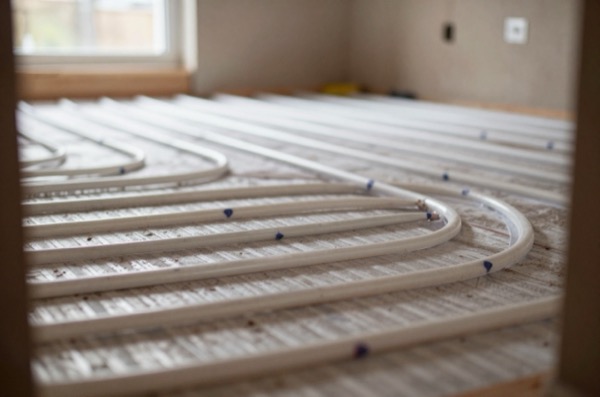
- Installing a linear drain with a tanked and sloping floor screed
- Full tanking / waterproof membrane system to walls and floor
- Tiling (floor and walls, typically 30–60 tiles/m² at £60–£120/m² supply and fix)5
- Ceiling-mounted or wall-arm rain head with concealed thermostatic valve
- Extractor fan upgrade (an intermittent bathroom extract fan has to move at least 15 l/s)6
- Re-plumbing waste and supply runs
The £3,000 end applies to a small en suite with budget tiles and a mid-range shower system. The £8,000+ end reflects larger rooms, bespoke drainage, premium large-format tiles, and top-tier shower hardware.
Combi Boiler vs Gravity-Fed System
Combi boiler, ideal for rain showers. Mains cold water heated on demand delivers consistent pressure (typically 1.5–3.5 bar) without needing a pump. Most rain heads work without modification. The limitation is simultaneous demand: if another tap is running, a non-thermostatic shower can scald or run cold.
Gravity-fed system, cold water tank in loft, hot water cylinder in airing cupboard. Pressure is determined by the vertical head (height between tank and shower). A one-storey head gives roughly 0.1 bar. Two storeys gives 0.2 bar, still below the 1.0 bar minimum for a proper rain shower. A shower pump is almost always required, adding £200–£500 to the project. Use a twin-impeller pump (one for hot, one for cold) to keep the flow balanced.
Unvented cylinder, mains pressure hot water stored in a sealed cylinder (typical system boilers). Excellent for rain showers; pressure matches mains supply. Ensure the cylinder relief and pressure valves are in good condition.
Building Regulations: What You Need to Know
For a standard mixer or thermostatic rain shower (no electrical connection beyond a pump), Building Regulations notification is not required.
Electric showers fall under Part P (Electrical safety, Dwellings). An electric shower needs its own circuit, and installing a new circuit is notifiable, as is any addition or alteration to an existing circuit inside the “special location”, the space around the bath tap or shower head that reaches 2.25 m above floor level and 0.6 m out from the edge of the bath or tray.7 Notifiable work must be self-certified by a registered competent person (NICEIC, NAPIT, or equivalent), certified by a registered third party, or notified to a building control body before it starts. Failure to comply can cause problems when you sell the property.
A pump in an airing cupboard outside the bathroom is not notifiable if it connects to an existing spur with an FCU (fused connection unit), but a new circuit for it is.
Getting the Best Price
- Buy the unit separately from a trade merchant (e.g., Wolseley, City Plumbing, Screwfix Trade) rather than having the plumber supply. Trade pricing on the unit can be 20–30% below what a plumber might pass on as a “supply and fit” quote.
- Thermostatic from the start, a thermostatic valve costs more upfront but avoids temperature surges and is far more pleasant to use. Retro-fitting one later costs more than doing it in one visit.
- Check water pressure first, ask your plumber to measure dynamic pressure at the shower position before you order any hardware. This avoids buying a 400 mm head that will never perform as intended.
- Get three quotes, installation prices vary considerably. Ask each plumber to specify whether the quote includes the shower unit or is labour-only.
- Group bathroom work, if other jobs are needed (replacing taps, fixing leaking pipe, installing extractor fan), having the plumber tackle everything in one visit saves on call-out costs.
References (7)
Figures in this note were checked against the sources below on 10 September 2026. Superscript numbers in the text point to them. Every source the site cites, by topic.
- 1costsupplier figureToolstation.RN-K63FSIA price, true at 2026-09. Toolstation's product page for a Deva fixed contemporary shower head and outlet. A published price for the head alone, which is the part a rain shower note is usually pricing when it quotes a low figure.
- 2costsupplier figureToolstation.RN-ON7YSBA price, true at 2026-09. a Toolstation category listing for bathroom showers, recorded as the page a price was read from. What it lists, and at what price, changes with the range, so it evidences that a figure was seen at this merchant rather than a price a reader can confirm today
- 3technicalvery strongThe National Archives (legislation.gov.uk), UK Statutory Instrument 1999/1148, legislation.RN-IKLPS9The exact list of plumbing work that must be notified to the water undertaker, with its consent obtained, before it begins. Regulation 5(1) requires notice, consent not to be unreasonably withheld, and compliance with any conditions. The Table item 4 covers installing: (a) a bath over 230 litres measured to the centre line of overflow; (b) a bidet with ascending spray or flexible hose; (c) a single shower unit of a type specified by the regulator connected directly or indirectly to a supply pipe; (d) a pump or booster drawing more than 12 litres per minute connected directly or indirectly to a supply pipe; (e) reverse osmosis; (f) a water treatment unit producing waste water; (g) an RPZ valve or other device for fluid category 4 or 5; (h) a garden watering system not operated by hand; (i) any water system laid outside a building less than 750mm or more than 1350mm below ground. Item 5 covers construction of a pond or swimming pool over 10,000 litres designed to be replenished by automatic means from a water undertaker's supply. Regulation 5(2) exempts approved contractors for items 2, 4(b) and 4(g).
- 4costvery strongHomes and Communities Agency, a government page.RN-IJYN87A price, true at 2026-01. The GOV.UK publication page for the Homes and Communities Agency guidance on dereliction, demolition and remediation costs, prepared with Ove Arup and Partners. Held for its regional adjustment factors, which are what the register uses it for: the multipliers that take a national construction rate to a region. It is not a source of current prices, and the rates in the guidance itself are of its own date.
- 5costsupplier figureElliren Tiles.RN-0YD7ZRA price, true at 2026-07. A tile retailer's 2026 cost guide, March 2026, giving tile prices and tiler labour rates per square metre for kitchens and bathrooms. The tile prices are the merchant's own and therefore real; the labour rates around them are the retailer's estimate and are not evidenced.
- 6technicalvery strongMinistry of Housing, Communities and Local Government.RN-QD1SFFTable 1.1 sets minimum intermittent extract rates: kitchen with a cooker hood extracting outside 30 l/s, kitchen without one 60 l/s, utility room 30 l/s, bathroom 15 l/s, sanitary accommodation 6 l/s. Extract terminals and fans other than cooker hoods should be as high as practicable and no more than 400mm below the ceiling; a cooker hood should sit between 650mm and 750mm above the hob if the manufacturer gives no figure. Table 1.7 requires background ventilators of at least 8000mm2 equivalent area in habitable rooms and kitchens for a dwelling, 10,000mm2 for a single-storey dwelling. Background ventilators should be at least 1700mm above floor level and at least 500mm from a fan in the same room. On replacement windows, paragraph 3.14 says new windows must carry background ventilators no smaller than the originals, and paragraph 3.15 gives the fallback minimums where the old size is unknown: 8000mm2 habitable rooms, 8000mm2 kitchen, 4000mm2 bathroom. Paragraph 3.32 confirms that replacing an extractor fan or cooker hood on existing cabling is not notifiable.
- 7technicalvery strongMinistry of Housing, Communities and Local Government.RN-JYJ3I5The document that decides what electrical work a homeowner may legally do themselves, and the exact list of notifiable jobs. Regulation 12(6A), reproduced at paragraph 2.5, makes only three things notifiable: the installation of a new circuit, the replacement of a consumer unit, and any addition or alteration to existing circuits in a special location. Regulation 12(9) defines special location as, in a room containing a bath or shower, the zone extending vertically from finished floor level to 2.25 metres (or the shower head position if higher) and horizontally 600mm from the edge of the bath tub or shower tray. Paragraph 2.7 states that all other electrical installation work is not notifiable, namely additions and alterations to existing installations outside special locations, and replacements, repairs and maintenance anywhere. Paragraph 2.8 gives worked examples: a built-in cooker is not notifiable unless a new cooker circuit is needed, and connecting an electric gate or garage door to an existing isolator is not notifiable but running a new circuit from the consumer unit to that isolator is. Paragraph 2.2 confirms Part P reaches outdoor work including fixed garden lighting, pond pumps and outbuildings such as sheds, detached garages and domestic greenhouses. Notifiable work must be certified by self-certification by a registered competent person, third-party certification, or a building control body (paragraph 3.1), with the compliance certificate issued within 30 days (paragraph 3.4). Note that Approved Document P is a source of guidance rather than a ban: non-notifiable work still has to comply with BS 7671.
-
Deva Contemporary Shower Head & Outlet Fixed, Toolstation, accessed 18 September 2026. Priced at 2026-09, so no calibration is needed. toolstation.com
-
Bathroom Showers, Toolstation, accessed 18 September 2026. Priced at 2026-09, so no calibration is needed. toolstation.com
-
The Water Supply (Water Fittings) Regulations 1999, regulation 5: Notification, legislation.gov.uk, accessed 10 September 2026. legislation.gov.uk
-
Guidance on dereliction, demolition and remediation costs, regional adjustment factors, Homes and Communities Agency with Ove Arup and Partners, accessed 21 September 2026. Priced at 2026-01, so no calibration is needed. gov.uk
-
2026 UK Tiling Cost Guide: Price per m2 & Labour Rates Today, Elliren Tiles, accessed 15 September 2026. Priced at 2026-07, so no calibration is needed. ellirentiles.co.uk
-
Approved Document F, Ventilation, Volume 1: Dwellings, 2021 edition, Ministry of Housing, Communities and Local Government, accessed 10 September 2026. assets.publishing.service.gov.uk
-
Approved Document P, Electrical safety, Dwellings, 2013 edition, Ministry of Housing, Communities and Local Government, accessed 10 September 2026. assets.publishing.service.gov.uk