No single flooring material is the right answer for every room. A thick wool carpet that is perfect for a bedroom will be ruined by a single dishwasher leak in a kitchen. Polished marble that looks spectacular in a hallway becomes a slip hazard in a wet room. The best flooring for any given space is determined by the specific demands that room places on it every day.
This guide works through the three most flooring-intensive rooms in a UK home, kitchen, bathroom, and living room, and gives a clear-eyed view of which materials perform well, which to avoid, and what realistic 2026 installed costs look like.
What “Best” Actually Means
Before recommending materials, it helps to define the criteria. A good floor for any room should:
- Resist the specific hazards of that room (moisture, spills, heavy foot traffic, dropped items)
- Meet slip resistance requirements, relevant in all wet areas; HSE classes a pendulum test value (PTV) of 36 or above as low slip potential, and that is the figure to specify for a wet floor1
- Be maintainable at a realistic effort level for the household
- Work with the subfloor, old concrete, suspended timber, and modern concrete screeds each impose different constraints
- Fit the budget, both upfront and for replacement/maintenance over time
Best Flooring for Kitchens
Kitchens are the most demanding floor environment in a home: water spills, cooking fat, grit tracked in from outside, heavy appliances, dropped crockery, and constant foot traffic. The floor also needs to work seamlessly with the rest of the room design.
Top Choice: Porcelain Tile
Porcelain is the benchmark kitchen floor material for a reason. Water absorption below 0.5% means spills sit on the surface rather than being absorbed. It resists scratching from grit, tolerates dropped heavy items better than wood, and the surface can be wiped clean in seconds. It is compatible with underfloor heating and, once laid correctly, is effectively maintenance-free.
Choose a matte or satin finish rather than polished, a PTV of 36+ in the wet condition is achievable in most matte porcelain ranges and should be specified explicitly when buying. Avoid textured surfaces with deep channels that collect food debris.
Large format tiles (600 × 600 mm or 800 × 800 mm) reduce grout lines, which are the main cleaning overhead with tiled floors.
Installed cost: £50–£120/m².
Strong Alternative: LVT (Luxury Vinyl Tile)
LVT has become the standard choice for kitchen renovations where budget matters or where the subfloor condition makes tile impractical. It is fully waterproof, warm underfoot (unlike stone and tile), quiet, and available in convincing wood and stone visual formats.
Click-system LVT floats over the subfloor, which makes it far more forgiving of minor irregularities (though it still requires a flat substrate to within ±3 mm under a 2 m straightedge). It can be laid over existing tiles if they are sound and well-bonded, a significant saving on preparation costs.
The limitations: LVT dents under concentrated loads (fridge legs, narrow chair feet), and cheaper products show joins under raking light. Wear layer thickness is the key quality indicator, 0.3 mm is adequate for residential kitchens; 0.5 mm or above is worth paying for.
Installed cost: £30–£65/m².2
What to Avoid in Kitchens
Solid wood and laminate: Both are vulnerable to water damage. A single appliance leak or a repeatedly wet area in front of the sink will cause swelling, buckling, or delamination. Engineered wood with a lacquered finish can work in a relatively dry kitchen with careful management, but it is a compromise.
Carpet: Unhygienic and difficult to clean around cooking areas.
Best Flooring for Bathrooms and Wet Rooms
Bathrooms present the same moisture challenge as kitchens but with the additional requirement for slip resistance in shower and bath areas. A wet room (fully tiled shower area with a linear drain and no tray) demands the most rigorous approach.
Top Choice: Porcelain Tile (with R11 rating for shower areas)
The specification logic for bathrooms is similar to kitchens, with one critical addition: slip rating. Shower floors and wet room floors should carry an R11 rating (DIN 51130) or equivalent, indicating grip even in soapy water conditions.
Mosaic tiles (25–50 mm square) are a practical choice for curved wet room floors and shower trays because the increased grout line density naturally improves grip. Standard large-format tiles in shower areas must have a deliberately textured surface, check the test certificate rather than relying on visual texture alone.
Underfloor heating under bathroom tiles is increasingly standard in UK renovations and significantly improves comfort on cold mornings. System output must be sized to compensate for the thermal mass of the tile and adhesive bed.
Installed cost: £60–£140/m² including waterproofing membrane in wet areas.
Strong Alternative: LVT
LVT is a legitimate choice for main bathrooms (bath rather than shower) and en-suites where the moisture load is lower. It is warmer underfoot than tile, more comfortable for children, and significantly cheaper. The caveat: click LVT is not suitable in shower areas or where standing water is a regular occurrence around the floor level, for these areas, tile is the right answer.
Installed cost: £30–£60/m².
What to Avoid in Bathrooms
Laminate: The substrate absorbs moisture through cut edges and joins, causing irreversible swelling. Even a wet towel left on a laminate bathroom floor repeatedly will cause damage.
Solid wood: Unsuitable unless the ventilation and humidity are tightly controlled and the floor is maintained scrupulously, not realistic in a family bathroom.
Carpet: Some older UK properties still have bathroom carpet; it is unhygienic and retains moisture. Replace on any renovation.
Best Flooring for Living Rooms
Living rooms are lower stakes from a moisture perspective but must handle sustained foot traffic, furniture loading, and the aesthetic weight of being the primary visible space in the home.
Top Choice: Engineered Wood
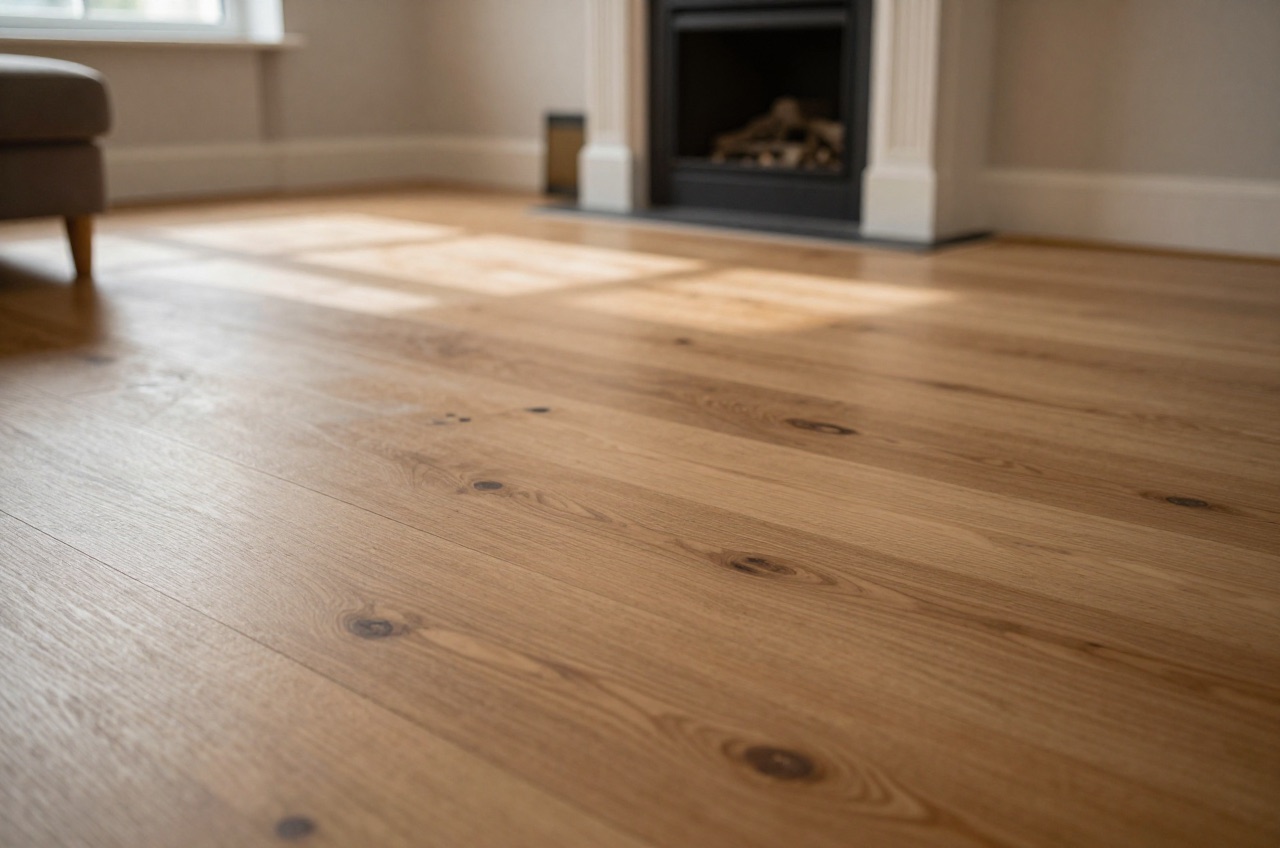
Engineered wood delivers the warmth, character, and acoustic comfort of a real wood floor without the movement problems of solid timber. A 3–6 mm oak veneer on a plywood core is compatible with underfloor heating, suitable for floating or glue-down installation, and refinishable at least once in its lifetime (more if the veneer is 5 mm+).
Wide-plank formats (180 mm+) suit open-plan spaces and create a sense of expanse. Brushed and oiled finishes show the natural grain character and are easier to repair spot-to-spot than lacquered surfaces.
Installed cost: £55–£130/m².
Strong Alternative: Quality Carpet
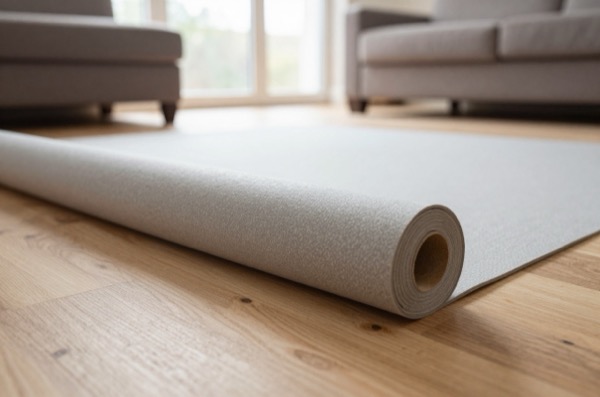
Carpet remains the most comfortable and acoustically effective living room floor. A 80/20 wool-nylon blend carpet on a quality crumb-rubber underlay outperforms any hard floor for warmth underfoot and noise absorption, both relevant in houses with young children or in rented properties where noise between floors matters.
The cost varies enormously by carpet quality. A serviceable twist-pile synthetic carpet costs £15–£30/m² installed. A 100% wool twist or loop-pile carpet runs £40–£90/m² installed. Expect a design life of 10–20 years for quality wool carpet in a living room with moderate traffic.
Installed cost: £20–£90/m².
What to Avoid in Living Rooms
Budget laminate: At the cheaper end (below £15/m² supply), laminate can look artificial under strong natural light and produces a hollow, echoey sound when walked on. The financial saving is real, but it is often visible.
Polished stone: Cold, hard underfoot, and demands sealing. Can be spectacular in the right setting but is a significant lifestyle choice, not a general recommendation.
Room-by-Room Summary
| Room | Top Pick | Alternative | Avoid |
|---|---|---|---|
| Kitchen | Porcelain tile (matte, R10+) | LVT (0.5mm wear layer) | Solid wood, laminate, carpet |
| Bathroom | Porcelain tile (R11 shower areas) | LVT (bath areas only) | Laminate, solid wood, carpet |
| Wet room / shower floor | Porcelain mosaic or textured tile (R11) | N/A | Everything else |
| Living room | Engineered wood | Quality wool carpet | Budget laminate |
| Hallway | Dense porcelain or herringbone engineered | LVT | Carpet (high traffic) |
A Note on Subfloor Compatibility
Whatever material you choose, the subfloor condition is the single biggest factor in how long it lasts and how good it looks. An uneven concrete slab will cause click-LVT joins to show; a bouncy timber subfloor will crack tile grout. Budget for proper substrate preparation, typically £8–£18/m² in labour, and do not skip it.
In older UK houses (pre-1980 concrete ground floors), a damp-proof membrane check is essential before laying any impermeable floor covering. If moisture is present in the screed (above 75% RH or 2.5% CM by carbide method), an epoxy DPM must be applied before laying. This adds £8–£15/m² but prevents the kind of failure that means relaying the entire floor within 18 months.
References (2)
Figures in this note were checked against the sources below on 9 September 2026. Superscript numbers in the text point to them. Every source the site cites, by topic.
- 1technicalvery strongHealth and Safety Executive, guidance.RN-2IWEP7HSE's guidance note behind every slip-resistance figure a flooring or paving note quotes, and the source that separates the two tests people conflate. Table 1 classifies slip potential from pendulum test values (PTV): 0 to 24 high, 25 to 35 moderate, 36 and above low. Table 2 gives the parallel Rz microroughness classification. It describes the HSL/UKSRG ramp CoF test, then deals with the German ramp tests separately: DIN 51097 uses barefoot operators with a soap solution and DIN 51130 uses heavily cleated EN ISO 20345 safety boots with motor oil, and HSE states it has reservations about both because neither uses contaminants representative of real workplaces and the way results are reported is a cause for concern. Table 3 sets the DIN 51130 R scale by slip angle: R9 6 to 10 degrees, R10 10 to 19, R11 19 to 27, R12 27 to 35, R13 above 35. It warns that R9 and sometimes R10 surfaces will be slippery when wet and that a single class covers a wide CoF range, R10 alone spanning 0.18 to 0.34, so an R number is not a substitute for a PTV. Note that BS 7976-2, the pendulum method, was withdrawn in February 2022, which makes this HSE page the right citation for the thresholds.
- 2costsupplier figureCountryLife Flooring.RN-E1Z1X4A price, true at 2026. CountryLife Flooring publishing its own price guidance for this work. A trade supplier writing about what it charges is evidence of the market rate and not a quotation, and the cost book treats it as one figure among several rather than on its own
-
Assessing the slip resistance of flooring (GEIS2), Health and Safety Executive, accessed 9 September 2026. hse.gov.uk
-
Flooring Cost Guide 2026, Prices Per m2 (UK), CountryLife Flooring, accessed 15 September 2026. Priced at 2026, so no calibration is needed. countrylifeflooring.co.uk