Damp is the most common building defect in UK housing, affecting an estimated 5 million homes according to the English Housing Survey. But not all damp is the same. Rising damp, penetrating damp, and condensation have different causes and different cures, and misdiagnosing which you have is the fastest way to spend £2,000 on works that make no difference. This guide explains how to identify each type and the most cost-effective ways to prevent them.
As a starting point: the majority of damp complaints in UK homes turn out to be condensation rather than rising or penetrating damp. Condensation is almost always the cheapest to address, and many cases can be resolved with ventilation improvements costing under £200.
The Three Types of Damp and How to Identify Them
Rising Damp
Rising damp occurs when groundwater is drawn upward through porous masonry by capillary action, in the absence of a functioning damp-proof course (DPC). The DPC is a waterproof layer, traditionally slate, now usually bitumen felt or plastic, built into the wall at approximately 150mm above external ground level.
Signs: A tide-mark on the wall surface, typically not rising above 1m from floor level. Salting (white crystalline deposits) on plaster or brick. Paint bubbling at skirting level. Skirting boards rotting from below.
Key diagnostic: Rising damp almost never appears above 1 metre, because capillary suction is overcome by gravity at that height. If you are seeing damp higher than 1m, the cause is almost certainly not rising.
Penetrating Damp
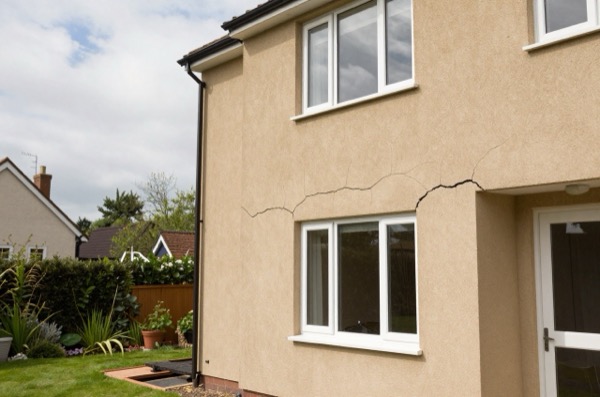
Penetrating damp enters from outside through defects in the building fabric, cracked render, failed pointing, blocked or broken gutters, defective window seals, or flat roof failures.
Signs: Damp patches that appear during or after heavy rain, often on external walls, around windows, or at ceiling level near a flat roof or parapet. The damp patch may be higher than 1m and not follow the floor line.
Key diagnostic: A strong correlation with rainfall. If the damp only appears or worsens after prolonged rain, look outward.
Condensation
Condensation occurs when warm, moisture-laden air meets a cold surface and the water vapour condenses into liquid. It is most common on cold exterior walls, windows, and in areas of poor ventilation, bathrooms, kitchens, and bedrooms.
Signs: Water droplets on windows in the morning. Black mould growth in corners, behind wardrobes against external walls, around window frames. A musty smell without visible tide marks or salting.
Key diagnostic: Condensation is almost always worst in winter, when temperature differentials between inside and outside are greatest. It is also worst in rooms where moisture is generated (cooking, bathing, drying clothes indoors).
Prevention Methods and Costs
The table below covers the most common prevention measures for each damp type, with 2026 UK cost ranges.
| Method | Damp Type Addressed | DIY? | Approx Cost (2026 UK) |
|---|---|---|---|
| Extractor fans (kitchen, bathroom) | Condensation | Partially | £80–£300 per fan installed |
| Trickle vents (window frame) | Condensation | Yes | £10–£40 per vent (self-fit) |
| Dehumidifier | Condensation | Yes | £150–£500 (appliance); £30–£80/year running cost |
| Positive input ventilation (PIV) unit | Condensation | No | £500–£900 installed |
| Repointing external brickwork | Penetrating | No | £20–£45/m² |
| Re-rendering / masonry sealer | Penetrating | Partially | £30–£80/m² (render); £5–£12/m² (sealer) |
| Gutter and downpipe repair | Penetrating | Yes | £50–£300 (materials + access) |
| Window seal replacement | Penetrating | Yes | £10–£30 per window (DIY silicone) |
| Flat roof repair or recover | Penetrating | No | £500–£3,000+ depending on size |
| DPC injection (chemical) | Rising | No | £300–£1,000 per wall (contractor) |
| Tanking (internal waterproof render) | Rising / penetrating | No | £60–£120/m² installed |
| Cavity wall insulation | Condensation (cold bridges) | No | £700–£2,000 (whole house) |
Preventing Condensation: The Biggest Bang for Your Buck
Condensation is the most prevalent and usually the most treatable form of damp. The Building Regulations Part F (Means of Ventilation) sets out minimum ventilation requirements for UK dwellings. For existing homes, Part F does not require retrospective compliance, but it provides a useful target.1
Under Approved Document F (2021 revision, applicable in England and Wales), kitchens must have an intermittent extract fan capable of at least 30 litres per second, and bathrooms at least 15 litres per second, with a background ventilation rate of at least 0.3 litres per second per m² of floor area via trickle vents or equivalent.1
In practical terms, for most UK homes this means:
- Fit or upgrade kitchen and bathroom extractor fans to models with a humidistat (switches on automatically when humidity rises). A quality humidistat fan such as a Vent-Axia Solo Plus or Manrose models costs £60–£150 and can be fitted in two hours by an electrician.
- Add trickle vents to windows if replacing or if frames allow. Trickle vents provide background ventilation that dilutes indoor humidity without significant heat loss.
- Dry clothes outdoors or in a tumble dryer vented to outside. Indoor clothes drying is one of the largest single contributors to condensation in UK homes.
- Keep background heating consistent. Cold spots on walls (caused by rooms going from warm to cold and back) worsen condensation. A consistently low background temperature (16–17°C) is better than a room that gets very warm and then cold.
Positive Input Ventilation (PIV)
For more persistent condensation problems, often in houses that have been heavily draught-proofed or have poor background ventilation, a PIV unit is an effective solution. PIV units are installed in the loft and gently push fresh, filtered air into the home, creating positive pressure that pushes moist air out through natural gaps.
Installation typically takes two to three hours. Running costs are low (20–50W units). Most homes see a significant reduction in condensation within weeks.
Preventing Penetrating Damp
Penetrating damp prevention is fundamentally about maintaining the building envelope. The most common culprits in UK homes are:
Failed pointing and render. Lime mortar (used in pre-1920s properties) is breathable and self-healing to a degree. Cement repointing of older brickwork is a common cause of damp, as it traps moisture in the brick behind a harder, non-breathable mortar. For older properties, always use a lime-based mortar. Repointing costs £20–£45 per m² with a scaffolding surcharge for higher elevations.
Blocked or leaking gutters. A blocked gutter overflowing against a wall can produce penetrating damp symptoms very similar to rising damp. Check and clear gutters annually. Gutter clearing costs £80–£200 for a standard semi-detached; gutter replacement £500–£1,500.
Flat roofs. Poorly maintained or aged flat roofs are a primary source of penetrating damp in 1960s–1990s UK housing. A felt flat roof has a lifespan of 10–20 years; EPDM and GRP systems last longer. Budget repair vs full recover depends on the extent of failure.
Masonry sealers. Silicone-based masonry sealers (such as Stormdry, around £50–£100 for a 5-litre tin) can dramatically reduce water ingress on exposed walls without compromising breathability. They are a cost-effective measure for gable ends and exposed elevations. One application typically lasts 20+ years.
Preventing Rising Damp
Rising damp is the least common of the three types and often misdiagnosed. If rising damp is confirmed (ideally by an independent surveyor with a capacitance meter and calcium carbide test, not by a damp-proofing company with a financial interest in treatment), the main options are:
Chemical DPC injection. A row of holes is drilled at low level and a silicone-based cream or liquid is injected to create a new waterproof barrier in the masonry. The wall must then be replastered with salt-resistant render. This is the standard industry treatment and costs £300–£1,000 per wall depending on length and number of leaves (solid wall vs cavity wall).
Electro-osmotic systems. A network of titanium wire electrodes embedded in the wall is connected to an earth rod. In theory this reverses the electrical potential driving capillary rise. Evidence for effectiveness is mixed and it is not endorsed by RICS as a primary treatment. Costs are similar to chemical injection.
Physical DPC insertion. In severe cases, a new physical DPC can be inserted by sawing through mortar courses and sliding in impermeable material, then repointing. This is disruptive and expensive but is the most reliable long-term solution for high-value properties.
Ground level reduction. If the external ground has risen above the DPC (common in older houses with raised paths or garden soil banked against walls), simply lowering the ground level costs relatively little and may eliminate rising damp without any treatment to the wall itself. Always check this first.
Getting an Independent Survey
The damp-proofing industry in the UK is largely unregulated. Some companies have a financial incentive to diagnose rising damp when condensation or penetrating damp is the true cause. Before commissioning significant damp-proofing works, consider paying an independent RICS-accredited building surveyor for a damp survey (£300–£600). Their report carries no sales motivation and will distinguish between damp types accurately.
RICS surveyors are bound by Professional Standards and their assessments are accepted by mortgage lenders, which matters if you are buying or selling the property.
References (1)
Figures in this note were checked against the sources below on 14 September 2026. Superscript numbers in the text point to them. Every source the site cites, by topic.
- 1technicalvery strongMinistry of Housing, Communities and Local Government.RN-QD1SFFTable 1.1 sets minimum intermittent extract rates: kitchen with a cooker hood extracting outside 30 l/s, kitchen without one 60 l/s, utility room 30 l/s, bathroom 15 l/s, sanitary accommodation 6 l/s. Extract terminals and fans other than cooker hoods should be as high as practicable and no more than 400mm below the ceiling; a cooker hood should sit between 650mm and 750mm above the hob if the manufacturer gives no figure. Table 1.7 requires background ventilators of at least 8000mm2 equivalent area in habitable rooms and kitchens for a dwelling, 10,000mm2 for a single-storey dwelling. Background ventilators should be at least 1700mm above floor level and at least 500mm from a fan in the same room. On replacement windows, paragraph 3.14 says new windows must carry background ventilators no smaller than the originals, and paragraph 3.15 gives the fallback minimums where the old size is unknown: 8000mm2 habitable rooms, 8000mm2 kitchen, 4000mm2 bathroom. Paragraph 3.32 confirms that replacing an extractor fan or cooker hood on existing cabling is not notifiable.
-
Approved Document F, Ventilation, Volume 1: Dwellings, 2021 edition, Ministry of Housing, Communities and Local Government, accessed 14 September 2026. assets.publishing.service.gov.uk