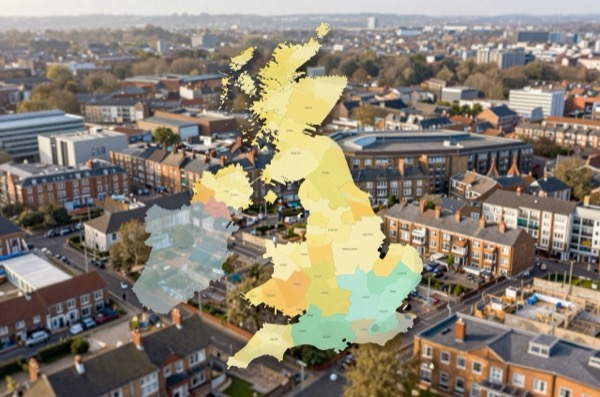
London loft conversions cost more than anywhere else in the UK, and the variation within the capital itself is substantial. A rear dormer in Havering will be priced very differently from the same job in Wandsworth or Kensington, even when the houses are structurally near-identical Victorian semis. This guide breaks down the real numbers by borough and explains what drives the difference.
Why London Costs More
Three factors push London loft conversion costs above the national average:
Labour rates: a skilled roofer or carpenter working in inner London typically earns £300–£380 per day (2026 rates), compared with £220–£260 in the Midlands. Loft conversions are labour-intensive, a rear dormer typically requires 5–8 tradespeople across 10–14 weeks, so this differential compounds quickly.
Site logistics: narrow Victorian terraces with no side access mean materials must be craned or hand-carried. Scaffolding in dense streets requires road permits (£150–£500 from the relevant highway authority) and sometimes traffic management. Skips require a licence (£60–£120 plus collection fees).
Demand and margin: London has the highest concentration of homes suitable for loft conversion in the country, and demand remains consistently strong. Contractors have less incentive to compete aggressively on price.
Conservation area compliance: large swathes of inner and south London fall within conservation areas where standard dormer forms may be refused, requiring more expensive architectural solutions or bespoke materials.
Borough-by-Borough Cost Table
The figures below are for a standard rear dormer loft conversion creating one double bedroom, including structural design, Building Regulations, all trades to decorated finish, and a conventional staircase. They exclude ensuite bathrooms, party wall surveyor fees, and furniture.
| Borough | Typical range (rear dormer, 1 bed) | Notes |
|---|---|---|
| City of London | £65,000 – £85,000 | Primarily commercial stock; residential rare |
| City of Westminster | £65,000 – £85,000 | High conservation area coverage, premium trades |
| Kensington & Chelsea | £65,000 – £90,000+ | Very high % of listed/conservation stock |
| Hammersmith & Fulham | £55,000 – £72,000 | Conservation areas around Brook Green, Ravenscourt |
| Wandsworth | £50,000 – £68,000 | High demand, Battersea/Clapham premium |
| Lambeth | £48,000 – £65,000 | Clapham/Brixton popular, conservation pockets |
| Southwark | £48,000 – £64,000 | Borough, Dulwich conservation areas |
| Islington | £55,000 – £72,000 | Very high conservation area coverage |
| Camden | £58,000 – £78,000 | Hampstead, Kentish Town conservation areas |
| Hackney | £48,000 – £64,000 | Stoke Newington conservation areas |
| Tower Hamlets | £45,000 – £60,000 | Bethnal Green, Bow terraces |
| Lewisham | £44,000 – £58,000 | Forest Hill, Blackheath |
| Greenwich | £44,000 – £60,000 | Conservation area around Greenwich town |
| Bromley | £40,000 – £54,000 | Outer borough, more parking/access |
| Croydon | £38,000 – £52,000 | Competitive market, outer zone |
| Sutton | £38,000 – £52,000 | Good supply of Victorian stock |
| Merton | £42,000 – £56,000 | Wimbledon conservation pockets |
| Kingston upon Thames | £42,000 – £56,000 | Surbiton, Kingston mix |
| Richmond upon Thames | £48,000 – £66,000 | Very high conservation coverage, Richmond/Twickenham |
| Ealing | £44,000 – £60,000 | Large stock of Edwardian semis |
| Hounslow | £40,000 – £54,000 | Chiswick conservation area adds premium locally |
| Brent | £42,000 – £58,000 | Wembley, Willesden mix |
| Harrow | £40,000 – £54,000 | Large semi-detached stock |
| Barnet | £42,000 – £58,000 | North London demand, Finchley/Edgware |
| Haringey | £44,000 – £60,000 | Wood Green, Crouch End demand |
| Enfield | £38,000 – £52,000 | Outer north, competitive |
| Waltham Forest | £40,000 – £56,000 | Walthamstow Victorian stock |
| Redbridge | £38,000 – £52,000 | Outer east |
| Newham | £40,000 – £56,000 | Post-Olympic regeneration zones |
| Barking & Dagenham | £36,000 – £48,000 | Most affordable London borough for trades |
| Havering | £36,000 – £50,000 | Romford, Hornchurch outer east |
| Bexley | £38,000 – £52,000 | Outer south-east |
Clapham, Balham, and Wandsworth in Detail
These south-west London neighbourhoods sit in Lambeth and Wandsworth boroughs respectively and represent a high-demand cluster for loft conversions, driven by a dense stock of Victorian and Edwardian terraces and high property values that make the investment worthwhile.
Clapham (Lambeth): typical rear dormer £50,000–£66,000. Several streets fall within the Clapham Old Town Conservation Area, where planners expect matching roof materials and may resist visible flat-roof dormers on front elevations. Budget an extra £1,500–£3,500 for planning application fees and potentially a pre-application advice meeting (around £300 from Lambeth LPA).
Balham (Wandsworth): typical rear dormer £50,000–£67,000. Wandsworth has one of the most active loft conversion markets in London; the council has a reasonably clear SPD on dormer design. Standard PD dormers (no larger than 40 m³ for a terraced house) typically proceed without planning consent.
Wandsworth town/Battersea: the closest zone to central London within the borough. Add £5,000–£10,000 over Balham pricing for equivalent work; contractors price in the congestion charge zone and restricted access.
Conservation Area Effects on Cost
London has over 1,000 designated conservation areas. Within them, permitted development rights for roof extensions are sometimes removed by an Article 4 Direction, meaning a planning application is required even for a rear dormer that would normally be PD. The additional cost implications are:
- Planning application fee: currently £548 for a householder application (2026 fee)1
- Drawings for planning: architectural drawings for a planning submission cost £1,200–£3,000 on top of structural drawings
- Restricted materials: planners often specify that dormer cladding must match the existing roof material (plain clay tile, slate, or lead). This can add £2,000–£6,000 over standard GRP or zinc flat-roof dormer construction
- Delay: 8-week statutory determination period, plus time to prepare the application. Budget 12–16 weeks total from submission to decision
- Risk of refusal: some conservation areas have been granted particularly restrictive policies. In the Royal Borough of Kensington & Chelsea, rear dormers in certain streets face near-certain refusal even on rear elevations
The conservation area boundary is shown on each council’s online planning map. Check before buying a property with a loft conversion in mind.
Finding Reliable London Loft Conversion Builders
London has a large number of firms operating specifically in loft conversions. Quality varies considerably. Practical filtering steps:
Check LABC registered builders: many boroughs operate Local Authority Building Control partnership schemes; a contractor who has completed multiple signed-off loft conversions in the same borough will have an established relationship with building control officers and be familiar with local preferences.
Ask for recent local completions: request two or three addresses of completed conversions within two miles of your property (not just the borough). Ask to view one. Gauge quality of finish on the staircase, plasterwork, and dormer flashings.
Get quotes from specialists not general builders: firms that do 20–30 loft conversions a year in south London will be faster and more competitive than a general builder doing their third one.
Structural engineer independence: some loft conversion companies employ in-house structural engineers. This is not inherently problematic but means you cannot independently verify calculations without appointing your own SE. For a major project, spending £900–£1,500 on an independent SE is worthwhile insurance.
Party wall notices: in London’s terrace-heavy streets, almost every loft conversion triggers the Party Wall etc. Act 1996. You must serve notice on each adjoining owner at least two months before structural works begin. Costs for a jointly appointed party wall surveyor typically run £900–£1,500 per neighbour. Some owners require their own surveyor, pushing costs to £2,000–£3,500 per neighbour.23
Is a London Loft Conversion Worth It?
At current (2026) London house prices, adding a bedroom typically adds 10–20% to market value. On a £700,000 Clapham terrace, that represents £70,000–£140,000 of potential uplift, against a conversion cost of £55,000–£65,000. The maths strongly support the investment in most inner and mid-London boroughs. The case is weaker in outer boroughs where property values are lower and the relative cost saving of moving (rather than converting) is smaller.
The calculation changes if the existing loft has poor headroom (ridge-to-ceiling below 2.0 m), the house is already near the top of the street’s value range, or a full mansard is required to create usable space, at £70,000–£90,000, the returns become marginal in lower-value outer boroughs.
References (3)
Figures in this note were checked against the sources below on 14 September 2026. Superscript numbers in the text point to them. Every source the site cites, by topic.
- 1technicalvery strongPlanning Portal, guidance.RN-M2KUCTThe Planning Portal's consolidated guide to planning application fees in England from 1 April 2026, built from the 2012 fees regulations as amended and MHCLG's annual indexation. More usable than the regulations themselves because it puts each application type next to its current fee and its definition. The statutory amounts are in the regulations; this is the readable index to them.
- 2technicalvery strongThe National Archives (legislation.gov.uk), legislation.RN-QBUTY2The exact wording of the two excavation triggers that decide whether a basement or a deep foundation needs a party wall notice, worth quoting rather than paraphrasing. Section 6(1) applies where the building owner proposes to excavate, or excavate for and erect a building or structure, within a distance of 3 metres measured horizontally from any part of a building or structure of an adjoining owner, and the excavation will within those 3 metres extend to a lower level than the level of the bottom of the neighbour's foundations. Section 6(2) applies within 6 metres measured horizontally where the work will within those 6 metres meet a plane drawn downwards in the direction of the excavation at an angle of 45 degrees to the horizontal. Section 6(5) requires the building owner to serve notice on the adjoining owner at least one month before beginning to excavate. Section 6(7) provides that if the adjoining owner does not serve a notice indicating consent within 14 days, they are deemed to have dissented and a dispute has arisen, which is what triggers the surveyor and award process.
- 3costsupplier figureSurvey of Party Wall.RN-JLADBQA price, true at 2026-09. a London party wall surveying practice publishing its own fixed fee, £950 to £1,450 per adjoining owner for a standard extension, broken into the stages it covers: site appraisal, serving the statutory notices, tracking the 14 day response, the schedule of condition, negotiating access, drafting the award and delivery, with VAT added on top. It is also the source for the point the notes most often get wrong, that the fee is per ADJOINING OWNER rather than per job, and that a neighbour who dissents and appoints their own surveyor is paid separately again by the building owner under section 10(11)
-
A guide to fees for Planning Applications in England, from 1 April 2026, Planning Portal, accessed 7 September 2026. ecab.planningportal.co.uk
-
Party Wall etc. Act 1996, section 6: Adjacent excavation and construction, The National Archives, accessed 14 September 2026. legislation.gov.uk
-
Fixed-Fee Party Wall Surveyor Cost London 2026 Guide, Survey of Party Wall, accessed 17 September 2026. Priced at 2026-09, so no calibration is needed. surveyofpartywall.co.uk