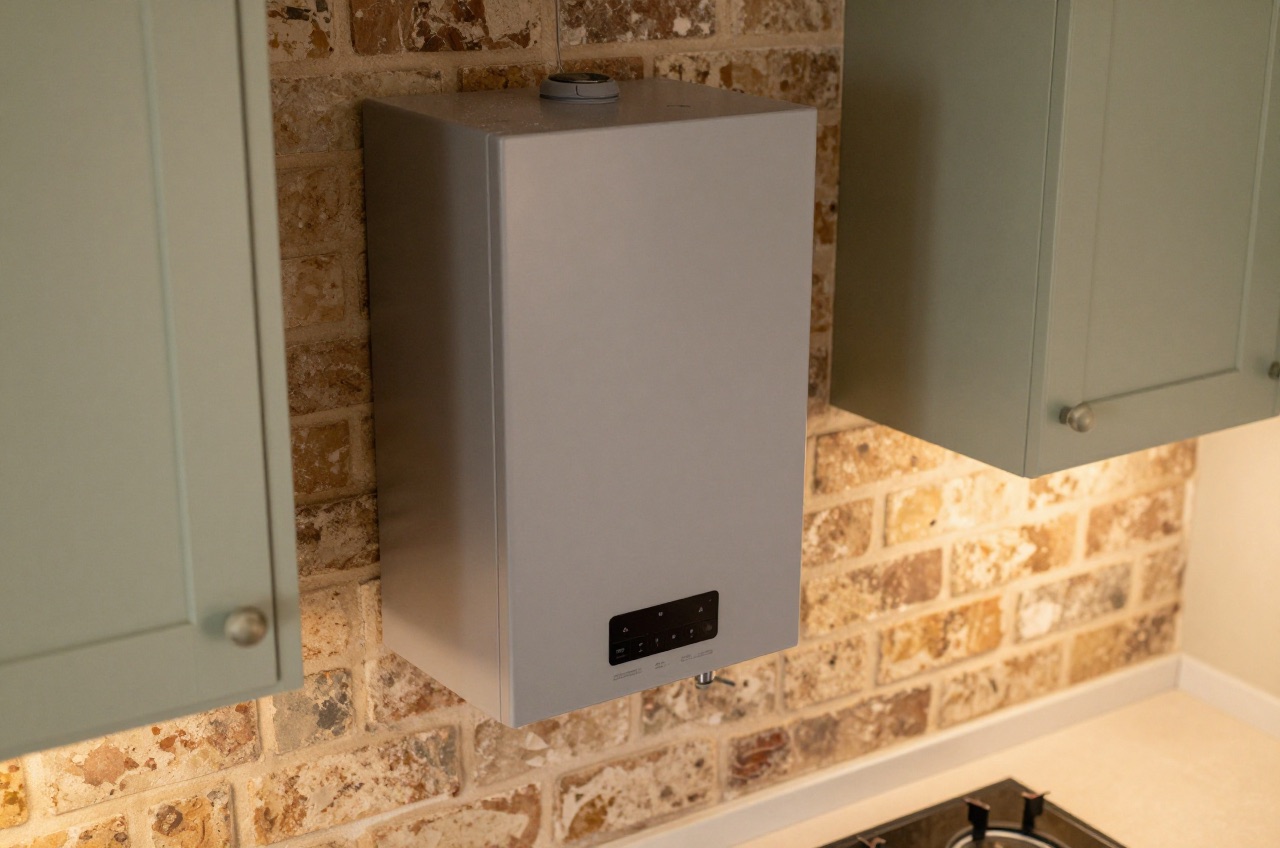
A boiler failure is usually sudden and always unwelcome, but even a planned replacement rewards careful comparison of boiler types, efficiency ratings, and installer quotes. The difference between a hasty emergency swap and a considered replacement can easily run to £1,000 or more in upfront cost, and significantly more over the boiler’s 10–15 year life in fuel bills.
For a straightforward like-for-like combi boiler swap in a three-bedroom semi, budget £1,800–£2,800 all-in from a regional firm, or £2,500–£3,500 from a national installer. Moving from a back boiler or heat-only system to a combi adds complexity: expect £2,500–£5,000 including system changes.
Boiler Types
Understanding the three main boiler types clarifies which is suitable for your property.
Combi boiler (combination)
A combi heats radiators and produces hot water on demand from the mains cold water supply, with no separate hot water cylinder or cold water tank in the loft. It is compact, fitting inside a standard kitchen unit or airing cupboard, and is the most popular choice in the UK for properties with up to three bedrooms and one bathroom.
Best suited to: smaller to medium properties; households of up to 4 people; properties where loft space is limited; conversions and flats
Limitations: hot water flow rate is limited by boiler output and mains pressure (typically 10–15 litres/minute at adequate temperature); running two showers simultaneously can cause a pressure drop; not suited to large family homes with multiple bathrooms expecting simultaneous hot water use
Combi boilers must be at least 92% efficient (ErP A-rated) under current Building Regulations.1 Leading manufacturers include Worcester Bosch (Greenstar range), Vaillant (ecoTEC), Baxi, and Ideal. A 30–35 kW output covers most three-bedroom properties comfortably.
System boiler
A system boiler heats radiators (via an expansion vessel and pump integral to the boiler) and fills a separate hot water cylinder. Mains cold water feeds the cylinder directly, so there is no cold water tank in the loft. This gives higher hot water flow rates, typically 30–60 litres/minute, making it suitable for large properties and multiple bathrooms.
Best suited to: 4+ bedroom properties; homes where hot water demand is high and simultaneous use is common; properties being upgraded from a traditional gravity-fed system where the loft tanks are being removed
Limitations: requires space for a hot water cylinder (typically 150–300 litres, needing a cupboard 500–550 mm diameter and 1,050–1,700 mm tall); hot water temperature drops if the cylinder is exhausted before it reheats (typically 25–40 minutes)
Heat-only (regular/conventional) boiler
A heat-only boiler requires both a hot water cylinder and cold water storage tanks in the loft. Almost all new replacements are of combi or system type, heat-only is only specified today where the existing gravity-fed system is sound, the household is large, or where an unvented system is not appropriate (very low mains pressure, for example).
Unvented cylinders
A system boiler can be paired with an unvented hot water cylinder (e.g. Megaflo, Range Tribune) that stores hot water at mains pressure, allowing power showers throughout the house without pumps. Unvented cylinders cost £600–£1,500 supply and must be installed by a G3-qualified engineer.2 They require an annual service and a tundish/pressure relief valve correctly routed.
Cost Breakdown
Boiler unit costs
Prices below are for the boiler unit only (supply), before installation.
| Boiler type and output | Budget brand | Mid-range | Premium |
|---|---|---|---|
| Combi 24–28 kW (2-3 bed) | £600 | £900 | £1,400 |
| Combi 30–35 kW (3-4 bed) | £750 | £1,100 | £1,700 |
| System 18–24 kW | £700 | £1,000 | £1,500 |
| System 28–35 kW | £850 | £1,300 | £1,800 |
| Heat-only 15–30 kW | £650 | £950 | £1,400 |
Installation labour costs
| Scenario | Low | Typical | High |
|---|---|---|---|
| Like-for-like combi swap (same location) | £350 | £550 | £900 |
| Like-for-like system boiler swap | £450 | £700 | £1,100 |
| Moving boiler to new location (e.g. kitchen to utility) | £700 | £1,100 | £1,800 |
| Replacing back boiler with combi (system changes required) | £1,200 | £2,000 | £3,500 |
| Full central heating installation (3-bed, 8–10 radiators) | £3,500 | £6,000 | £9,500 |
All-in replacement costs (supply and fit)
| Boiler type | 2-bed flat / small house | 3-bed semi | 4-bed detached |
|---|---|---|---|
| Combi (mid-range brand) | £1,600–£2,400 | £2,000–£3,000 | £2,500–£4,000 |
| System + cylinder | £2,500–£4,000 | £3,000–£5,000 | £4,000–£7,000 |
| Premium combi (Worcester, Vaillant) | £2,200–£3,200 | £2,800–£4,000 | £3,500–£5,500 |
National comparison-site installers (British Gas, HomeServe, Boxt) typically quote at the higher end of the ranges above; local Gas Safe registered sole traders or small firms typically quote 20–35% below.
Combi vs System Boiler: Which to Choose?
| Factor | Combi | System + cylinder |
|---|---|---|
| Hot water flow rate | 10–15 l/min (dependent on boiler size) | 30–60 l/min (mains pressure) |
| Simultaneous use (2+ showers) | May drop pressure | Handles comfortably |
| Space required | Boiler only (600 × 400 × 300 mm typical) | Boiler + cylinder (300–500 litres) |
| Mains pressure required | 1.5 bar minimum | 1.5 bar minimum |
| Installation cost | Lower | Higher (cylinder, zone valves) |
| Running cost | Similar if same efficiency | Similar; system may be slightly more efficient at full load |
| Hot water wait time | Instant (cold start) | Instant from stored cylinder |
| Recovery after peak use | Continuous (no storage limit) | 25–40 min to reheat cylinder |
| Suitability for solar thermal | Poor (no cylinder to store solar heat) | Excellent, add solar coil cylinder |
| Suitability for heat pump | Not ideal, heat pumps prefer low-temperature systems with cylinders | Better, but a dedicated heat pump cylinder is preferred |
What the Installation Should Include
A competent Gas Safe installation for a like-for-like swap should include:
- Removal and safe disposal of the old boiler
- Fitting the new boiler with all new fittings, filling loop, and pressure gauge
- Magnetic filter (Adey MagnaClean or equivalent), this is not optional; installation without a filter voids most manufacturers’ warranties within a short period
- Scale reducer or inhibitor if the property is in a hard water area (hardness above 200 mg/l CaCO³, check your water supplier’s data)1
- Chemical flush of the system using a power flushing machine (£150–£400 extra for a full flush if sludge is present) or a chemical clean for cleaner systems
- Flue extension and terminal to current safety distances (300 mm from any opening window, 600 mm from any surface facing the terminal)3
- Gas tightness test, combustion analysis, and completion certificate
- Building Regulations compliance certificate via Gas Safe Register4
A completion certificate is a legal requirement. The Gas Safe engineer self-certifies under the Competent Person Scheme.5 This certificate is required when selling the property.
When to Consider a Heat Pump Instead
The Boiler Upgrade Scheme (BUS) currently provides a £7,500 grant toward an air source heat pump installation in England and Wales (as of June 2026).67 If your property has loft insulation of at least 100 mm, cavity or solid wall insulation, and windows that are at least double-glazed, a heat pump may now be cost-competitive on a 10-year total-cost-of-ownership basis.
An air source heat pump costs £8,000–£16,000 installed before the grant, reducing to £500–£8,500 after. Running costs depend heavily on electricity tariffs, the heat pump’s COP (3.0–4.5 for modern units at UK winter temperatures), and whether the heating system is optimised for low-temperature operation (wet UFH or fan coils rather than standard radiators).
Heat pumps are not appropriate for every property in 2026, properties with poor insulation fabric, inefficient radiators, or single-phase electrical supply that cannot support a 3–9 kW heat pump may not see the expected savings. An independent MCS-certified heat pump survey (often free from installers, or available at £300–£500 from independent surveyors) is the starting point.
Boiler Warranties and Servicing
Most mid-range boilers come with a 2-year manufacturer’s warranty as standard, extendable to 5, 7, or 10 years when installed by an accredited installer and registered within 30 days of installation. Premium manufacturers (Worcester Bosch, Vaillant) offer up to 12 years’ parts and labour warranty on some models when installed by their Platinum/Gold accredited networks, this is worth factoring into the total cost of ownership.
Annual servicing costs £70–£150 from a local Gas Safe engineer and is required by most manufacturer warranties and recommended by Gas Safe for safety. Service contracts from national companies run £150–£350/year including a breakdown cover element.
A boiler that is serviced annually and has a quality magnetic filter fitted typically lasts 12–15 years; one that is not serviced frequently fails in 8–10 years.
References (7)
Figures in this note were checked against the sources below on 7 September 2026. Superscript numbers in the text point to them. Every source the site cites, by topic.
- 1technicalvery strongHM Government (GOV.UK).RN-IHEXOXThe full Approved Document L Volume 1 for dwellings, 2021 edition with the 2023 amendments, for use in England. This is the statutory guidance on conservation of fuel and power: the U-value tables for new and replacement elements, the rules on when an existing element must be upgraded, controls and commissioning for heating systems, and the notification requirements. If a note quotes a target U-value for a wall, roof, floor, window or door, this is where the number comes from.
- 2technicalvery strongMinistry of Housing, Communities and Local Government.RN-YAW64MRequirement G3(4) states the hot water supply to any fixed bath must be designed so the water delivered to that bath cannot exceed 48 degrees C; paragraph 3.65 says this is achieved with an in-line blending valve or other temperature control device with a maximum temperature stop, and 3.66 accepts valves to BS EN 1111:1999 or BS EN 1287:1999 that fail safe. G3(3) requires unvented storage vessels to prevent stored water exceeding 100 degrees C and to convey safety discharge somewhere visible and safe. Regulation 36 and Requirement G2 cap potential consumption in a new dwelling at 125 litres per person per day, or the optional 110 litres per person per day where a planning condition specifies it; G2 applies only to dwellings erected or formed by material change of use. Sections G4 sanitary conveniences, G5 bathrooms and G6 food preparation areas set scale of provision.
- 3technicalvery strongMinistry of Housing, Communities and Local Government.RN-IU0X2MThe 2022 amendments took effect 1 October 2022 and extended the carbon monoxide alarm provisions. Table 2 sets the minimum flue sizes: 200mm diameter for a fireplace with an opening up to 500mm by 550mm, 125mm diameter for a closed appliance up to 20kW burning smokeless or Clean Air Act compliant fuel, 150mm for other closed appliances up to 30kW and 175mm for those above 30kW and up to 50kW. Diagram 17 gives the flue outlet clearances: at or within 600mm of the ridge the outlet must be at least 600mm above the ridge, elsewhere on a roof it must be at least 2300mm horizontally from the nearest weather surface and either 1000mm above the intersection or as high as the ridge, and it must be 1000mm above the top of any openable rooflight or dormer within 2300mm. Bends must be no more than 45 degrees to the vertical and paragraph 1.49 limits a sweepable flue to four changes of direction.
- 4technicalstrongGas Safe Register, guidance.RN-3GZ0JEGas Safe Register's consumer factsheet on notification of gas work in England and Wales, revised April 2016. Explains which gas work must be notified to building control, that a registered engineer does this through the scheme, and what certificate the householder should receive afterwards. The page blocks automated fetching, so it is described from its title and publisher.
- 5technicalvery strongGOV.UK, a government page.RN-FM4G39The official list of competent person schemes and what each one covers, plus what self-certification means: a registered installer certifies their own work as compliant and notifies building control, instead of the council inspecting it. This is the source for which trades can self-certify what, which is why a FENSA or Gas Safe registered installer does not need a separate building notice.
- 6technicalvery strongGOV.UK.RN-9EFNVZThe grant values: £7,500 towards an air source heat pump, £7,500 towards a ground source heat pump including water source heat pumps and those on shared ground loops, and £5,000 towards a biomass boiler. A further £1,500 is available until March 2027 where the property is heated by oil or LPG and has no mains gas connection. Only one grant is available per property. Capacity limits are 45kWth for an individual system, 70kWth for multiple heat pumps and 300kWth for shared ground loops. Hybrid systems pairing a gas boiler with a heat pump are not eligible, and an existing low carbon heating system cannot be replaced under the scheme.
- 7technicalvery strongGOV.UK, a government page.RN-DJPZSBThe Boiler Upgrade Scheme application page: the grant amounts for an air source heat pump, ground source heat pump and biomass boiler, who is eligible, and the fact that the installer applies on the householder's behalf rather than the householder claiming it back. This is the official statement of the grant, so it is the figure to use rather than an installer's summary of it.
-
Approved Document L, Conservation of fuel and power, Volume 1: Dwellings, 2021 edition incorporating 2023 amendments, HM Government (GOV.UK), accessed 7 September 2026. assets.publishing.service.gov.uk
-
Approved Document G: Sanitation, hot water safety and water efficiency (2015 edition incorporating 2016 and 2024 amendments), HM Government (GOV.UK), accessed 7 September 2026. assets.publishing.service.gov.uk
-
Approved Document J: Combustion appliances and fuel storage systems (2010 edition incorporating 2010, 2013 and 2022 amendments), HM Government (GOV.UK), accessed 7 September 2026. assets.publishing.service.gov.uk
-
Notification of gas work in England & Wales (consumer factsheet, revised April 2016), Gas Safe Register, accessed 7 September 2026. gassaferegister.co.uk
-
Competent person schemes, GOV.UK, accessed 7 September 2026. gov.uk
-
Apply for the Boiler Upgrade Scheme: What you can get, GOV.UK, accessed 7 September 2026. gov.uk
-
Apply for the Boiler Upgrade Scheme: Overview, GOV.UK, accessed 7 September 2026. gov.uk