The roofing material you choose affects not just aesthetics but cost, structural requirements, maintenance burden, lifespan, and planning acceptability. UK roofs work across a wide range of pitches, exposures, and architectural styles, no single material is right for every situation.
This guide covers every material type you are likely to consider for a UK domestic roof in 2026, with real cost and performance data.
Pitched Roof Materials
Natural Slate
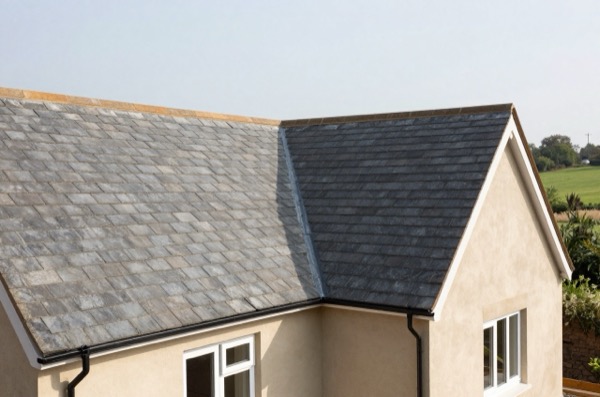
Natural slate is the premium standard for pitched roofs in the UK, used on everything from Victorian terraces to contemporary self-builds. Most UK natural slate is imported from Spain (Cupa, Galician) or Wales (Ffestiniog, Penrhyn). Welsh slate carries a heritage premium and is frequently required by planners in conservation areas in Wales and the Pennines.
Specification: Slates are typically 500 × 250 mm or 600 × 300 mm, 4–8 mm thick, fixed with stainless steel nails through two holes near the head. Minimum pitch: 20° (22.5° is safer for exposed locations).
Weight: 25–35 kg/m², heavier than concrete tile, so structural adequacy should be confirmed for older buildings where it is replacing a lighter material.
Installed cost: £130–£220/m² (slope area). Welsh slate sits at £170–£260/m² due to scarcity and planning demand.1
Lifespan: 80–150 years if well fixed and pointed. Individual slates can crack and slip but are easily replaced.
Maintenance: Annual inspection recommended. Replace slipped or cracked individual slates promptly, water ingress at a single defect will damage battens and eventually rafters beneath.
Clay Plain Tiles
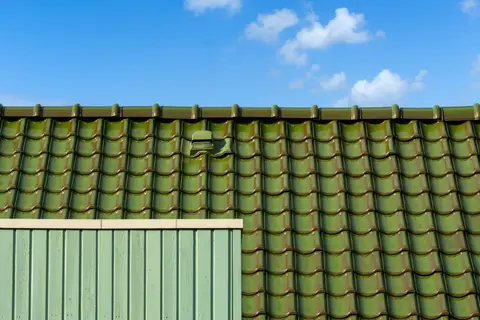
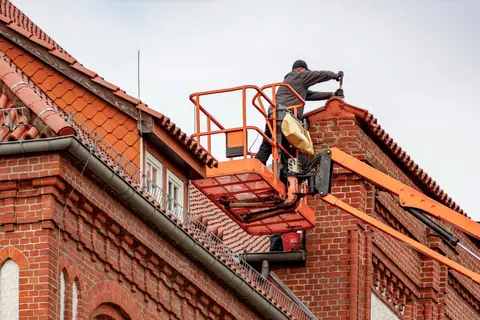
Clay plain tiles (typically 265 × 165 mm) are the traditional pitched roof tile of southern England, used on Victorian, Edwardian, and Georgian properties throughout the Home Counties, Sussex, and Kent. Double-lap fixing means excellent weather resistance even at pitches as low as 35°.
Weight: 70–85 kg/m², significantly heavier than most alternatives. Confirm structural capacity before specifying on an existing building.
Installed cost: £100–£160/m².
Lifespan: 60–100+ years. Some Victorian clay tile roofs are still on their original tiles; the weak point is usually the mortar-bedded ridge and hip.
Maintenance: Relatively low. Individual tile replacement is straightforward. Ridge repointing every 20–30 years.
Concrete Interlocking Tiles
The dominant material for UK housing since the 1960s, concrete interlocking tiles (e.g., Marley Modern, Redland 49) offer good value and reliable performance. Available in a wide range of profiles and colours, though colour fades over time and the surface granules can erode on cheaper products.
Specification: Typical size 420 × 330 mm; single-lap system means lower batten counts and faster installation than plain tiles.
Weight: 40–55 kg/m².
Installed cost: £80–£120/m².
Lifespan: 40–60 years in good conditions; many 1970s installations are now approaching end of life.
Minimum pitch: Varies by profile; most standard profiles require 17.5°–22.5° minimum.
Maintenance: Ridge mortar repointing after 20–30 years; individual tile replacement possible but matching older profiles can be difficult once discontinued.
Fibre Cement Slate
A manufactured alternative to natural slate, fibre cement slates (e.g., Cedral, Marley Eternit Thrutone) are lighter, more uniform, and cheaper. They are accepted by most planning authorities as a reasonable match for natural slate in many (though not all) conservation areas.
Weight: 18–25 kg/m², the lightest pitched roofing option, making them suitable for loft conversions and structures where loading is a concern.
Installed cost: £90–£140/m².
Lifespan: 30–50 years.
Appearance: Close to natural slate at distance; planning officers sometimes require samples to assess acceptability.
Metal Tile and Sheet Roofing
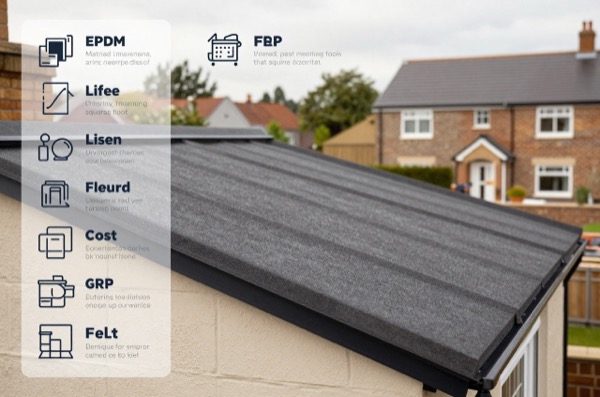
Steel and aluminium roofing systems are increasingly used in UK residential construction, both as standing-seam flat/low-pitch systems and as pressed metal tiles. Lindab, Ruukki, and similar manufacturers offer profiled metal systems suitable from 3° pitch upward.
Standing-seam (low pitch / flat): Installed cost £120–£200/m². Lifespan 40–60 years. Suitable from 1.5° pitch. Ideal for contemporary extensions and garden rooms.
Pressed metal tiles: £80–£130/m². Resemble natural slate or plain tile from a distance. Lifespan 40–60 years. Very lightweight (4–8 kg/m²), increasingly popular for loft conversions and extensions.
Flat Roof Materials
GRP (Glass Reinforced Plastic / Fibreglass)
GRP is the most popular flat roofing system for domestic extensions in the UK in 2026. A continuous glass-fibre laminate is laid over a plywood deck and finished with a coloured gel coat. Because it is laid wet and cures in situ, it forms a completely seamless waterproof skin.
Installed cost: £70–£120/m² (plan area).
Lifespan: 25–40 years. The gel coat may need refreshing after 15–20 years.
Weight (when cured): 3–5 kg/m², adds almost nothing to structural load.
Best use: Extensions up to around 100 m² plan area; larger areas may require expansion joints. Not suitable for rooftop terraces intended for regular foot traffic without appropriate surface protection.
EPDM (Ethylene Propylene Diene Monomer) Rubber
EPDM is a single-ply rubber membrane, typically 1.2 mm or 1.5 mm thick, bonded or mechanically fastened to a plywood or OSB deck. Available in very large sheets (reducing joint count), it is extremely puncture-resistant and UV-stable.
Installed cost: £65–£100/m².
Lifespan: 25–35 years; some EPDM roofs have performed for 50+ years.
DIY potential: Moderate, bonded EPDM systems are available to competent DIYers, though professional installation is recommended for complex perimeters.
Best use: Garages, outbuildings, extensions. Increasingly popular as an alternative to GRP.
Torch-On Felt (3-Layer System)
Traditional felt roofing uses three layers of bitumen-modified felt, the top layer surfaced with mineral granules, torch-applied to fuse the layers together. Modern SBS (styrene-butadiene-styrene) modified felt outperforms old-fashioned built-up felt significantly.
Installed cost: £50–£80/m².
Lifespan: 15–20 years for a quality 3-layer system; less for cheaper single-layer products.
Best use: Budget applications where medium-term performance is acceptable; not recommended for roofs that are difficult to access for maintenance.
Liquid-Applied Systems
Two-component polyurethane or PMMA (polymethyl methacrylate) liquid membranes (e.g., Kemper 2K-PUR, Sika Comfortplan) are applied by roller or spray and cure chemically in situ. They conform to any geometry, ideal for complex roof shapes, penetrations, and detail areas.
Installed cost: £90–£140/m².
Lifespan: 25–30 years.
Best use: Complex roof geometry with many penetrations; refurbishment over existing built-up felt; green/sedum roofs as the waterproofing layer.
Full Comparison Table
| Material | Type | Cost/m² installed | Lifespan | Weight (kg/m²) | Min Pitch |
|---|---|---|---|---|---|
| Natural Welsh slate | Pitched | £170–£260 | 100–150 yrs | 30–35 | 20° |
| Natural Spanish slate | Pitched | £130–£220 | 80–120 yrs | 25–35 | 20° |
| Clay plain tile | Pitched | £100–£160 | 60–100 yrs | 75–85 | 35° |
| Concrete interlocking tile | Pitched | £80–£120 | 40–60 yrs | 40–55 | 17.5° |
| Fibre cement slate | Pitched | £90–£140 | 30–50 yrs | 18–25 | 20° |
| Pressed metal tile | Pitched | £80–£130 | 40–60 yrs | 4–8 | 12° |
| Standing-seam metal | Low pitch | £120–£200 | 40–60 yrs | 5–10 | 1.5° |
| GRP fibreglass | Flat | £70–£120 | 25–40 yrs | 3–5 | 0–5° |
| EPDM rubber | Flat | £65–£100 | 25–35 yrs | 2–4 | 0–5° |
| 3-layer torch-on felt | Flat | £50–£80 | 15–20 yrs | 3–6 | 0–5° |
| Liquid-applied | Flat/complex | £90–£140 | 25–30 yrs | 2–4 | 0–5° |
Planning and Conservation Considerations
In conservation areas and for listed buildings, the choice of roofing material is often constrained by planning requirements. Common requirements include:
- Welsh slate in areas where Welsh slate was historically used (North Wales, parts of the Pennines)
- Clay plain tiles in tile-hung areas of Kent and Sussex
- Matching material for any like-for-like replacement on a listed building (consent required)
- No fibre cement slate in some strictly controlled conservation areas (check with the local planning authority before specifying)
For permitted development extensions, the material must be of “similar appearance” to the existing house, this is a judgement the local authority can make. When in doubt, submit a prior approval application or seek pre-application advice.2
References (2)
Figures in this note were checked against the sources below on 14 September 2026. Superscript numbers in the text point to them. Every source the site cites, by topic.
- 1costsupplier figureBuy Roof Slate.RN-CB8REPA price, true at 2026-01. A slate supplier's 2026 breakdown of what a slate roof costs: slate by origin, Welsh against Spanish and Brazilian, then labour, scaffolding and the total by property size and per square metre. A merchant that sells slate, so the material prices are their own published figures and the labour and scaffold elements around them are estimates rather than evidence.
- 2technicalvery strongThe National Archives, legislation.RN-OWGIY3Schedule 2 Part 1 of the GPDO 2015, development within the curtilage of a dwellinghouse. This is permitted development itself: Class A enlargement and alteration, with the limits and conditions, through the classes covering roof alterations, porches, outbuildings and hard surfaces. Every statement about what can be built without planning permission traces to this Part, and the exclusions at the start of each class are where most projects actually fall out.
-
Slate Roof Cost 2026: Full UK Price Guide, Buy Roof Slate, accessed 11 September 2026. Priced at 2026-01, so no calibration is needed. buyroofslate.co.uk
-
The Town and Country Planning (General Permitted Development) (England) Order 2015, Schedule 2, Part 1, The National Archives, accessed 14 September 2026. legislation.gov.uk