A full house rewire is one of the more disruptive and expensive renovation tasks, but for homes with old or deteriorating wiring it is not optional, it is a safety requirement. Costs are frequently misunderstood because the electrical work itself is only part of the total spend; making good plasterwork, ceilings, and decoration after the cable runs are installed adds a significant sum that is routinely omitted from quotes.
What Does a House Rewire Involve?
A full rewire replaces all the fixed electrical wiring in a property: the consumer unit (fuse box), all circuits, cables, sockets, switches, light fittings, and connection points. The process typically involves:
- Isolating and removing old wiring
- Chasing channels (grooves) into plaster or notching timber joists to run new cables
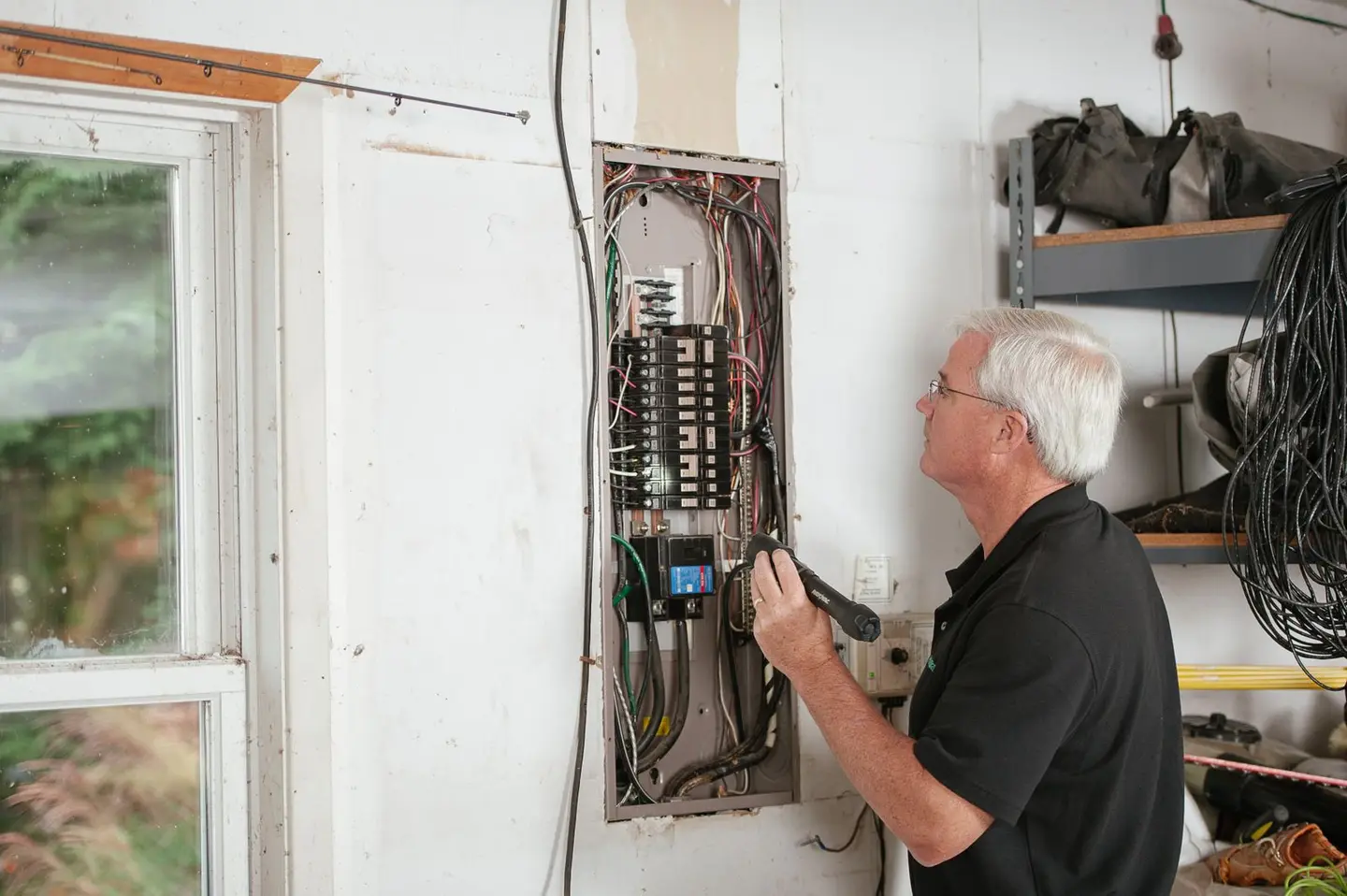
- Installing a new consumer unit with RCDs (residual current devices) and MCBs (miniature circuit breakers) to current BS 7671 standards1
- Running new circuits: ring main (sockets), radial circuits (kitchen appliances, electric shower, cooker), lighting circuits, outdoor circuits
- First fix: cables in place but not yet connected to sockets/switches
- Plasterer makes good chases and any other damaged surfaces
- Second fix: sockets, switches, light fittings installed and connected
- Testing and certification (a BS 7671 Electrical Installation Certificate from the electrician, plus a Building Regulations compliance certificate)2
A full rewire requires a minimum of two visits by a qualified electrician, often more for larger properties, and a plastering visit between the first and second fix.
Signs You Need a Rewire
Not every property needs a full rewire. Some indicators that yours might:
Age of wiring:
- Rubber-insulated wiring (pre-1960s): Rubber degrades over time and becomes brittle and cracked. This is a fire risk. Full rewire required.
- Aluminium wiring (1960s–1970s): Used briefly as a copper alternative; aluminium expands and contracts differently, causing loose connections. Replace on safety grounds.
- Single earth cables / no earth (pre-1966): Un-earthed wiring is unsafe and cannot support modern RCDs. Full rewire needed.
- Round-pin sockets, Bakelite switches: Visual indicators of pre-1947 wiring, require full rewire.
- PVC wiring with no RCD protection (common 1970s–1990s): Wiring may be serviceable but consumer unit should be upgraded; a full rewire may not be necessary.
Physical condition:
- Scorch marks around sockets or switches
- Sockets or switches that are warm to the touch
- Frequently tripping circuits or blown fuses
- Visible bare wire, cracked insulation, or taped-up junctions
- Extensions and adapters used extensively throughout (insufficient circuits for modern demand)
Survey findings:
- An EICR (Electrical Installation Condition Report) rated C1 (danger) or C2 (potentially dangerous) on multiple items usually indicates a rewire is more economical than piecemeal repairs3
House Rewire Cost by Number of Bedrooms (UK 2026)
These are total costs for the electrical work only (supply + labour), excluding plastering, decoration, and any additional specialist work.
| Property size | Rewire cost (electrical only) | Typical duration |
|---|---|---|
| 1-bed flat or studio | £2,500–£4,5004 | 3–5 days |
| 2-bed house | £3,500–£6,000 | 4–6 days |
| 3-bed house | £5,000–£8,500 | 5–8 days |
| 4-bed house | £7,000–£11,000 | 7–10 days |
| 5-bed house | £9,000–£14,000 | 8–12 days |
| 5-bed house, large or with outbuildings | £12,000–£18,000+ | 10–15 days |
The cited prices in this table were published in 2023 and brought to 2026. What that means.
Regional variation is significant. London and South East rates are typically 25–40% above these figures. Scotland, Wales, and Northern England are broadly in line with or slightly below the mid-range above.
Factors that increase cost:
- Solid brick walls (versus timber-frame or stud-work), harder and slower to chase
- Lath and plaster ceilings, fragile; requires more care and more making good
- High-spec finish requirements (flush metal sockets, bespoke plates, smart-home systems)
- Additional circuits: EV charger (£400–£800 extra), solar PV connection, underfloor heating
- Outbuildings, garages, or external circuits
- Large or complex consumer unit (more circuits = more materials and time)
Total Cost Including Making Good
Making good after a rewire is often budgeted as an afterthought but it represents a substantial portion of total expenditure. Electricians chase plaster, drill through ceilings and walls, lift floorboards, and cut through skirting boards. Restoring all of this to a decorated finish is not included in an electrical quote unless explicitly stated.
| Making good scope | Typical additional cost |
|---|---|
| Patching chases (no full replastering) | £600–£1,500 |
| Full replastering of 2-3 rooms (where chasing is extensive) | £2,000–£4,500 |
| Full interior decoration after replastering | £2,500–£6,000 |
| Combined rewire + make good + decorate (3-bed house) | £10,000–£18,000 total |
An occupied property is extremely disruptive to rewire. Most electricians will advise having the work done when the property is vacant or during a broader renovation programme where making good and decoration are already planned. Attempting to rewire around occupants while minimising damage is possible but adds time and therefore cost.
The Process in More Detail
Consumer Unit Replacement
Even if a full rewire is not needed, an old consumer unit (fuse box) with rewirable fuses or an older MCB board without RCD protection should be upgraded. A consumer unit replacement typically costs:
- Standard dual-RCD consumer unit replacement: £400–£700 supply + labour
- RCBO consumer unit (individual protection per circuit): £600–£1,000
- Including certification
A consumer unit replacement triggers Part P notification and must be carried out by a registered electrician or notified to Building Control.2
First Fix
After the consumer unit is removed and old wiring stripped out, new cables are run. Standard modern cable is twin-and-earth flat PVC (e.g. 2.5 mm² for ring mains, 1.5 mm² for lighting, 4 mm² for electric shower circuits, 6 mm² or 10 mm² for cooker circuits). Cables run in chases in plaster walls, in conduit, or clipped to joists.
Testing and Certification
On completion, the installation is tested against BS 7671 (the IET Wiring Regulations).1 The electrician issues a BS 7671 Electrical Installation Certificate (EIC) for the work, and where they are a registered competent person their scheme issues you a Building Regulations compliance certificate within 30 days and registers the work with the local authority.2 You should always receive a signed EIC, this is essential documentation for property sales and insurance.
Building Regulations: Part P
All fixed electrical work in dwellings in England falls under Part P of the Building Regulations, but only certain work is notifiable.2 There are two compliance routes:
-
Registered competent person: An electrician registered with NICEIC, NAPIT or another scheme authorised by government can self-certify their work. This is the standard route for domestic rewires. The homeowner receives an EIC and the work is registered automatically.
-
Building Control notification: If an unregistered person carries out notifiable work (rare for a full rewire), they must notify the local authority Building Control before starting. BC will inspect and issue a completion certificate. This route costs extra (Building Control fee: typically £200–£500) and is slower.
What is notifiable: A full rewire is always notifiable. Consumer unit replacement is notifiable. Adding a new circuit is notifiable. Minor work (replacing a socket, adding a spur off an existing circuit) is generally not notifiable.2
Part P and property sales: Mortgage lenders and solicitors routinely require evidence of Part P compliance for electrical work done since 2005. Missing certificates can delay or complicate a sale. If you buy a property where work was done without a certificate, you can obtain a retrospective EICR (typically £200–£400) which, if satisfactory, provides similar comfort.
Getting Quotes
When obtaining quotes for a rewire, ensure each quote specifies:
- Whether it includes consumer unit replacement (it should)
- The number of circuits, sockets, and light fittings being installed
- Whether the quote is for first and second fix (it should be)
- Whether making good is included or excluded (most exclude it)
- Whether the Electrical Installation Certificate and Part P notification are included
- The type of consumer unit and brand of accessories
Three quotes are advisable. The cheapest quote is not always the best value, an electrician who works quickly and tidily, minimising plaster damage, can save £1,000–£2,000 in making good even if their electrical quote is slightly higher.
Is a Rewire Worth It?
A full rewire adds demonstrable value to a property with old wiring, both in sale price and in insurance premiums. Insurers increasingly apply premium loading or exclusions to properties with documented old wiring; a rewire with a clean EIC resolves this.
For rental properties, there is a mandatory requirement for an EICR (Electrical Installation Condition Report) at least every 5 years (with a copy of the latest report given to each new tenant), and any C1 or C2 items must be remediated within 28 days.3 A landlord whose EICR returns multiple C2 findings is likely spending more on piecemeal remediation than a full rewire would cost.
The return on investment for a full rewire in a property that needs it, measured in safety, insurance, sale value, and regulatory compliance, consistently justifies the expenditure.
References (4)
Figures in this note were checked against the sources below on 7 September 2026. Superscript numbers in the text point to them. Every source the site cites, by topic.
- 1technicalstrongInstitution of Engineering and Technology, a standard.RN-OO3I37The IET's home page for BS 7671, the Wiring Regulations, currently the 18th Edition with amendments. BS 7671 is the standard every domestic electrical installation is designed, inspected and certified to, and compliance with it is how Part P of the Building Regulations is normally satisfied. The standard itself is paid; this page carries the amendment status, model forms and technical guidance.
- 2technicalvery strongMinistry of Housing, Communities and Local Government.RN-JYJ3I5The document that decides what electrical work a homeowner may legally do themselves, and the exact list of notifiable jobs. Regulation 12(6A), reproduced at paragraph 2.5, makes only three things notifiable: the installation of a new circuit, the replacement of a consumer unit, and any addition or alteration to existing circuits in a special location. Regulation 12(9) defines special location as, in a room containing a bath or shower, the zone extending vertically from finished floor level to 2.25 metres (or the shower head position if higher) and horizontally 600mm from the edge of the bath tub or shower tray. Paragraph 2.7 states that all other electrical installation work is not notifiable, namely additions and alterations to existing installations outside special locations, and replacements, repairs and maintenance anywhere. Paragraph 2.8 gives worked examples: a built-in cooker is not notifiable unless a new cooker circuit is needed, and connecting an electric gate or garage door to an existing isolator is not notifiable but running a new circuit from the consumer unit to that isolator is. Paragraph 2.2 confirms Part P reaches outdoor work including fixed garden lighting, pond pumps and outbuildings such as sheds, detached garages and domestic greenhouses. Notifiable work must be certified by self-certification by a registered competent person, third-party certification, or a building control body (paragraph 3.1), with the compliance certificate issued within 30 days (paragraph 3.4). Note that Approved Document P is a source of guidance rather than a ban: non-notifiable work still has to comply with BS 7671.
- 3technicalvery strongMinistry of Housing, Communities and Local Government, guidance.RN-IUHGG0The definitive figures for an EICR note. The electrical installation must be inspected and tested at least every 5 years by a qualified person competent to undertake the inspection and testing, against the 18th Edition of the Wiring Regulations published as British Standard 7671. The report must go to existing tenants within 28 days of the inspection and test, to new tenants before they occupy the premises, and to the local council within 7 days of a request. Remedial work must be completed within 28 days, or any shorter period specified as necessary in the report. The observation codes are C1 danger present with risk of injury, C2 potentially dangerous, C3 improvement recommended and not mandatory, and FI further investigation required without delay. A local housing authority can impose a financial penalty of up to £40,000.
- 4coststrong locallyRoyal Borough of Greenwich, Housing and Safer Communities, a government page.RN-SXB1KMA price, true at 2023-06, brought forward on the Construction Output Price Index. The priced schedules from a London borough's capital programme delivery contract with its contractor, published as a spreadsheet. Genuine competitively tendered rates for housing works at real scale, which is rare to see in public. Read them as contract rates for volume work under a framework, which is a different market from a homeowner buying one job.
-
BS 7671 - 18th Edition, Institution of Engineering and Technology, accessed 7 September 2026. electrical.theiet.org
-
Approved Document P: Electrical safety - Dwellings (2013 edition), HM Government, accessed 7 September 2026. assets.publishing.service.gov.uk
-
Electrical safety standards in the private and social rented sectors: guidance, Ministry of Housing, Communities and Local Government, accessed 7 September 2026. gov.uk
-
Equans pricing schedules, Royal Borough of Greenwich Capital Programme Delivery Contractors contract SPS-2686, Document 4 Pricing Schedules, Royal Borough of Greenwich, Housing and Safer Communities, accessed 18 September 2026. Priced at 2023-06; brought to 2026 on the Construction Output Price Index, housing repair and maintenance (Great Britain), published by Office for National Statistics, a factor of 1.0358. royalgreenwich.gov.uk